
When Should Ticket Sales Start for Your Event?
The best time to start ticket sales is the point where your audience has enough information to commit and your team has enough runway to build demand. For some events, that is two weeks before doors open. For others, especially conferences, festivals, destination events, or higher-priced shows, it may be six months or more.
A good on-sale date is not just a date on a calendar. It affects cash flow, marketing momentum, production confidence, and how urgently people act when they see your event. Start too early and buyers may ignore it because the event feels distant. Start too late and you may create stress for your team, your artists, your sponsors, and your budget.
So when should ticket sales start for your event? Use the framework below to choose a timing window that fits your audience, your event type, and your financial risk.
The short answer: most events should start ticket sales 4 to 12 weeks before the event
For many small and mid-size events, the sweet spot is 4 to 12 weeks before event day. That usually gives you enough time to announce, test demand, adjust promotion, and build urgency without asking buyers to commit too far in advance.
There are exceptions. A local club night with a loyal audience may sell well with a 10 to 21 day window. A festival, conference, or major concert may need 4 to 9 months because attendees need to plan travel, request time off, coordinate with friends, or justify a higher ticket price.
Think of your on-sale date as the start of a campaign, not just the moment checkout opens. If you want a deeper planning system for the full calendar, TixFlow’s guide on how to set ticket sale dates for maximum momentum is a useful companion. This article focuses specifically on choosing the right launch window.
Recommended ticket sales start dates by event type
The right answer depends heavily on how much planning your audience needs. A $15 local DJ set and a $450 industry conference do not have the same buying cycle.
| Event type | Recommended sales start | Why this timing works | Watch out for |
|---|---|---|---|
| Weekly club night or recurring party | 10 to 21 days before | Local audiences often decide late, especially for familiar formats | Starting too early can dilute urgency |
| One-off local concert, DJ night, or listening party | 3 to 6 weeks before | Enough time to promote while keeping the event close enough to feel real | Weak launch assets can slow early sales |
| Mid-size concert or touring artist show | 6 to 12 weeks before | Fans need notice, artists need promo time, and paid ads may need testing | Waiting too long can limit group planning |
| Workshop, class, or professional meetup | 4 to 10 weeks before | Buyers need to understand the outcome and fit it into their schedule | Too many ticket options can confuse buyers |
| Conference, business event, or summit | 3 to 6 months before | Attendees may need approval, travel planning, and budget allocation | Long campaigns need clear sales phases |
| Festival or multi-day event | 4 to 9 months before | Travel, accommodation, and lineup announcements require more runway | Early sales need strong trust signals |
| Fundraiser, gala, or seated dinner | 8 to 14 weeks before | Guests often coordinate tables, sponsors, and formal plans | Capacity planning matters early |
These are not rigid rules. They are starting points. The best organizers adjust based on audience behavior, brand strength, pricing, and how much cash they need before event day.
Five questions to ask before tickets go live
Before you decide when ticket sales start, check whether your event is ready to convert attention into purchases. A rushed launch can waste your strongest announcement moment.
Is the core offer confirmed? Buyers should know the date, location, start time, main attraction, and what is included. If the venue, lineup, speakers, or experience details are still vague, consider announcing the event first and opening sales later.
How warm is your audience? If you already have a strong email list, artist fanbase, community, or social following, you can start closer to the event and still move quickly. If you are building awareness from scratch, you need a longer runway.
How much does the ticket cost? Higher prices require more time and more trust. A $20 ticket can be an impulse purchase. A $300 ticket may need repeated exposure, social proof, payment coordination, or employer approval.
Do attendees need to coordinate with other people? Group plans take longer. Concert crews, birthday groups, team outings, sponsor tables, and travel groups all need time to decide.
Do you need ticket revenue to fund production? If ticket income helps cover deposits, marketing, staffing, artist fees, rentals, or venue payments, starting earlier can reduce pressure. This is especially important for independent organizers and music producers who cannot float large costs for months.
Starting too early vs. starting too late
A common mistake is assuming earlier is always better. It is not. Early sales can help cash flow, but they only work when the event is credible, the audience is reachable, and the offer is clear.
| Timing problem | What it looks like | Why it hurts sales | Better approach |
|---|---|---|---|
| Sales start too early | Event is months away, details are incomplete, buyers hesitate | The event feels abstract and urgency is weak | Build a waitlist or announcement phase first |
| Sales start too late | Strong interest exists, but buyers have little time to plan | People may already have plans or cannot coordinate groups | Open sales earlier with limited tiers |
| Sales start without a plan | Checkout opens, but promotion is inconsistent | The launch moment passes without momentum | Prepare launch assets before going live |
| Sales start with one flat price | Everyone sees the same offer from day one to final week | No reason to buy now instead of later | Use phases, tiers, or capacity-based changes |
If your event is not ready but you want to capture demand, do not force a full ticket launch. You can announce the date, collect interest, share the concept, and prepare buyers for the on-sale moment.
Use sales phases instead of one long, flat campaign
For most events, the question is not only “When should ticket sales start?” It is also “What should happen after they start?”
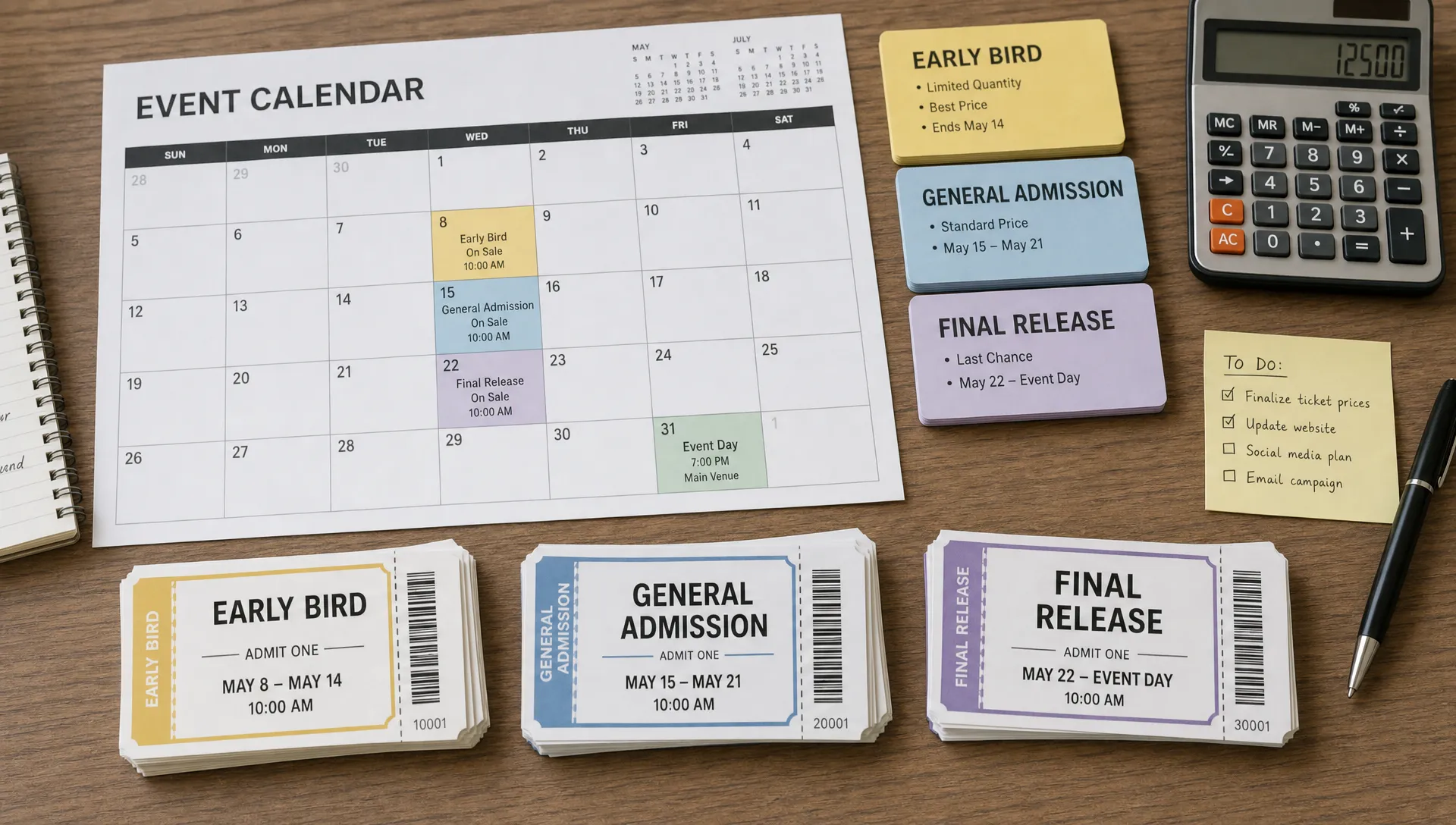
A long campaign with one price and one message often loses energy. A phased campaign gives buyers reasons to act at different moments. For example, you might begin with a limited early supporter tier, move into general admission, then shift to a final pricing phase as capacity fills or the event date approaches.
Early bird pricing can be useful, but only when it has a clear purpose. It should reward decisive buyers, help validate demand, or support early cash flow. It should not feel like a random discount. If you are considering this structure, see TixFlow’s guide on when to launch ticket early bird offers before setting your first tier.
The key is to connect each phase to a real reason. That reason could be limited capacity, rising production costs, a lineup reveal, a sponsor announcement, or a genuine deadline. Buyers respond better when urgency feels honest.
Cash flow should influence your ticket sales start date
For organizers, ticket timing is also a cash flow decision. The later you sell, the longer you carry expenses before revenue arrives. That may be fine for a low-cost event. It can be risky for a show with venue deposits, sound, lighting, artists, security, bar guarantees, or paid media.
Starting earlier can help you answer practical questions before you spend more:
- Is demand strong enough to increase marketing spend?
- Which ticket tier is moving fastest?
- Do you need more partners, sponsors, or street promotion?
- Can you confirm production upgrades with confidence?
- Are buyers responding to the lineup, the price, or the location?
This is where your ticketing platform matters. If payouts are slow, early sales may still leave you waiting for usable cash. TixFlow is built for organizers who care about cash flow, with instant payouts, flat per-ticket fees, flexible ticket tiers, automated sales phases, and Stripe Connect integration.
Match the launch window to your promotion channels
Your ticket sales start date should line up with how you plan to reach buyers. Different channels need different timelines.
Email and SMS can drive fast early sales if you already have an engaged list. Social media may need more repetition, especially if your reach is inconsistent. Paid ads usually need testing time before they become efficient. Partner promotion depends on how quickly collaborators can approve copy, post assets, and send links. Artist promotion can be powerful, but it often needs coordination so everyone posts at the right time.
For a music producer promoting a release party, the best ticket launch might happen shortly after the first strong content moment, such as a single drop, lineup reveal, or behind-the-scenes clip. For a business organizer, the best launch might happen after the agenda and speaker promise are clear enough for attendees to justify the purchase.
Do not open sales just because the event exists. Open sales when your promotion engine is ready to send qualified attention to a checkout page that can convert.
Practical examples by event scenario
A local producer hosting a 150-cap listening party may not need a three-month campaign. If the artist has an active audience and the venue is familiar, tickets might go live three to four weeks before the event. The first week can focus on core fans, the second week on collaborators and community pages, and the final stretch on urgency as capacity tightens.
A promoter running a 600-cap electronic music night with several DJs may benefit from a six to eight week window. That gives enough time for lineup content, artist posts, paid social testing, and tiered pricing. Starting earlier also helps identify whether the headliner is pulling demand or whether support acts and local partners need to push harder.
A workshop organizer selling a $95 professional training session may need five to eight weeks. Buyers need to understand what they will learn, who it is for, and why the price is worth it. The sales page should answer objections before launch, not after sales stall.
A conference organizer selling passes to attendees from multiple cities may need three to six months. In that case, the launch date should support a longer story: early pricing, speaker announcements, agenda reveals, sponsor updates, and final registration deadlines.
Signs you are ready to start ticket sales
Your event does not need to be perfect before tickets go live, but it should be clear enough for buyers to feel confident. A good readiness check is simple: if someone lands on your page today, can they understand the value and complete the purchase without needing to message you first?
You are probably ready if the event page clearly explains the experience, the ticket types make sense, the price is easy to understand, and your team knows what happens when a buyer has a question. You should also have your first promotional assets ready, including announcement copy, artist or speaker assets, short social captions, email copy, and tracking links if you use them.
A smooth checkout is part of readiness too. Requiring buyers to create an account before purchasing can add friction at the worst possible moment. TixFlow supports no buyer registration, customizable event pages, smart promo codes, unlimited ticket tiers, and digital guest lists, which helps teams keep the buying path focused.
What to monitor after sales start
Once sales are live, your first job is not to celebrate or panic. Your first job is to read the signal.
Early sales tell you who is paying attention, which channels are working, and whether your pricing feels right. A slow first day does not always mean the event will fail, especially if your audience tends to buy late. But silence after a major launch push can reveal a positioning problem, a weak offer, a confusing page, or a mismatch between price and perceived value.
Watch sales velocity, conversion patterns, promo code usage, tier performance, and buyer timing. If you want a more detailed measurement approach, TixFlow’s article on how to use ticket statistics to improve event sales explains which numbers matter most.
The best organizers do not set a launch date and hope. They use the first wave of sales to decide what to adjust next.
Common mistakes when choosing a ticket launch date
One mistake is opening sales before the event page is persuasive. If buyers cannot quickly understand the date, location, lineup, schedule, price, and reason to attend, they may leave and never return.
Another mistake is starting sales during a noisy moment for your audience. Major holidays, competing local events, school breaks, and major industry dates can all affect attention. You do not need a completely empty calendar, but you should know what else your audience is thinking about that week.
A third mistake is relying entirely on final-week urgency. Some audiences do buy late, especially for nightlife. But if your costs are high or your capacity is large, waiting for last-minute sales can make production decisions harder than they need to be.
Finally, avoid changing your structure too often. If buyers see constant discounting, they may learn to wait. It is better to set a clear sales phase plan and communicate it consistently.
Frequently Asked Questions
When should ticket sales start for a small local event? For many small local events, 3 to 6 weeks before the event is a strong starting point. If it is a recurring club night with a loyal audience, 10 to 21 days may be enough.
Is it bad to start ticket sales too early? It can be. If the event feels too far away or key details are missing, buyers may ignore the launch. Early sales work best when the offer is clear and there is a reason to buy now.
How early should tickets go on sale for a concert? Local concerts often work well with a 4 to 8 week window. Larger concerts, touring acts, or shows that require travel may need 8 to 12 weeks or more.
Should I announce my event before tickets go on sale? Often, yes. A short announcement or waitlist period can build anticipation before checkout opens. This is especially useful if you are still finalizing details or want a stronger launch day.
What if my audience usually buys tickets at the last minute? Start sales early enough to test demand, but design your campaign for late urgency. Use clear phases, capacity updates, and final reminders without pretending the event is almost sold out if it is not.
Make your ticket launch easier to control
The right ticket sales start date gives your event room to grow without losing urgency. Choose a window that matches your audience’s decision cycle, your event’s complexity, and your cash flow needs. Then support that date with clear ticket tiers, a fast checkout, and real-time visibility into what is selling.
TixFlow helps organizers launch faster with instant payouts, low flat per-ticket fees, no buyer registration, customizable event pages, unlimited ticket tiers, automated sales phases, promo codes, and digital guest lists. If you want ticket sales to feel less chaotic from day one, start with a platform built for modern event teams.