
How to Set Ticket Sale Dates for Maximum Momentum
Setting ticket sale dates is one of the most underrated revenue decisions an event organizer makes. The date you choose does more than determine when checkout opens. It shapes anticipation, cash flow, marketing rhythm, price perception, and the speed at which early interest turns into paid orders.
A strong event does not always sell because tickets were available early. It sells because the audience was warmed up, the offer felt clear, and each phase of the campaign gave buyers a reason to act now. That is why the best ticket sale dates are not picked randomly on a calendar. They are designed around momentum.
Below is a practical framework you can use to plan sale dates for concerts, club nights, community events, conferences, pop-ups, and recurring events, without relying on pressure tactics or last-minute panic.
What ticket sale dates are really deciding
Ticket sale dates answer three questions at once: when buyers can act, when money starts coming in, and when your marketing message changes.
If you open sales too early, you may stretch the campaign so long that urgency disappears. If you open too late, you risk compressing demand into a short window, creating stress for your team and making it harder to forecast attendance. The right date sits between those extremes.
Your sale calendar should create a sequence of small commitments. First, people notice the event. Then they understand why it matters. Then they see a clear reason to buy before a price change, tier sellout, VIP cutoff, or final deadline.
That sequence matters because buyer attention is perishable. Someone who is excited today may forget in three days if there is no obvious next step. A well-timed sale date gives that attention somewhere to go.
Start with the event date and work backward
The easiest mistake is choosing a launch date first. Instead, start with the day of the event and work backward through every milestone that affects demand, operations, and cash.
Before you publish a sale date, map the following constraints:
- Venue deposit deadlines and production payment dates
- Artist, speaker, partner, or lineup announcement timing
- Sponsorship or press announcement requirements
- Creative asset readiness, including flyers, videos, email copy, and event page content
- Audience buying habits, such as payday cycles, weekend planning, or travel needs
- Operational capacity for guest list management, customer questions, and door planning
Once you see those constraints, the launch date becomes a strategic choice. For example, if your event depends on travel planning, you likely need a longer runway. If it is a local recurring event with a loyal audience, a shorter campaign may keep energy concentrated.
The goal is not simply to give people enough time. It is to give them enough context at the moment tickets become available.
Build a 4-phase ticket sale calendar
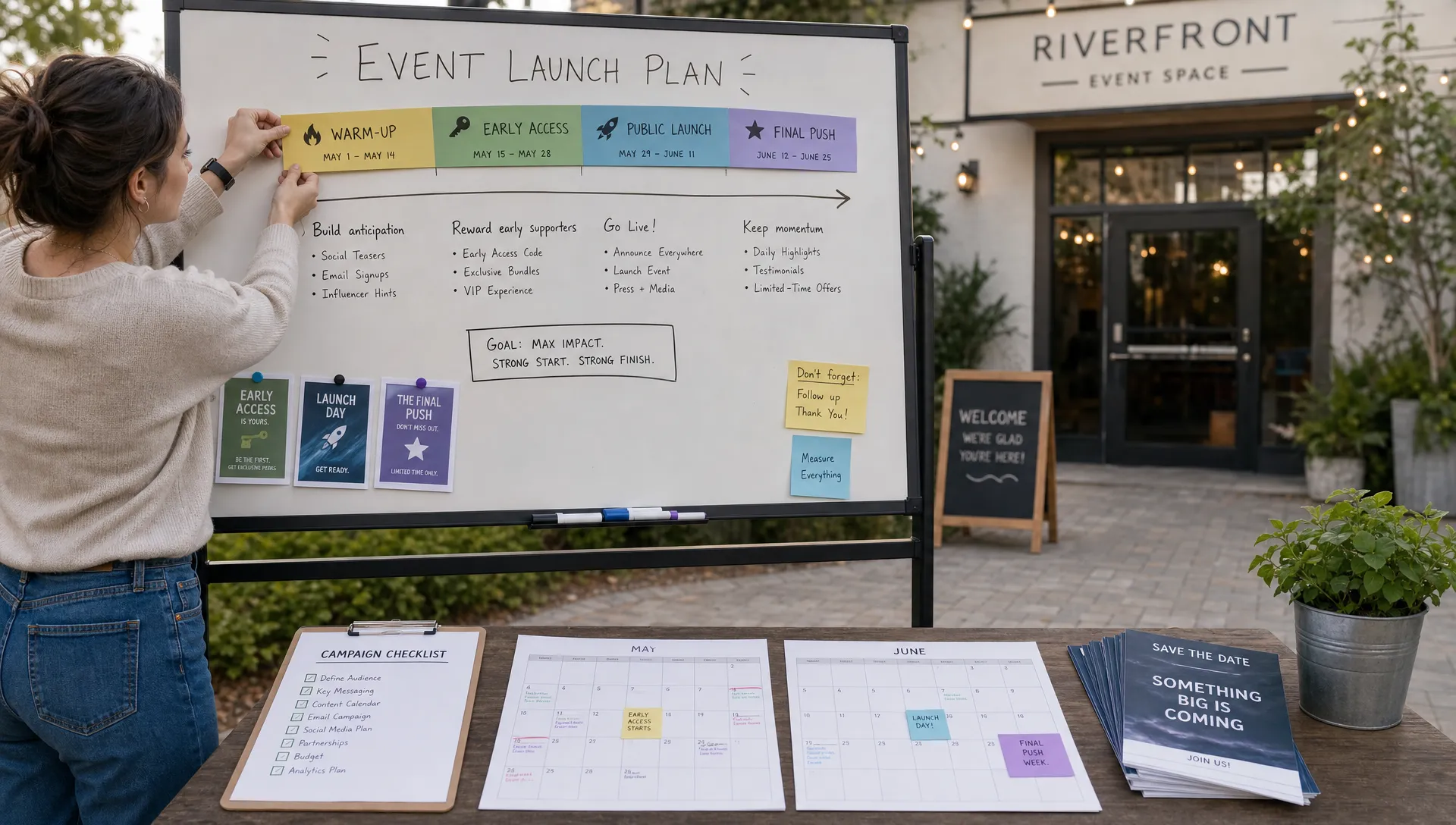
Most events benefit from four phases: warm-up, early access, public launch, and final push. The length of each phase depends on the event type, but the logic stays the same.
| Phase | Purpose | Best timing logic | What to avoid |
|---|---|---|---|
| Warm-up | Build awareness before checkout opens | Starts when your announcement assets are ready | Announcing too early with no next step |
| Early access | Reward insiders, fans, members, or past buyers | Opens before public sale with a clear cutoff | Making early access feel identical to public sale |
| Public launch | Convert broad demand into paid orders | Goes live when messaging, pricing, and checkout are tested | Launching before the event page is ready |
| Final push | Capture late buyers and undecided groups | Begins when deadlines, tiers, or capacity limits are real | Creating fake urgency that damages trust |
This phased approach helps you avoid the all-or-nothing launch problem. Instead of asking one announcement to do all the work, you give each phase a job.
The warm-up phase creates familiarity. Early access gives your strongest audience a reason to move first. Public launch turns social proof into broader demand. The final push helps undecided buyers make a decision while your team still has time to manage operations.
If you already have tickets live and need to generate urgency without sounding aggressive, use a dedicated campaign plan for promoting tickets once they are on sale. Sale dates are the structure, but your messaging is what makes each date matter.
Choose the public on-sale date carefully
Your public on-sale date should happen when your audience is most likely to notice, trust, and complete the purchase. That means thinking beyond your team schedule.
Avoid launching when your audience is distracted by major holidays, local competing events, or big announcements from similar organizers. If your attendees plan around paydays, consider how your launch and price changes line up with those cycles. If your event requires group coordination, give buyers enough time to talk to friends before the first meaningful deadline.
The best public sale date usually has three ingredients: a clear reason to buy, a tested checkout flow, and enough marketing support to create visibility within the first 24 to 72 hours.
That first window matters because launch performance sets expectations. A strong opening wave gives you social proof, validates pricing, and helps your team forecast demand. A weak launch does not automatically doom the event, but it often means you need to work harder later to rebuild energy.
Use sale dates to support pricing strategy
Ticket sale dates work best when they are connected to your pricing plan. If every ticket costs the same from day one until doors open, buyers have little reason to act early unless the event is likely to sell out.
You do not need complicated pricing to create momentum. A simple structure can work well: early supporters get the best price, standard buyers get the core offer, and late buyers pay more as capacity tightens or the event date approaches.
The important part is that each date has a real purpose. A price increase should reflect a real campaign stage, capacity milestone, or planning need, not an arbitrary countdown. If you are using scarcity or demand-based pricing, connect your calendar to a clear dynamic ticket pricing strategy so buyers understand why prices change.
For events with multiple audiences, tiers can be even more powerful. General admission, VIP, group passes, student tickets, member access, and last-minute entries may all need different sale windows. A platform that supports unlimited ticket pricing tiers gives organizers more room to match timing to buyer intent without forcing every attendee into one offer.
How far ahead should tickets go on sale?
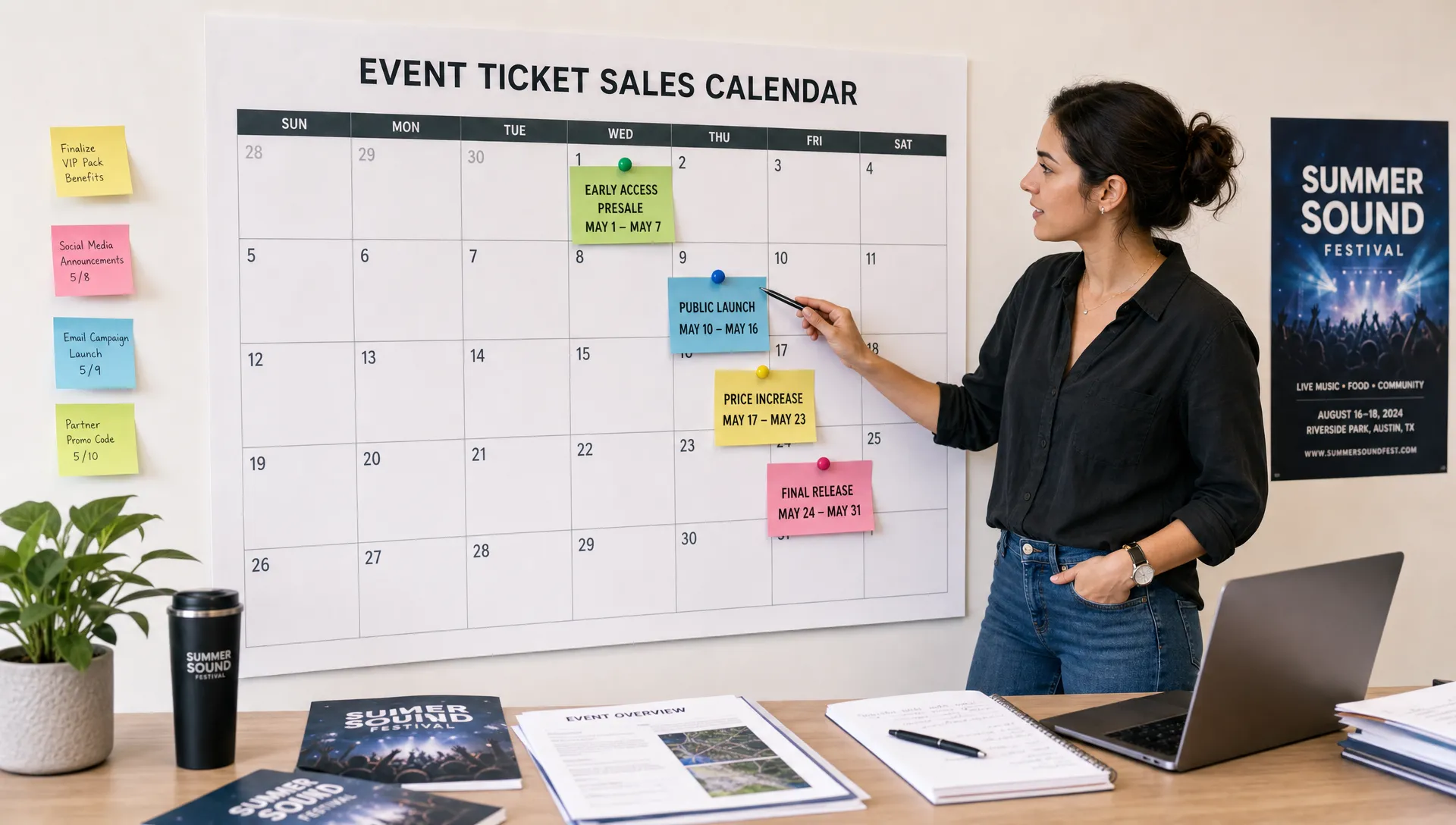
There is no universal answer, but there are useful planning ranges. The right timeline depends on how much planning your attendees need, how well-known your brand is, and how much upfront cash the event requires.
| Event type | Practical sale window | Why it works |
|---|---|---|
| Small local event | 3 to 6 weeks before the event | Keeps urgency high while giving locals time to plan |
| Club night or small concert | 4 to 8 weeks before the event | Allows lineup promotion and early social proof |
| Conference or professional event | 2 to 6 months before the event | Gives attendees time for budgets, travel, and approvals |
| Festival or multi-day event | 3 to 9 months before the event | Supports travel planning, phased announcements, and cash flow |
| Recurring event series | 2 to 6 weeks per event | Maintains a steady rhythm without audience fatigue |
Treat these as planning ranges, not rigid rules. A highly anticipated artist can sell quickly with a shorter window. A new event concept may need more time to educate the market. A professional audience may require earlier access because budgets and schedules take longer to approve.
The real test is whether each week of the campaign has a job. If you cannot explain what buyers will learn, feel, or do during a week, your campaign may be too long.
Match ticket sale dates to audience behavior
Different buyers move at different speeds. Your sale calendar should account for that.
Superfans and repeat attendees are often ready as soon as tickets open, especially if they trust your brand. Give them early access, loyalty pricing, or first choice of limited tiers. Their purchases create the first layer of proof.
General buyers usually need more context. They want to know who else is going, what the experience includes, and whether the date fits their schedule. Your public launch should make the value obvious without requiring them to ask basic questions.
Group buyers need time to coordinate. If your event is social by nature, do not set your first price increase so soon that groups cannot organize. A smart deadline creates action, but an unrealistic one creates friction.
Late buyers need clarity and speed. They are often asking whether tickets are still available, whether the event is worth it, and how quickly they can complete the purchase. This is where no buyer registration, a simple checkout, and instant ticket delivery can make a real difference.
Use community input without losing momentum
For community-driven events, ticket sale dates can also be a trust-building tool. If your audience feels involved in the event, they are more likely to share it, defend it, and buy early.
That does not mean every decision needs to be open-ended. Too much uncertainty can slow down sales. Instead, invite input on decisions that improve participation without delaying the campaign, such as preferred launch times, add-on experiences, or member presale access.
Civic events, advocacy gatherings, and mission-led communities can borrow from participation models like JustSocial, which focuses on technology-supported engagement and transparency. The lesson for organizers is simple: people respond better when the process feels visible, fair, and easy to join.
For ticketing, that means explaining who gets early access, when public sales open, what changes after each deadline, and how capacity is handled. Transparency reduces confusion, and reduced confusion improves conversion.
Protect cash flow while building demand
Ticket sale dates directly affect cash flow. Opening sales earlier can help fund production, deposits, staffing, marketing, and inventory. But early revenue is only useful if the campaign still has enough excitement left for the final stretch.
Think of your sale dates as cash flow gates. Each phase should generate a measurable result: enough early sales to validate demand, enough public launch revenue to cover key costs, and enough final sales to maximize capacity without operational chaos.
This is where payout timing matters. If your platform delays access to funds, your sale calendar may look good on paper but still create pressure behind the scenes. TixFlow is built for organizers who want faster control over revenue, with instant payouts, Stripe Connect integration, flat per-ticket fees, and real-time sales control.
That combination matters because momentum is not only public. It is also internal. When your team can see sales movement, adjust phases, manage ticket tiers, and access revenue faster, you can make better decisions before the event, not after it.
A simple ticket sale date template
Use this template as a starting point, then adjust based on your event size, audience, and operational needs.
| Timeline | Action | Main goal |
|---|---|---|
| 6 to 10 weeks out | Confirm pricing, event page, creative, and launch plan | Prepare the campaign before attention peaks |
| 4 to 8 weeks out | Announce event and open early access | Convert your warmest audience first |
| 3 to 6 weeks out | Open public sale | Turn awareness into broad paid demand |
| 2 to 4 weeks out | Trigger price change, tier cutoff, or new release | Give undecided buyers a reason to act |
| 7 to 10 days out | Push final availability and operational details | Capture late demand and reduce buyer questions |
| 24 to 72 hours out | Focus on last-call messaging and guest list readiness | Maximize attendance without creating door chaos |
The template is intentionally simple. Your calendar does not need dozens of steps. It needs clear moments that buyers understand and your team can execute.
Common mistakes to avoid
Opening sales before the offer is clear
If buyers do not understand the lineup, location, experience, pricing, or refund expectations, opening checkout will not solve the problem. It may simply expose the confusion. Make the event page clear before the sale date arrives.
Making every deadline feel the same
If early bird ends, then another early bird appears, then a final deadline repeats for two weeks, buyers learn not to trust your dates. Use fewer deadlines, make them real, and honor them.
Ignoring the first sales signal
Your first 48 hours can reveal a lot. If early access converts well, you may have room to accelerate a price change or release another tier. If public launch is slow, you may need clearer messaging, partner promotion, or more proof before pushing urgency.
Choosing dates only around your team calendar
Operational convenience matters, but buyers do not act because a date is convenient for you. They act when timing, clarity, and motivation line up.
Frequently Asked Questions
What are the best ticket sale dates for a small local event? For many small local events, opening sales 3 to 6 weeks before the event keeps the timeline focused while giving attendees enough time to plan. If your audience is highly loyal or the event is recurring, you may be able to use a shorter window.
Should I announce an event before tickets go on sale? Yes, in most cases. A short warm-up period helps your audience recognize the event before you ask them to buy. Just make sure the announcement includes a clear next step, such as an early access signup or exact public on-sale date.
How many ticket sale phases should I use? Most events only need three to five meaningful phases. Too many phases can confuse buyers. Focus on early access, public sale, one or two price or tier changes, and a final availability push.
When should early bird tickets end? Early bird tickets should end when they have done their job: rewarding early buyers and creating the first demand signal. Set the end date before public urgency fades, and avoid extending it repeatedly unless there is a clear reason.
Can ticket sale dates improve event cash flow? Yes. Earlier and better-structured sale dates can bring in revenue before the event, helping with deposits, production, staffing, and marketing. The key is to balance cash needs with audience momentum.
Turn your sale calendar into momentum
The best ticket sale dates do not simply open checkout. They create rhythm. They help your warmest buyers move first, give the wider audience a reason to act, and give your team the real-time information needed to adjust before it is too late.
With TixFlow, organizers can set up events quickly, create flexible ticket tiers, automate sales phases, use smart promo codes, manage digital guest lists, and keep checkout simple for buyers with no registration required. If you want your next event to sell with less friction and better cash flow, start by building a ticket sale calendar that makes every phase count.