
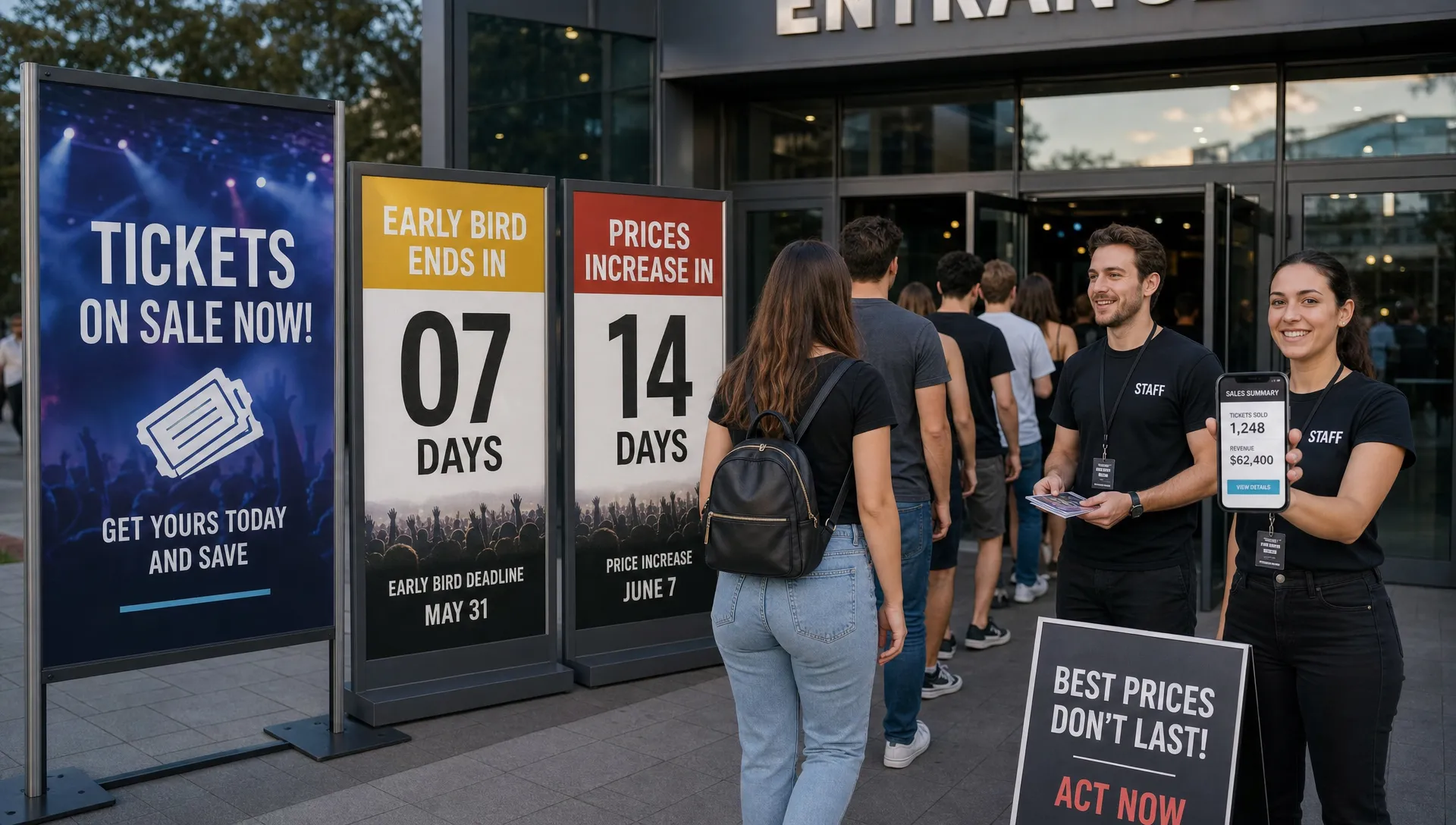
How to Promote Tickets on Sale Now and Drive Urgency
Putting tickets on sale now is the easy part. Turning that announcement into action is where many events lose momentum.
A strong ticket launch does more than tell people that sales are open. It gives buyers a clear reason to act today, makes the purchase feel low-friction, and shows that the event has real demand. That matters whether you are promoting a club night, local festival, workshop, conference, comedy show, listening party, or independent music event.
The goal is not to manufacture panic. The goal is to create believable urgency around real limits: price changes, capacity, VIP access, artist demand, seating, early-bird windows, or the simple fact that your production budget depends on early cash flow.
Here is how to promote your event once tickets are live, build urgency without sounding desperate, and turn attention into paid admissions.
Start with a real urgency angle, not just a louder announcement
Many ticket campaigns fail because the message is too generic. “Tickets are on sale now” tells people what happened, but not why they should care or why they should buy before they forget.
Before posting, define the urgency driver behind your campaign. Good urgency usually comes from one of four places:
| Urgency driver | What it means | Best for |
|---|---|---|
| Limited time | A price, bonus, or access window expires soon | Early-bird launches, presales, flash offers |
| Limited quantity | A tier, seat type, table, or VIP option has a fixed cap | Concerts, nightlife, workshops, seated events |
| Rising price | Tickets become more expensive as demand builds | Festivals, music events, multi-phase launches |
| Social momentum | Buyers see that other people are committing | Community events, artist-led shows, local experiences |
The strongest campaigns often combine two of these. For example: “Early-bird tickets are live until Friday or until the first 100 are gone.” That gives buyers a reason to act now without relying on vague hype.
If there is no real limit, create a legitimate one. You can offer an early supporter price, a presale for your mailing list, a limited VIP add-on, or a timed bundle. The key is that the promise must be true. If you say prices rise Monday, they should rise Monday.
Make the event page ready before you send traffic
Urgency only works if the buying path is ready. If people click your announcement and land on a confusing event page, slow checkout, unclear pricing, or a forced sign-up wall, your campaign loses energy.
Before you announce that tickets are live, check the basics:
- The event name, date, time, venue, and age policy are clear.
- Ticket tiers are easy to compare.
- Fees are transparent before checkout.
- The main call to action is obvious on mobile.
- Buyers can complete the purchase without creating an account.
- Confirmation and ticket delivery feel instant and trustworthy.
For many events, the checkout experience is part of the promotion. A buyer who is excited for ten seconds can still abandon if the process feels too slow. If you are reviewing your sales flow, this guide to why guest checkout can increase ticket sales is especially relevant, because forced registration often adds friction at the exact moment buyers are ready to commit.
Your event page should also support the urgency message visually. If early-bird tickets are limited, say so near the ticket tier. If VIP access includes a meet-and-greet, priority entry, a table, or merch, make that value clear before the buyer reaches checkout.
Build a launch sequence instead of a single post
A single “tickets on sale now” post is rarely enough. People miss it, save it, get distracted, or wait for friends to decide. A better approach is to run a short launch sequence that repeats the same core message from different angles.
Think of the first 72 hours as a campaign, not an announcement.
| Timing | Goal | Message angle |
|---|---|---|
| Launch moment | Create awareness | Tickets are live, here is the core promise of the event |
| 6 to 12 hours later | Catch people who missed it | Early response, first buyers, best tiers still available |
| Day 2 | Build confidence | Artist, speaker, venue, lineup, testimonials, behind-the-scenes proof |
| Day 3 | Drive action | Early-bird deadline, price increase, limited tier, or bonus ending |
The launch moment should be direct. Do not bury the link or make people search for details. Lead with the strongest value proposition and the reason to buy now.
For example, a music producer promoting a release party could write:
“Tickets are live for the first official playback night. Early supporter tickets are available until Friday, then prices move to general admission. Limited capacity, intimate room, full sound system, special guests.”
That message works because it gives buyers context, value, and urgency in one paragraph.
Use copy that turns attention into action
Urgency is partly structural, but wording matters. Strong ticket copy makes the next step feel obvious.
A useful formula is:
Event promise + audience fit + urgency reason + simple action.
Here are a few examples you can adapt:
| Event type | Stronger tickets-on-sale message |
|---|---|
| Club night | “Tickets are live for Friday’s warehouse session. First release is limited, and prices increase once this tier sells through.” |
| Independent concert | “Presale is open for the hometown show. Grab your ticket before general sale opens and help us lock in production early.” |
| Workshop | “Seats are now available for the live session. Capacity is capped to keep the room interactive, so early booking is recommended.” |
| Festival | “Phase 1 tickets are on sale now. This is the lowest price before the lineup drop and next pricing phase.” |
| Comedy show | “Tickets are live for one night only. Small room, reserved seating, and limited front-row availability.” |
Notice that each example explains why buying now matters. That is the difference between urgency and noise.
Avoid overusing phrases like “don’t miss out” and “last chance” if they are not tied to a specific deadline or limit. They can work, but only when the campaign gives them substance.
Match the message to each promotion channel
Every channel has a different job. Your email list may be ready to buy. Your Instagram followers may need social proof. Reddit or X users may be discussing similar events, artists, venues, or local plans and need a helpful nudge rather than a hard sell.
Email is usually best for direct conversion. Use a clear subject line, a short event summary, and one main call to action. If you have segmented lists, send a different message to past attendees, VIP buyers, press contacts, and friends of the venue.
Social platforms are better for repetition and proof. Use reels, short clips, artist drops, venue walkthroughs, rehearsal footage, crowd photos from previous events, or a quick “first release moving” update.
Community channels work best when the post feels useful. Instead of dropping a link into every group, frame the event around the community’s interest. A local electronic music group might respond to the lineup and sound system. A startup community might care about the speakers and networking format. A neighborhood group might care about the venue, timing, and accessibility.
If you want to find people already discussing relevant topics, tools like Pounce can help monitor high-intent conversations on X and Reddit so you can respond where the demand is already forming, instead of relying only on broad posts.
The best channel mix is usually simple: one owned channel for conversion, one or two social channels for visibility, and a few partner channels for credibility.
Create urgency with pricing phases, not constant discounts
Discounting can move tickets, but it can also train buyers to wait. If your audience expects a promo code every week, your early buyers feel punished and your margins shrink.
Pricing phases are often healthier. They reward early action while preserving perceived value. For example:
| Phase | Purpose | Buyer message |
|---|---|---|
| Presale | Reward insiders and early supporters | “Presale access before the public launch.” |
| Early bird | Build initial cash flow | “Lowest available price until this tier sells out.” |
| General admission | Main sales period | “Standard ticket access while capacity remains.” |
| Final release | Capture late demand | “Final tickets available at the door-price equivalent.” |
This structure is especially useful for organizers who need cash flow early. Early ticket revenue can help cover deposits, marketing spend, travel, staff, and production costs before the event date.
If you want to go deeper on pricing, the TixFlow guide to ticket pricing strategies that help small events sell out covers how to make price feel fair while still encouraging early purchase behavior.
Promo codes still have a place, but they should be targeted. Use them for partners, street teams, artists, sponsors, ambassadors, or previous attendees. A smart promo code should help you attribute sales, not just reduce price.
Turn social proof into a reason to buy now
People are more likely to buy when they believe other people are going. That does not mean you need to exaggerate demand. Simple proof is enough.
Useful social proof includes:
- “First release is 60% sold.”
- “VIP tables are halfway gone.”
- “Past attendees get first access until midnight.”
- “The last edition sold out before event week.”
- “More than half the workshop seats were claimed in the first 24 hours.”
Only use numbers you can verify. If you do not have enough sales momentum yet, use other forms of proof: artist credibility, venue reputation, partner announcements, press mentions, audience testimonials, or behind-the-scenes preparation.
For music producers and nightlife organizers, artist-led posts often outperform brand posts because the relationship is stronger. Give each performer or partner a short copy block, tracking link, and deadline. Make it easy for them to share without rewriting everything.
A good partner caption could say:
“Playing this one on Saturday, and first-release tickets are moving. If you are planning to come, grab yours before the next price phase.”
That feels more natural than a generic flyer dump, and it gives the audience a practical reason to act.
Use real-time sales control during the campaign
A ticket campaign is not set-and-forget. Once tickets are live, you should watch how buyers respond and adjust quickly.
Key signals to monitor include:
| Signal | What it may tell you | Possible action |
|---|---|---|
| High page views, low purchases | The offer is interesting, but checkout or pricing may be blocking conversion | Clarify value, reduce friction, test copy, review fees |
| Strong early sales, then drop-off | Launch audience converted, but broader promotion needs proof | Release social proof, partner posts, behind-the-scenes content |
| One tier selling faster than others | Buyers prefer a specific price point or value package | Adjust tier visibility, add scarcity messaging, review remaining inventory |
| Promo code sales concentrated by partner | One channel is outperforming | Give that partner more assets or extend their code window |
| Late surge before deadline | Urgency is working | Reinforce deadline, prepare next phase, avoid extending casually |
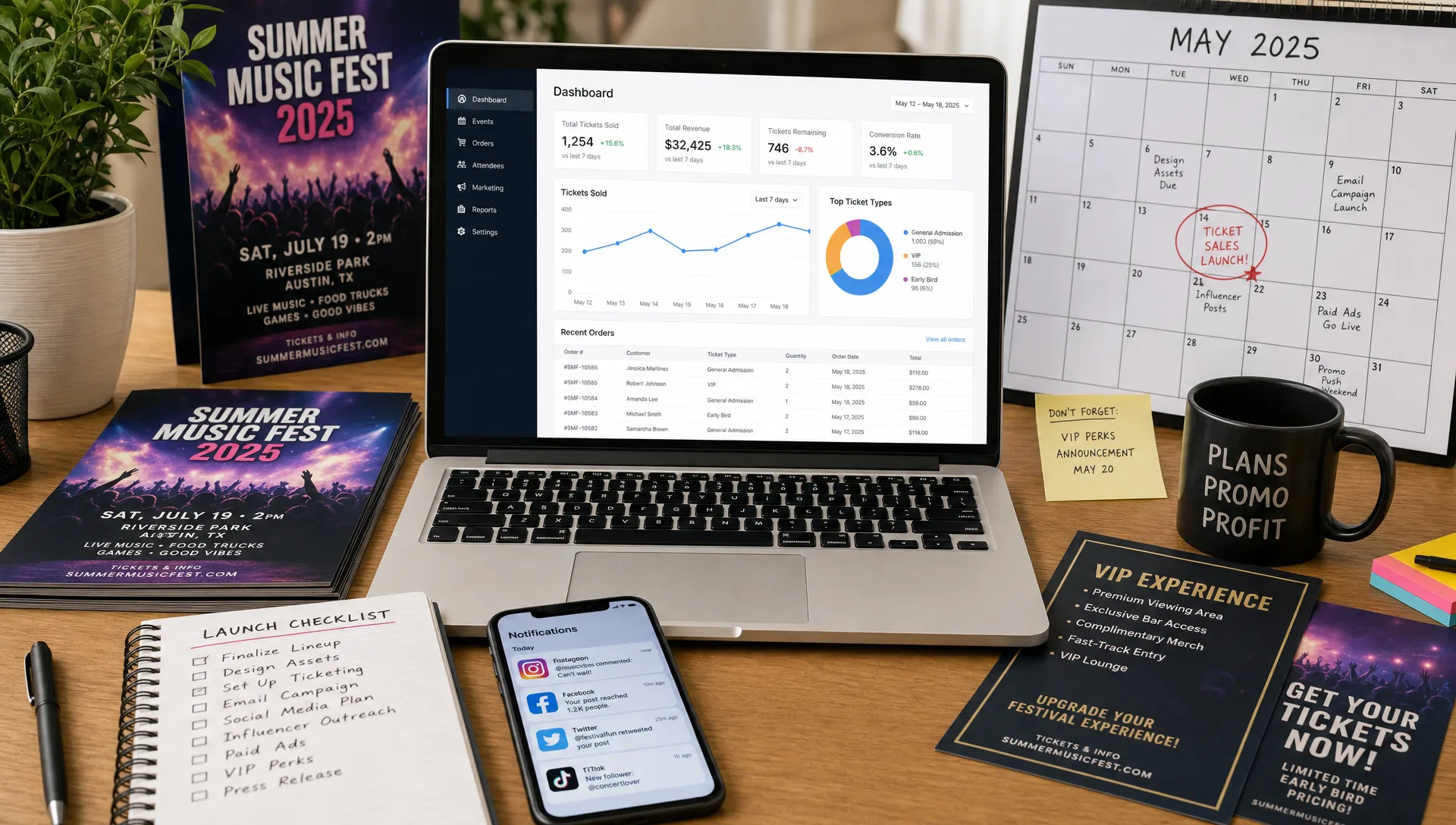
Real-time sales control matters because urgency campaigns move quickly. If first-release tickets are almost gone, your next post should reflect that. If a VIP tier is not moving, the value may need clearer explanation. If buyers are abandoning checkout, more promotion will not solve the underlying conversion problem.
This is where a platform built for live control helps. TixFlow supports flexible ticket tiers, automated sales phases, smart promo codes, digital guest lists, and real-time sales control, so organizers can adapt campaigns without turning ticket management into a manual spreadsheet job.
Protect cash flow while building demand
Urgency is not just about selling out. For many organizers, it is about getting cash in early enough to run the event well.
If you are funding production, deposits, venue costs, staff, artists, or marketing out of pocket, your ticketing setup affects your risk. Long payout delays can force you to front more money than necessary, even when sales are healthy.
A healthier cash-flow plan starts before launch:
- Decide how much early revenue you need to cover fixed costs.
- Set an early-bird quantity that helps you reach that number.
- Avoid discounting below your true break-even point.
- Use price phases to improve margin as demand increases.
- Track daily sales so you know when to increase or pause ad spend.
If protecting margin is a priority, it is worth reviewing how fees affect your net revenue. This TixFlow article on how to sell tickets without cutting into revenue explains why the cheapest-looking setup is not always the most profitable once fees, checkout friction, and payout timing are considered.
TixFlow is designed for organizers who want faster access to revenue, lower friction for buyers, and more control over the sales process. Features like instant payouts, flat per-ticket fees, no buyer registration, Stripe Connect integration, and customizable event pages can help teams promote confidently while keeping operations simple.
Avoid urgency tactics that damage trust
Urgency can increase sales, but fake urgency can hurt your brand. Buyers notice when “last chance” appears every week or when a “limited” tier quietly reopens at the same price.
Avoid these common mistakes:
- Extending every deadline after saying it is final.
- Hiding fees until the last step.
- Using countdowns that reset.
- Claiming tickets are almost gone when they are not.
- Running public discounts immediately after early buyers paid full price.
- Making the checkout process longer than the announcement made it sound.
Trust is especially important for repeat events. A buyer might forgive one messy campaign, but if they feel manipulated, they may wait longer next time or skip the event entirely.
The better approach is simple: set real rules, communicate them clearly, and follow through. If plans change for a legitimate reason, explain the change rather than pretending nothing happened.
A practical tickets-on-sale-now promotion checklist
Use this checklist before and during your next launch:
| Step | Question to answer |
|---|---|
| Define the urgency | What changes if the buyer waits? |
| Prepare the page | Can a mobile buyer understand and purchase quickly? |
| Set ticket phases | What price or access changes over time? |
| Write channel-specific copy | What does each audience need to hear? |
| Equip partners | Do artists, speakers, sponsors, and venues have ready-to-share assets? |
| Monitor performance | Which tiers, channels, and promo codes are converting? |
| Update the campaign | Are you using real sales data to guide the next message? |
| Follow through | Did the deadline, price increase, or tier limit happen as promised? |
This keeps the campaign focused. You are not just posting more. You are giving buyers clearer reasons to act at each stage.
Frequently Asked Questions
How do I announce that tickets are on sale now? Lead with the event’s main value, then explain the urgency. A strong announcement includes the event name, date, location, ticket link, price phase, and a clear reason to buy now, such as limited early-bird pricing or capped capacity.
How often should I post after tickets go live? For most events, post several times during the first 72 hours, then continue with meaningful updates. Avoid repeating the exact same flyer every day. Rotate between launch news, social proof, artist or speaker highlights, deadline reminders, and behind-the-scenes content.
What is the best urgency tactic for small events? Limited early-bird pricing is often the simplest and most believable tactic. It rewards early buyers, supports cash flow, and gives you a natural reason to promote before the general sales phase.
Should I use discounts to sell more tickets? Use discounts carefully. Targeted promo codes for partners, past attendees, or ambassadors can work well. Public discounts used too often can reduce perceived value and teach buyers to wait.
How can I create urgency without sounding pushy? Be specific and honest. Instead of saying “hurry,” say what is actually changing: the price increases Friday, first-release tickets are nearly sold, VIP access is capped, or the presale ends tonight.
Turn urgency into smoother ticket sales
Promoting tickets effectively comes down to three things: a clear reason to buy now, a low-friction checkout, and enough control to adjust as demand changes.
With TixFlow, organizers can create customizable event pages, set unlimited ticket tiers, automate sales phases, use smart promo codes, manage digital guest lists, and access instant payouts with flat per-ticket fees. That combination helps you promote with urgency while keeping the buying experience fast for attendees and manageable for your team.
If your next campaign is ready to move from “tickets are live” to “tickets are selling,” explore TixFlow and build a ticketing flow designed for modern event sales.