
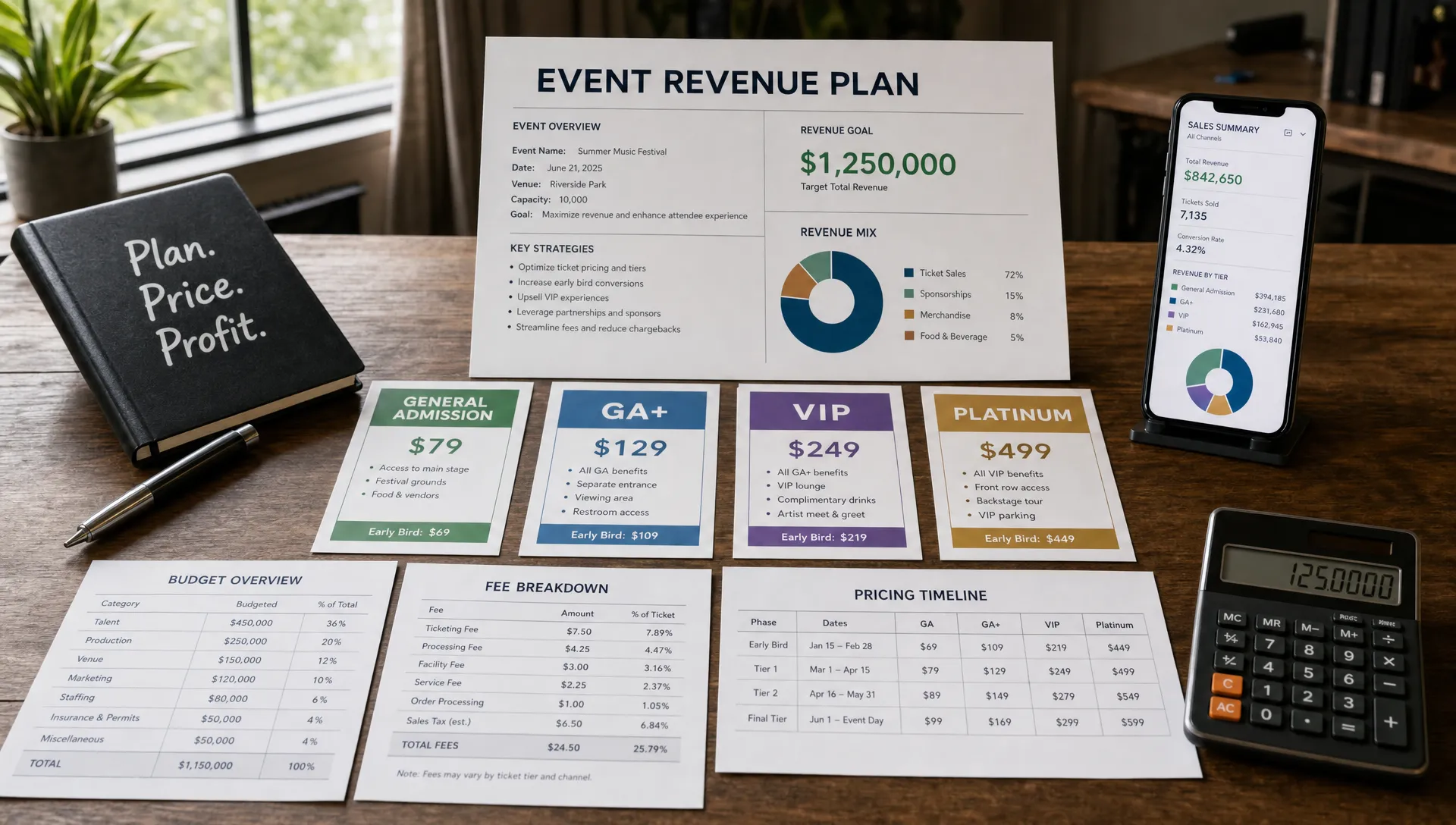
How to Sell Your Tickets Without Cutting Into Revenue
Selling more tickets is good. Keeping enough of the money from each sale is what makes the event sustainable.
That distinction matters more than many organizers realize. A packed room can still underperform if your revenue is drained by absorbed fees, constant discounting, slow payouts, manual admin, and a checkout process that pushes buyers away before they complete payment. For music producers, venue hosts, pop-up organizers, workshop leaders, and community event teams, the goal is not just to sell your tickets. The goal is to sell them with a margin that still supports production, talent, staff, marketing, and the next event.
This guide breaks down the practical ways to protect your ticket revenue without making the buyer experience feel expensive or complicated.
Start with net revenue, not gross sales
Gross ticket sales are the big number everyone likes to celebrate. Net revenue is the number that pays the bills.
Before you launch sales, estimate what you actually keep after platform fees, payment processing, refunds, comped tickets, discounts, affiliate cuts, and taxes where applicable. This gives you a realistic baseline for pricing and capacity decisions.
For example, a $30 ticket does not necessarily produce $30 of usable event income. If you absorb all fees, give out too many promo codes, and wait weeks for payouts, your real operating position may be far weaker than your sales dashboard suggests.
A simple revenue model should include:
- Ticket price by tier
- Expected number of paid tickets per tier
- Ticketing and payment fees
- Promo code usage
- Refund allowance
- Complimentary tickets
- Fixed event costs
- Variable costs per attendee
Once you know your break-even point, you can make better decisions about tiers, sales phases, and promotions. You are no longer guessing whether a discount is harmless or whether a fee is small enough to ignore.
Identify the revenue leaks before launch
Most revenue loss happens quietly. It is not always one big mistake. It is often a series of small decisions that seem convenient in the moment: absorbing every fee, manually tracking guest list changes, launching with only one price, or asking buyers to create an account before checkout.
| Revenue leak | Why it hurts | Better approach |
|---|---|---|
| Absorbed fees | Reduces margin on every ticket sold | Use transparent, predictable fee handling |
| Too many discounts | Trains buyers to wait for deals | Use limited, targeted promo codes |
| Slow payouts | Creates cash flow pressure before event day | Choose a setup that supports faster access to funds |
| One flat price | Misses early urgency and premium demand | Use tiers and automated sales phases |
| Forced registration | Adds friction during purchase | Let buyers check out without creating an account |
| Manual guest lists | Increases errors at entry | Use digital guest lists tied to ticket sales |
The earlier you fix these leaks, the less pressure you put on last-minute sales. A strong ticketing setup should help you protect revenue from the first sale, not only after you realize margins are shrinking.
Stop using discounts as your main sales strategy
Discounts can work, but they are often overused. If every campaign depends on a lower price, buyers learn that the listed price is not the real price. That weakens urgency and can make full-price buyers feel penalized.
A better approach is to use discounts as a precise tool rather than a blanket solution.
For example, a music producer promoting a listening party might offer a short-lived artist community code to early supporters, while keeping the public price intact. A wellness organizer might give a partner code to a studio or local brand audience. A conference host might reserve codes for sponsors or group buyers.
The key is control. Smart promo codes should have a clear purpose, a limit, and an expiration point. They should help you reach a specific audience without lowering the perceived value of the entire event.
Good promo code use protects revenue because it answers three questions before the discount goes live: who is it for, why does it exist, and when does it stop?
Price in phases instead of lowering your main ticket price
If you want buyers to act early, build urgency into the structure of your ticket sales. Do not rely only on reminders and social posts.
Sales phases help you reward early buyers while gradually increasing revenue per attendee as demand grows. This is especially useful for small and mid-sized events where each ticket matters. Early bird, general admission, final release, VIP, and door pricing can all serve different purposes.
The important part is that each tier should feel intentional. Early bird pricing is not just a cheaper ticket. It is a reward for commitment. Final release pricing is not a punishment. It reflects limited remaining availability and the added certainty that the event is happening.
If you are still deciding how to set those numbers, this guide on how to price tickets for small events can help you think through value, audience expectations, and break-even planning.
A simple phased structure could look like this:
| Phase | Purpose | Revenue benefit |
|---|---|---|
| Early supporter | Builds initial momentum | Secures cash and social proof early |
| General admission | Captures the main audience | Establishes the standard value of entry |
| Final release | Converts late buyers | Increases revenue when scarcity is real |
| VIP or premium | Serves high-intent buyers | Raises average order value without discounting |
This structure gives you more control than a single static price. It also makes your marketing clearer because each phase gives buyers a reason to act now.
Make fees predictable and transparent
Ticket fees are one of the biggest sources of tension for organizers and attendees. If the organizer absorbs them, the buyer sees a cleaner price, but the event margin takes the hit. If fees appear too late in checkout, buyers may feel surprised and abandon the purchase.
The best approach depends on your event, your audience, and your pricing model, but the principle is the same: know the impact before you launch.
Flat per-ticket fees can be easier to model than percentage-based fees because you can calculate margin more clearly across ticket tiers. That predictability matters when you are working with tight production budgets or small-capacity rooms.
If you are currently covering costs without realizing how much they reduce your take-home revenue, the article on how to stop absorbing ticket fees explains the tradeoffs in more detail.
Transparency does not mean overwhelming buyers with technical details. It means avoiding surprises. When the final price feels clear, fair, and consistent, buyers are less likely to hesitate at the last step.
Reduce checkout friction so you do not pay for it twice
A slow checkout cuts into revenue in two ways. First, it loses buyers who were ready to purchase. Second, it forces you to spend more on reminders, ads, and manual follow-up to recover demand that should have converted the first time.
For event ticketing, friction often comes from unnecessary steps. Buyer registration is a common example. If someone clicks from an Instagram story, artist text blast, email campaign, or venue page, they are already in a fragile buying moment. Asking them to create an account can interrupt that momentum.
No buyer registration is especially important for casual events, nightlife, live music, pop-ups, workshops, and one-time community gatherings. Many attendees are not trying to build a long-term account with a ticketing platform. They just want to buy a ticket and receive confirmation instantly.
A smoother checkout protects revenue because it respects buyer intent. The fewer unnecessary steps between interest and payment, the more of your demand turns into actual sales.
Protect cash flow before event day
Revenue is not only about how much you earn. It is also about when you can use it.
Many organizers have to pay deposits, contractors, artists, production crews, venues, designers, photographers, security, and marketing costs before the event happens. If ticket income is locked until after the event or delayed through multiple handoffs, you may end up funding the event out of pocket even when sales are strong.
That is why payout timing should be part of your platform decision. Instant payouts can give organizers more flexibility to cover real costs as sales come in. For independent event teams and music producers, that can be the difference between scaling promotion confidently and waiting too long to reinvest in marketing.
Cash flow control also helps you avoid panic discounting. When funds arrive faster, you are less likely to slash prices just to create short-term liquidity.

Build value instead of cutting price
One of the best ways to protect ticket revenue is to make the ticket feel more valuable, not cheaper.
Value can come from access, experience, convenience, community, exclusivity, or timing. A standard ticket gets someone in the door. A stronger offer makes them feel like they are buying into something worth prioritizing.
For a live show, that might mean early entry, a meet-and-greet, a limited merch bundle, or a better viewing area. For a workshop, it might mean materials included, a post-event resource, or a smaller group format. For a wellness or lifestyle event, it could mean a curated sensory experience with relevant partners, such as an herbal wellness activation inspired by brands like Air Tea Company, which focuses on warm-air herbal vaporization and nature-led wellness rituals.
The point is not to add random perks. The point is to increase perceived value in a way that fits the audience. When the offer feels richer, you do not need to rely as heavily on discounts to drive action.
Use premium tiers to raise average order value
Not every attendee wants the cheapest ticket. Some buyers want convenience, status, access, or a more complete experience. If you only offer one general admission ticket, you leave that demand untapped.
Premium ticket tiers can help you increase revenue without increasing capacity. This is useful when venue size is fixed or production costs are already committed.
Examples of premium tiers include VIP entry, reserved seating, backstage access, drink-inclusive packages where legally and operationally appropriate, workshop add-ons, creator meetups, merch bundles, or early access. The right tier depends on the event, but the principle is consistent: give high-intent buyers a better option instead of forcing everyone into the same price point.
Be careful not to weaken the standard ticket. Premium tiers should add value without making general admission feel incomplete. If the base ticket feels stripped down, buyers may feel manipulated. If premium feels meaningfully enhanced, it can lift revenue while keeping the main offer attractive.
Keep real-time control over sales
Ticket sales rarely move in a perfectly predictable line. A post may go viral. An artist announcement may spike demand. A weather concern may slow sales. A sponsor may request a block of tickets. A guest list may change hours before doors open.
Real-time sales control helps you respond without creating chaos.
If a tier is moving faster than expected, you may need to close it and open the next phase. If a sponsor code is being shared too widely, you may need to pause it. If capacity changes, you need accurate inventory immediately. If a final marketing push works, you need the checkout and guest list to stay aligned.
This matters because revenue is often lost in the gap between what is happening and what the organizer can control. Manual systems create delays. Delays create overselling, underselling, confusion, or missed opportunities.
A platform with real-time sales control, unlimited ticket tiers, automated sales phases, and smart promo codes gives event teams more room to adapt while still protecting the financial plan.
Do not let guest list chaos eat into revenue
Guest lists are necessary, but they can quietly damage revenue if they are not controlled.
Comped tickets, artist lists, sponsor lists, staff access, media passes, and last-minute additions all affect capacity. If they are tracked in spreadsheets or text threads, it becomes easy to lose count. That can lead to overselling, underestimating paid capacity, or giving away more access than planned.
A digital guest list helps connect entry operations with ticket inventory. It also reduces disputes at the door, which protects the attendee experience and keeps lines moving.
For revenue protection, set clear rules before launch. Decide how many complimentary entries are available, who can approve them, when the list closes, and whether unused allocations return to paid inventory. Small policies like these can recover meaningful revenue over time.
Track revenue per attendee, not just tickets sold
If you want to improve each event, track the metrics that reveal margin quality. Total tickets sold is useful, but it does not tell the full story.
Revenue per attendee shows whether your pricing and tiers are working. Promo code usage shows whether discounts are helping or replacing full-price demand. Sales by phase show whether urgency is clear. Checkout conversion shows whether your buying flow is supporting or suppressing demand.
Here is a simple performance review framework:
| Metric | What it tells you | What to adjust next time |
|---|---|---|
| Average ticket revenue | How much you keep per attendee before costs | Tier design and pricing gaps |
| Promo code share | How dependent sales are on discounts | Code limits, timing, and targeting |
| Sales by phase | Whether urgency is working | Phase length and price jumps |
| Payout timing | How quickly sales support operations | Payment setup and platform choice |
| No-show rate | How many buyers actually attend | Reminder timing and event positioning |
| Door issues | Where entry friction appears | Guest list process and ticket scanning |
The goal is not to make every event perfect. The goal is to learn which decisions improved revenue quality and which ones only made sales look better on the surface.
Choose a ticketing platform that supports your margin
Your ticketing platform is not just a payment tool. It shapes checkout conversion, fee exposure, payout timing, pricing flexibility, and entry operations.
If you want to sell your tickets without cutting into revenue, look for a setup that helps you avoid the most common margin traps. That means fast checkout, no unnecessary buyer registration, predictable fees, flexible ticket tiers, real-time control, automated sales phases, smart promo codes, digital guest lists, and payment infrastructure that supports cleaner operations.
TixFlow is built for organizers who want a faster, simpler way to sell tickets while keeping control over revenue. With instant payouts, flat per-ticket fees, customizable event pages, unlimited ticket tiers, automated sales phases, smart promo codes, digital guest lists, and Stripe Connect integration, it gives event teams the tools to reduce friction for buyers and simplify the work behind the scenes.
Frequently Asked Questions
How can I sell tickets without losing money to fees? Start by calculating net revenue per ticket before launch. Use predictable fee structures, decide whether fees are absorbed or passed on, and avoid pricing your event based only on the public ticket price.
Should I offer discounts to sell more tickets? Discounts can help when they are targeted and limited, but they should not be your main sales strategy. Use promo codes for specific audiences, partners, or short campaigns instead of lowering the perceived value of the whole event.
What is the best way to increase ticket revenue without raising capacity? Use tiered pricing, premium ticket options, automated sales phases, and value-added experiences. These strategies can increase average revenue per attendee without requiring a larger venue.
Why does checkout friction reduce revenue? Every extra step gives buyers another reason to pause or abandon the purchase. Removing unnecessary registration and making payment fast can help more interested buyers complete checkout.
How do instant payouts help event organizers? Faster access to ticket revenue can help organizers cover deposits, promotion, staffing, production, and vendor costs before the event. Better cash flow can also reduce the need for last-minute discounting.
Keep more of every ticket you sell
Selling out should feel like a win, not a financial squeeze. The strongest organizers protect revenue before the first ticket goes live by planning pricing, fees, checkout, payouts, promo codes, and guest lists as one connected system.
If you want a ticketing setup that helps you move faster while keeping control of your margin, TixFlow gives you the tools to launch quickly, reduce buyer friction, manage sales in real time, and access payouts without unnecessary delays.