
Ticket Pricing Strategies That Help Small Events Sell Out
Small events do not sell out because the ticket price is low. They sell out because the price feels fair, the value is obvious, and buyers have a clear reason to act before capacity runs out.
That distinction matters. A 90-seat workshop, a 200-person music night, or a local food pop-up has less room for pricing mistakes than a large festival. If you underprice, you may fill the room and still miss your revenue target. If you overprice too early, you can stall momentum before the event has social proof.
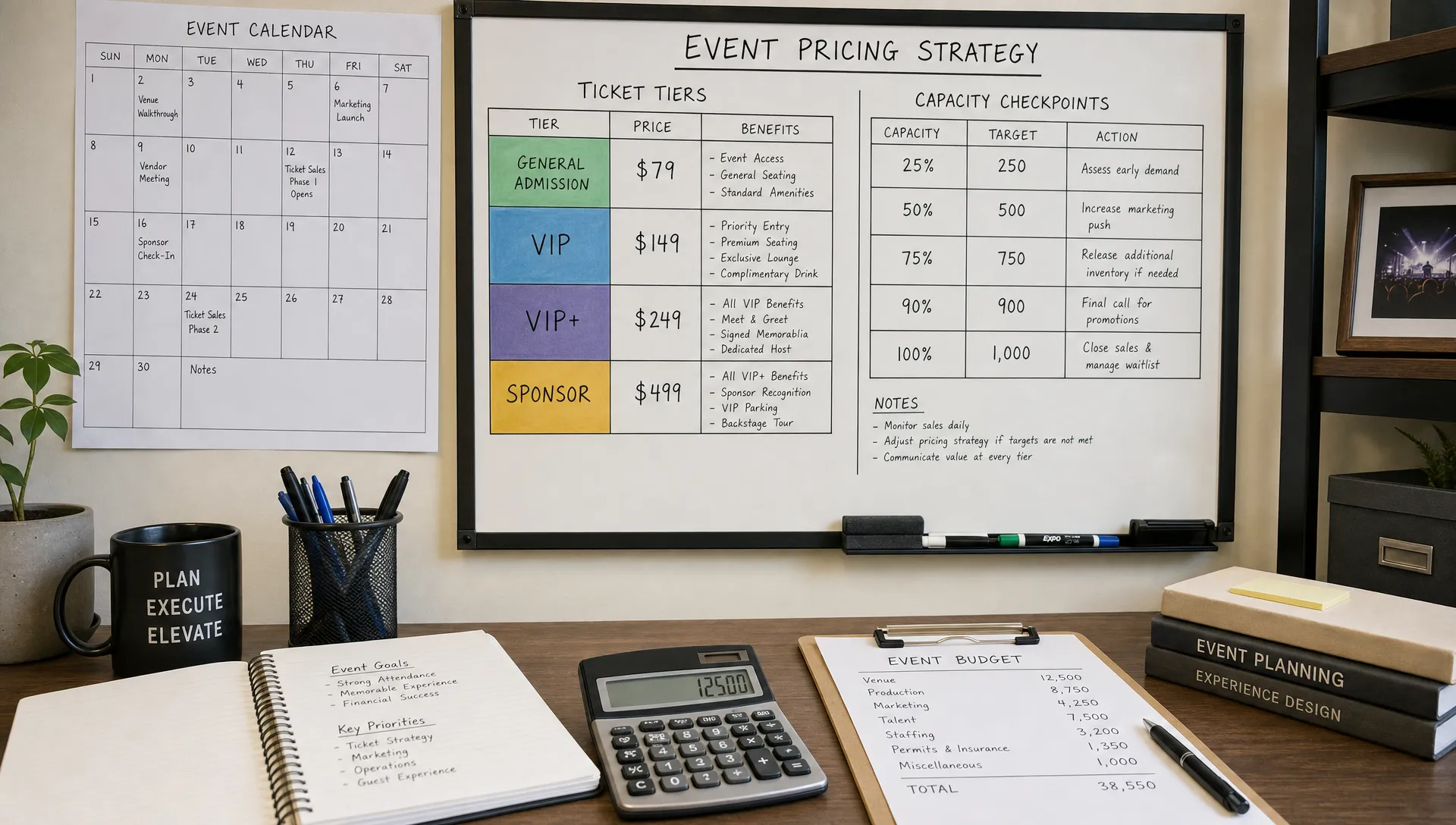
The best ticket pricing strategies for small events create a path: early supporters get rewarded, undecided buyers see rising urgency, and your team protects margin as demand becomes clearer.
Start with sell-out math, not a guess
Before you create early bird tickets or promo codes, calculate the minimum average ticket price you need. This does not mean every ticket must cost the same. It means your pricing structure needs to produce enough revenue if the event reaches realistic capacity.
A simple formula is:
Required average ticket price = total event costs + revenue goal, divided by realistic paid attendance
Use realistic paid attendance, not total room capacity. If your venue holds 150 people but you expect 10 guest list spots, 5 sponsor passes, and a few comps for partners, your paid capacity is closer to 135. That difference can change your pricing floor.
| Pricing input | What to calculate | Why it matters |
|---|---|---|
| Fixed costs | Venue, production, insurance, staff, permits | These costs stay mostly the same whether you sell 50 or 150 tickets |
| Variable costs | Food, materials, seating, wristbands, per-attendee supplies | These rise as attendance increases |
| Guest list and comps | Free or discounted admissions | These reduce the number of revenue-generating seats |
| Profit or reserve | Your target margin or safety buffer | This prevents a sold-out event from becoming a break-even event |
| Paid capacity | The number of tickets you can realistically sell | This is the denominator that makes pricing honest |
If you are still working through the basics, TixFlow has a deeper guide on how to price tickets for small events that covers the foundational calculations. Once your floor is clear, the next step is to design pricing that builds demand.
Build a ticket ladder that rewards early commitment
Small event buyers rarely purchase at the same time. Your closest fans, members, students, customers, or community will usually buy first. Casual attendees need more reminders, more proof, or a stronger deadline.
A ticket ladder lets you match price to buyer timing without making late buyers feel punished. The key is to make each tier simple and credible.
| Ticket tier | Best use | Design rule |
|---|---|---|
| Founding or community ticket | For loyal followers, members, or email subscribers | Keep quantity limited and position it as a thank-you, not a clearance sale |
| Early bird | For buyers willing to commit before social proof is visible | Use a clear deadline or quantity cap, preferably both |
| Standard admission | For the majority of attendees | Make this the true reference price for the event |
| Last-call ticket | For late buyers when capacity is limited | Use only if demand supports it, and avoid a jump that feels unfair |
| Premium or VIP ticket | For buyers who want extra value | Include real benefits, such as better seating, access, materials, or hospitality |
The goal is not to create a confusing menu. For most small events, three to five ticket options are enough. Too many tiers can slow the decision down, especially if the differences are not obvious.
A strong ladder might look like this for a 120-capacity event: 25 early bird tickets, 75 standard tickets, 20 last-call tickets, plus a small premium tier if the event can genuinely deliver extra value. This structure gives you early momentum while preserving revenue from buyers who decide later.
Use deadlines carefully, then keep your word
Early bird pricing works because it gives buyers a reason to act now. But it only works if your deadlines are believable.
If you extend every early bird deadline, your audience learns to wait. If you reopen a sold-out lower tier without explanation, you weaken trust. Small events often rely on repeat buyers and community reputation, so pricing credibility matters.
A better approach is to plan sales phases before launch. You might announce that early bird tickets are available until a specific date or until a set quantity sells out. When that phase ends, move forward. If you need a softer transition, offer a targeted promo code to a specific partner list rather than publicly reviving the old price.
Automated sales phases can help here because they remove manual pressure from the organizer. Instead of deciding emotionally when sales feel slow, you can set the structure in advance and let the event move through its planned pricing stages.
Price the value, not just the seat
A ticket is not only access to a room. It is an evening out, a learning outcome, a networking opportunity, a performance, a memory, or a connection to a community.
That is why your ticket price must match the value your event page communicates. If the page feels vague, even a low price can feel risky. If the page is specific and compelling, a higher price can feel reasonable.
Before discounting, improve the perceived value of the offer. Make sure buyers can quickly understand who the event is for, what is included, what makes it different, and why attending now is worthwhile.
| Event type | Value signals that support stronger pricing |
|---|---|
| Workshop or class | Clear learning outcomes, instructor credibility, materials included, limited seats |
| Music or nightlife event | Lineup, atmosphere, venue quality, time slot, community reputation |
| Networking event | Audience quality, format, host credibility, attendee curation |
| Food or tasting event | Menu details, chef or vendor names, portion expectations, exclusivity |
| Fundraiser or community event | Mission, impact, transparency, social experience |
This is especially important for premium tickets. Do not create a VIP tier just because you want a higher price point. Create it because a segment of your audience genuinely wants added value and you can deliver it clearly.
Use scarcity without sounding manipulative
Scarcity is powerful for small events because it is often true. There are only so many seats, tasting portions, workshop kits, tables, or venue spots. The mistake is exaggerating scarcity so heavily that it feels like a sales trick.
Use specific, factual scarcity instead. Show when a tier is limited. Communicate when capacity is close to full. Explain if the venue has a hard limit. Buyers respond better to clear information than to vague pressure.
Dynamic pricing can also work for small events, but it should be predictable. A price that rises as ticket inventory decreases is easier to accept than a price that changes randomly. If you want to go deeper on this model, TixFlow explains the mechanics in its guide to a dynamic ticket pricing strategy.
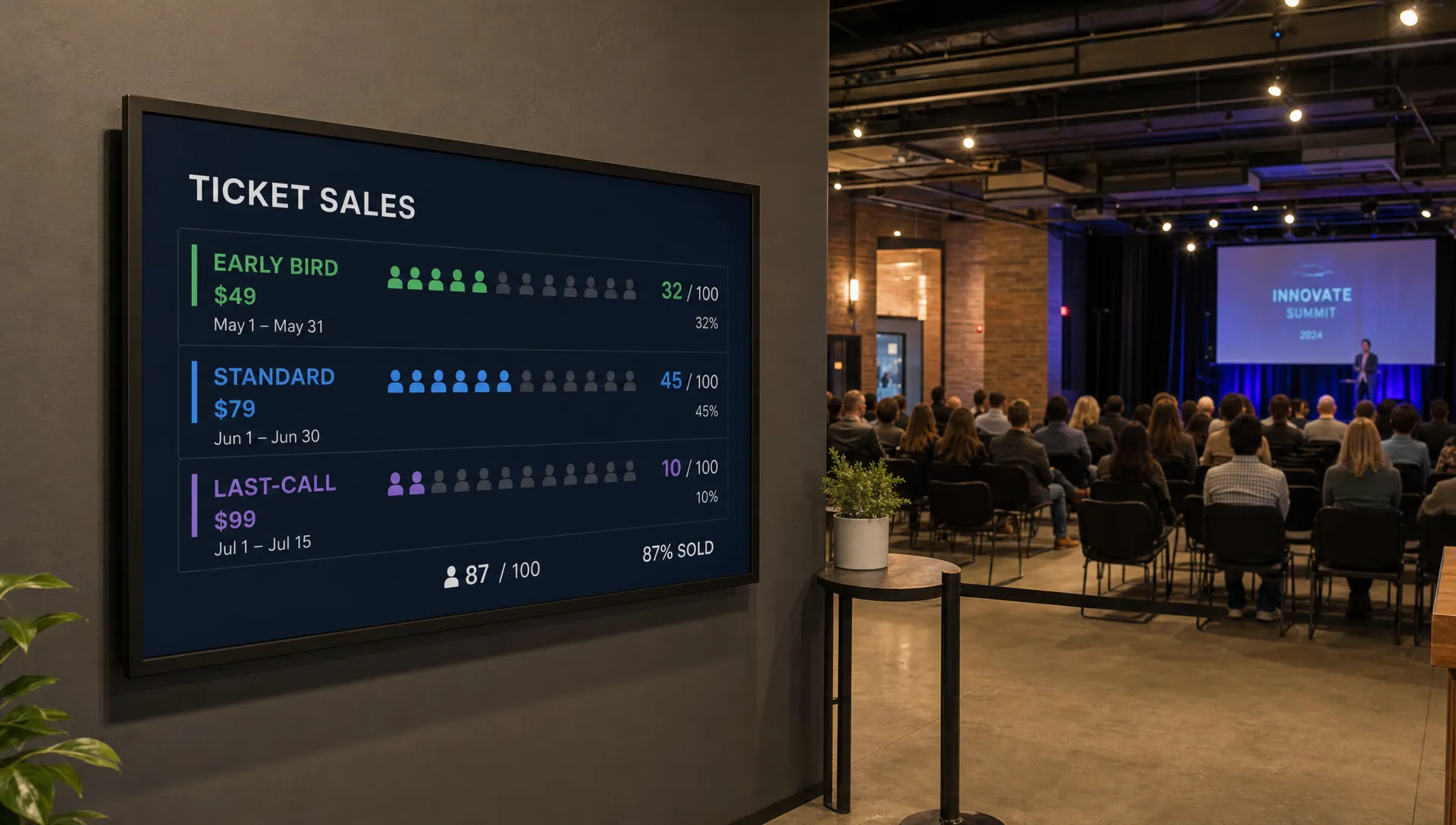
For small events, dynamic does not need to mean complex. It can be as simple as lower pricing for the first 25 tickets, standard pricing for the main allocation, and a final tier when fewer than 20 spots remain.
Make discounts targeted, not permanent
Discounts are useful when they change buyer behavior. They are risky when they train your audience to ignore the main price.
A blanket discount sent to everyone can weaken urgency, especially if it arrives shortly after launch. Buyers may wonder why they purchased early, or they may assume another discount is coming later. Targeted discounts are usually safer and more strategic.
Good discount use cases include partner codes, student or community access, group purchases, member perks, and limited-time reactivation for people who clicked but did not buy. Smart promo codes can help you measure which partners or channels actually drive sales, not just clicks.
The best promo codes have a purpose. A partner code should help you evaluate a partner. A group code should increase average order size. A student code should expand access without lowering the value for everyone. If you cannot explain what behavior the discount is meant to create, it may not belong in your pricing plan.
Decide how fees fit into the displayed price
Ticket fees are part of pricing, even if organizers think of them as separate. Buyers care about the final amount they pay, not the internal accounting category.
Unexpected fees can hurt conversion because they make the final price feel different from the advertised price. Checkout research from the Baymard Institute consistently identifies unexpected costs and checkout friction as major reasons people abandon online purchases. Event tickets are not immune to that behavior.
You have three common options:
| Fee approach | When it works | What to watch |
|---|---|---|
| Absorb the fee | Premium events, brand-sensitive experiences, simple pricing promises | Your margin is lower unless you account for it in the ticket price |
| Pass the fee to buyers | Budget-sensitive organizers, events with tight cost structures | The final checkout price must still feel fair and transparent |
| Blend the fee into pricing | Events that want a clean buyer experience and predictable margin | You need to calculate your ticket price carefully upfront |
There is no universal answer. What matters is that your fee strategy is intentional. Flat per-ticket fees can make planning easier because you can forecast costs more clearly across tiers. For a deeper revenue perspective, see TixFlow’s article on how to stop absorbing ticket fees without losing sight of the attendee experience.
Protect conversion at checkout
A great pricing strategy can still fail if the checkout process adds friction. This is especially true for small events, where buyers may be making a quick decision from a social post, email, or text message.
Every extra step gives them time to reconsider. Forced account creation, unclear final pricing, slow pages, too many required fields, and payment uncertainty can all reduce completed purchases.
For small events, checkout should feel almost invisible. The buyer should understand the ticket, see the final cost, pay quickly, and receive confirmation without unnecessary registration. This is why no buyer registration and a customizable checkout experience can support pricing performance, not just operations.
Think of checkout as the final part of your pricing strategy. If a buyer clicked because the price felt right, your job is to preserve that confidence until the ticket is confirmed.
Watch demand signals and adjust before it is too late
Small event organizers often wait too long to respond to sales patterns. By the time they realize pricing is off, there may be only a few days left to fix it.
Instead, set checkpoints before launch. Review sales after the first announcement, after the early bird phase, halfway to the event, and during the final week. You are looking for signals, not panic.
| Demand signal | What it may mean | Pricing move to consider |
|---|---|---|
| Early bird sells out very quickly | The first tier may be underpriced or your core audience is strong | Move confidently to standard pricing and avoid reopening the lower tier |
| Sales start strong then stall | Early supporters bought, but casual buyers need more proof | Improve event page value, add testimonials, or use targeted partner codes |
| Few sales after multiple promotions | Price may not match perceived value or audience fit | Rework positioning before discounting broadly |
| Strong sales with capacity remaining | Demand is healthy | Let the next tier activate or test a small premium option if value exists |
| 80% sold with time left | Scarcity is real | Communicate remaining availability and protect the final ticket price |
This is where real-time sales control becomes valuable. If you can see which tiers are moving, which codes are working, and when buyers drop off, you can adjust with discipline instead of guessing.
Common small-event pricing mistakes to avoid
Even experienced organizers can fall into pricing habits that make sell-outs harder. The most common mistakes are usually simple.
Avoid pricing every ticket the same from launch to door. This removes urgency and gives early buyers no reward. Avoid massive last-minute discounts unless you are willing to make future buyers wait for them. Avoid copying a competitor’s price without knowing their costs, audience, sponsor support, or capacity. Avoid adding premium tiers that do not include premium value. Avoid hiding fees until the final step of checkout.
Most importantly, avoid treating price as the only lever. If tickets are not selling, the issue may be positioning, timing, audience targeting, event-page clarity, checkout friction, or trust. Lowering the price can help in some cases, but it cannot fix every problem.
A simple sell-out pricing framework
If you want a practical starting point, use this framework for your next small event:
- Calculate your break-even average ticket price using paid capacity, not total capacity.
- Choose a standard ticket price that supports your revenue goal.
- Create a limited early tier that rewards fast action without damaging margin.
- Add a final tier only if capacity is limited and demand supports it.
- Use targeted promo codes for partners, groups, or access goals instead of blanket discounts.
- Decide your fee strategy before launch so the final price feels transparent.
- Review sales at planned checkpoints and adjust messaging before slashing prices.
This keeps your pricing simple enough for buyers and structured enough for your team.
Frequently Asked Questions
What is the best ticket pricing strategy for a small event? The best strategy is usually a simple tiered structure: a limited early bird tier, a standard tier that represents the true value of the event, and a final tier if demand and capacity justify it. The exact prices should be based on your costs, paid capacity, and audience expectations.
Should small events use early bird tickets? Yes, early bird tickets can work very well when they are limited and honest. Use a clear deadline or quantity cap, and avoid repeatedly extending the offer. The goal is to reward early commitment, not to discount indefinitely.
How much should I discount tickets? Discount only enough to motivate a specific behavior, such as group buying, partner promotion, or student access. Large public discounts can damage perceived value and encourage people to wait for a better deal.
Is it better to absorb ticket fees or pass them to buyers? It depends on your margin, audience, and positioning. Absorbing fees can create a cleaner buyer experience, while passing fees can protect organizer revenue. Either way, make the final price clear before checkout.
When should I raise ticket prices? Raise prices when a planned tier ends, when a quantity threshold is reached, or when demand clearly supports it. Buyers are more likely to accept increases when they are communicated upfront and tied to real scarcity.
Sell more tickets with pricing that stays under your control
Small events sell out when pricing, timing, and checkout all work together. You need flexible tiers, clear sales phases, transparent fees, and a buying experience that does not slow people down.
TixFlow is built for organizers who want that control without unnecessary complexity. With instant payouts, flat per-ticket fees, unlimited ticket tiers, automated sales phases, smart promo codes, customizable event pages, digital guest lists, and no buyer registration, you can create a ticketing flow that supports both revenue and conversion.
If your next event has limited capacity, do not leave pricing to guesswork. Build the path to sold out before the first ticket goes live.