

Ticket Sale Websites Should Show Where Every Order Came From
For event organizers, the sale is only half the story. The other half is knowing why it happened.
A ticket order might come from an Instagram story, a promoter’s WhatsApp group, an artist newsletter, a paid ad, a venue partner, a QR code on a poster or a returning fan who typed the link directly. If your ticketing platform shows only the final transaction, you see revenue but not the path that created it. That makes marketing harder to judge, partners harder to reward and future campaigns harder to improve.
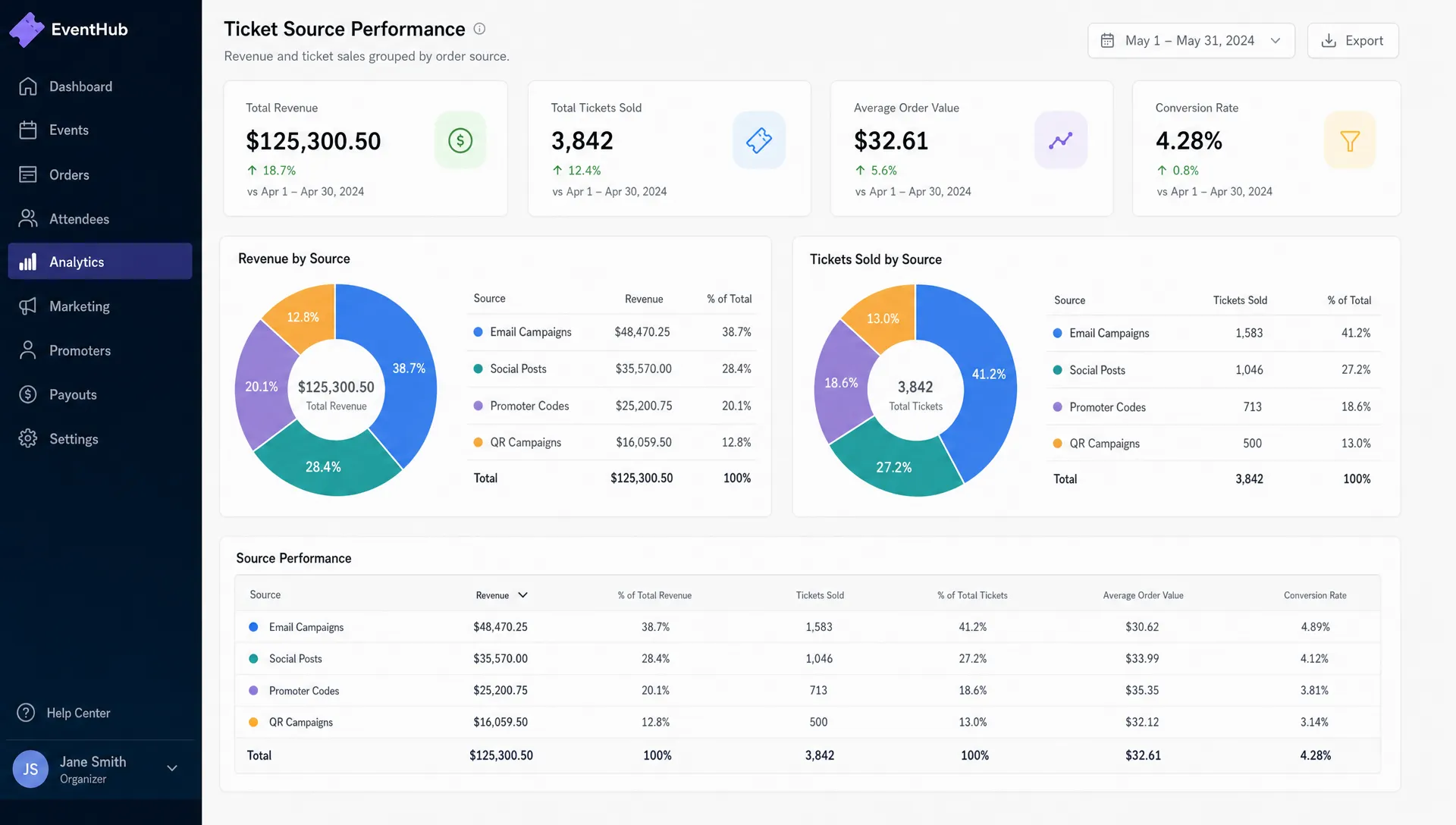
Modern ticket sale websites should show where every order came from because source data is no longer a “nice to have” report. It is operational information. It affects pricing, cash flow, ad spend, sales phases, promo strategy and even the relationships behind the event.
Order source tracking turns sales data into decisions
Most event teams already look at top-line numbers: tickets sold, revenue collected, capacity remaining and refund volume. Those numbers matter, but they do not explain what to do next.
If early bird tickets are selling fast, should you increase ad spend or move to the next tier? If sales slow down in week three, should you post more artist content, activate promoters or send another email? If VIP tables are selling but general admission is flat, is the problem price, audience targeting or the channel you are using?
Order source tracking helps answer those questions. Instead of treating every ticket sale as identical, it connects each purchase to the marketing touchpoint, link, code or channel that influenced it. That gives organizers a clearer view of what is actually moving buyers from interest to checkout.
For a music producer, that might mean discovering that a smaller DJ’s repost drove more paid orders than a bigger account with higher reach. For a festival team, it could reveal that email converts better for multi-ticket orders while social ads are better for first-time attendees. For a venue, it might show which recurring partners bring in buyers who purchase early enough to protect cash flow.
What “where every order came from” should mean
A ticketing dashboard should not reduce source tracking to a vague label like “social” or “web.” Organizers need attribution that is practical at the order level.
At minimum, ticket sale websites should help connect each order to signals such as:
- The campaign link or UTM parameters used to reach the ticket page
- The promo code, affiliate code or partner code attached to the purchase
- The referrer, such as a website, newsletter or social platform when available
- The ticket tier purchased and whether it was part of a timed sales phase
- The buyer’s order time, quantity and revenue contribution
- The checkout path, especially if buyers arrived from different landing pages
This does not require making attribution overly complex. In many event campaigns, the useful question is simple: which source produced this order, this revenue and this buyer behavior?
That clarity is especially important when teams use multiple promotional channels at once. A launch campaign might include early access emails, artist links, paid ads, street team QR codes and sponsor posts. Without order-level attribution, all those efforts collapse into one sales total. With attribution, each channel can be judged by its contribution.
Why source visibility matters for cash flow
Ticketing is not only a marketing function. It is a cash flow function.
Organizers often have venue deposits, artist advances, production invoices, security costs, staffing needs and marketing spend due before the event date. The timing of ticket revenue can determine whether the team can scale promotion confidently or has to slow down spending.
When a ticketing platform shows where orders come from, it becomes easier to understand which activities create fast, usable revenue. That matters for teams that need control over cash flow, not just a final settlement after the event.
For example, if a promoter code produces a strong burst of early orders, the organizer can keep that partner active and potentially assign more inventory or a dedicated offer. If paid ads drive traffic but buyers wait until the final week, the organizer might adjust the campaign objective, creative or price deadline. If a private email list drives high average order value, the team can prioritize list-building before the next event.
The point is not to obsess over every click. The point is to know which sources bring in money when it matters.
The real cost of invisible order sources
When source data is missing, organizers often rely on assumptions. The loudest partner gets credit. The largest social account looks most valuable. The campaign with the most likes feels successful. None of those signals reliably proves ticket revenue.
Invisible source data can create several costly problems.
| Problem | What happens without source visibility | What order-source data helps reveal |
|---|---|---|
| Misallocated marketing budget | Spend continues on channels that look busy but do not convert | Which channels produce paid orders and revenue |
| Partner disputes | Promoters, artists or affiliates argue over who drove sales | Which codes, links or campaigns generated orders |
| Weak pricing decisions | Tier changes are based on total sales only | Which sources respond to deadlines, discounts or VIP offers |
| Poor cash flow planning | Revenue timing feels unpredictable | Which channels drive early versus late purchases |
| Confusing post-event reviews | Teams remember activity, not performance | Which actions should be repeated next time |
For small teams, this can be the difference between growing responsibly and repeating expensive guesses. For larger teams, it can affect partner reporting, sponsorship value, artist negotiations and future venue planning.
Source tracking improves promo codes and partner campaigns
Promo codes are often treated as discounts first and tracking tools second. That is a missed opportunity.
A smart promo code can reveal which community, artist, street team, sponsor or content creator brought a buyer into the funnel. It can also tell you whether a discount actually changed behavior or merely reduced revenue from people who would have purchased anyway.
For example, a “FRIDAY10” code promoted through a general social post may look successful if it gets many redemptions. But if a partner-specific code sells fewer tickets at a higher average order value, that partner may be more valuable. A code attached to a final 48-hour campaign may create urgency, while a code released too early may train buyers to wait.
Ticketing software should make promo code performance visible in context, not buried in a spreadsheet. Organizers need to see the source, ticket type, order value and timing together. That is how a code becomes a decision tool rather than a generic discount.
If you are building the broader event page and offer structure around these campaigns, it also helps to think about how your listing presents tickets to buyers. Clear tier names, deadlines and checkout details can reduce confusion before source tracking ever comes into play, as covered in this guide on how to list tickets for sale without confusing buyers.
Multi-channel sales need one reliable source of truth
Many organizers promote across several surfaces at once. That is normal. The issue starts when every channel has its own partial version of the truth.
Instagram shows reach and link clicks. Email software shows opens and click rates. Ad platforms show conversions based on their own tracking windows. Promoters report screenshots. The ticketing dashboard shows orders. If those systems do not connect, the organizer has to stitch the story together manually.
A strong ticketing platform should become the revenue source of truth. It does not need to replace every marketing tool, but it should show which source was tied to each completed order. That lets teams evaluate channels using actual ticket sales, not vanity metrics.
This matters even more when selling tickets on multiple sites or through several partner pages. Splitting inventory can expand reach, but it can also fragment reporting. If you are considering a multi-site strategy, it is worth reviewing the operational tradeoffs in this breakdown of selling tickets on multiple sites before adding more channels than your team can measure.
Source data should be available while the event is still sellable
Post-event reporting is useful, but it is often too late. By the time the team reviews the campaign, the venue is empty, the marketing spend is gone and unsold inventory cannot be recovered.
Order source data is most valuable during the sales cycle. Real-time or near real-time visibility helps organizers adjust while there is still time to improve the outcome.
A practical dashboard should help answer questions like:
- Which source is driving today’s orders?
- Which campaign is selling higher-priced tickets?
- Which promo codes are active but underperforming?
- Which channel is creating traffic without checkout completion?
- Which source is helping move a slow ticket tier?
This is why real-time sales control matters. If an organizer can see source performance early, they can change pricing phases, pause weak offers, extend a high-performing campaign or give a partner more attention before momentum fades.
TixFlow is built around that kind of organizer control, with features such as real-time sales control, unlimited ticket tiers, automated sales phases, smart promo codes and customizable event pages. The goal is not just to sell tickets, but to give teams the visibility and flexibility needed to manage the sale as it happens.
Attribution should not make checkout harder
There is a trap in ticketing analytics: collecting more data can make the buyer experience worse.
If a platform requires buyers to create accounts, fill unnecessary fields or move through too many steps so the organizer can gather more information, conversion can suffer. The best source tracking happens quietly in the background, using campaign links, codes, referral signals and order metadata without adding friction to checkout.
For attendees, buying a ticket should feel instant and trustworthy. For organizers, the order should still arrive with useful context. Those two goals should work together, not compete.
This is especially important on mobile, where many event buyers come from social links, group chats or last-minute plans. Every extra field can interrupt intent. Ticket sale websites that force registration or slow the payment flow may collect more account data but lose buyers before the order is complete.
If you are evaluating conversion more broadly, source tracking belongs alongside checkout speed, price clarity and mobile usability. The same factors that make a ticketing site convert well also make its attribution more meaningful because the data is based on completed orders, not abandoned interest. For a deeper view, see what makes a high-converting ticketing website.
How order-source data helps after the event
Once the event ends, source data becomes a planning asset. It helps your team decide what to repeat, what to renegotiate and what to retire.
A useful post-event review should not only say “we sold 780 tickets.” It should show how those 780 tickets were distributed across sources, phases, tiers and timing. That turns the event into a playbook for the next one.
For example, the review may show that:
- Early access emails produced the highest revenue per order
- Partner links drove volume but mostly lower-priced tickets
- A final-week urgency campaign sold remaining general admission quickly
- VIP sales came mainly from direct traffic and returning buyers
- Paid ads were useful only after a strong organic launch established demand
This can also influence non-ticket operations. Some events sell merchandise, VIP packs, shipped wristbands or sponsor goods alongside admission. In those cases, order origin can help teams coordinate fulfillment and logistics with the same discipline used for ticket attribution. Product businesses often rely on partners like 3PL logistics services to connect order flow with warehousing and dispatch, and event teams with physical add-ons can learn from that same order-tracking mindset.
The more your ticketing data connects revenue to action, the easier it becomes to scale future events without rebuilding your strategy from scratch.
What organizers should look for in source reporting
Not every ticketing platform needs enterprise-grade attribution. Many event teams simply need clear, reliable order context that can be used quickly.
When comparing ticket sale websites, look for source reporting that is easy to interpret and tied directly to sales outcomes. A report is only useful if your team can act on it without needing a data analyst for every campaign.
| Source reporting feature | Why it matters for organizers |
|---|---|
| Order-level source visibility | Shows the origin of each purchase, not only aggregate traffic |
| Promo code and campaign tracking | Helps measure partners, discounts and audience segments |
| Real-time sales updates | Lets teams adjust campaigns before the event date |
| Ticket tier performance by source | Reveals which channels sell GA, VIP, group tickets or early bird tiers |
| Exportable or shareable data | Supports partner reporting and post-event reviews |
| Low-friction checkout | Keeps attribution from hurting conversion |
The most useful setup is usually simple: clear campaign links, well-named promo codes, organized ticket tiers and a dashboard that connects orders to their source. Complexity should serve the organizer, not bury them in reports.
A simple order-source framework for your next event
Before launching your next ticket page, define your source strategy. Do this before links go live, not after the first wave of traffic arrives.
Start by naming your main channels: direct, email, organic social, paid ads, artist partners, venue partners, street team QR codes, sponsors and affiliates. Then create a clear tracking convention for each campaign or partner. If you use promo codes, make them distinct enough to identify without confusion. If you use QR codes, assign them to specific locations or poster batches.
Next, connect those sources to the decisions you will make. If a source sells quickly, will you increase spend, extend the partner campaign or move to the next pricing tier? If a source produces clicks but no sales, will you change the landing page, the offer or the audience? If a partner drives high-value orders, will you give them more inventory or a better commission structure next time?
Finally, review source performance at set moments during the campaign. For example, check after launch day, after the first weekend, before each price change and during the final 72 hours. A few structured reviews are better than constantly reacting to noise.
Frequently Asked Questions
Why should ticket sale websites show where every order came from? They should show order sources because organizers need to know which campaigns, partners, links and promo codes actually create sales. This helps teams spend smarter, manage cash flow and improve future events.
Is order-source tracking the same as website analytics? Not exactly. Website analytics can show visits, clicks and traffic sources, but ticketing source tracking connects those signals to completed ticket orders, revenue, ticket tiers and purchase timing.
Do small events need source tracking? Yes. Small events often have tighter budgets and less room for guesswork. Knowing whether sales came from an artist post, an email list or a paid campaign can help a small team protect cash and avoid wasting promotion effort.
Can promo codes replace campaign tracking links? Promo codes help, but they should not be the only method. Some buyers forget codes or share them outside the original channel. Campaign links, referral data and promo codes work best together.
Should attribution make checkout longer? No. Source tracking should happen in the background whenever possible. A ticketing platform should reduce checkout friction for buyers while still giving organizers useful order context.
Better ticketing starts with better source visibility
Ticket revenue is more useful when you know what created it. For organizers, music producers and event teams managing tight cash flow, order-source visibility helps turn every campaign into clearer decisions before, during and after the event.
TixFlow gives organizers a modern ticketing foundation with instant payouts, flat per-ticket fees, no buyer registration, customizable event pages, real-time sales control, unlimited ticket tiers, automated sales phases, smart promo codes and digital guest lists. If you want a ticketing setup built for speed and control, start with TixFlow and give every order the context it deserves.