
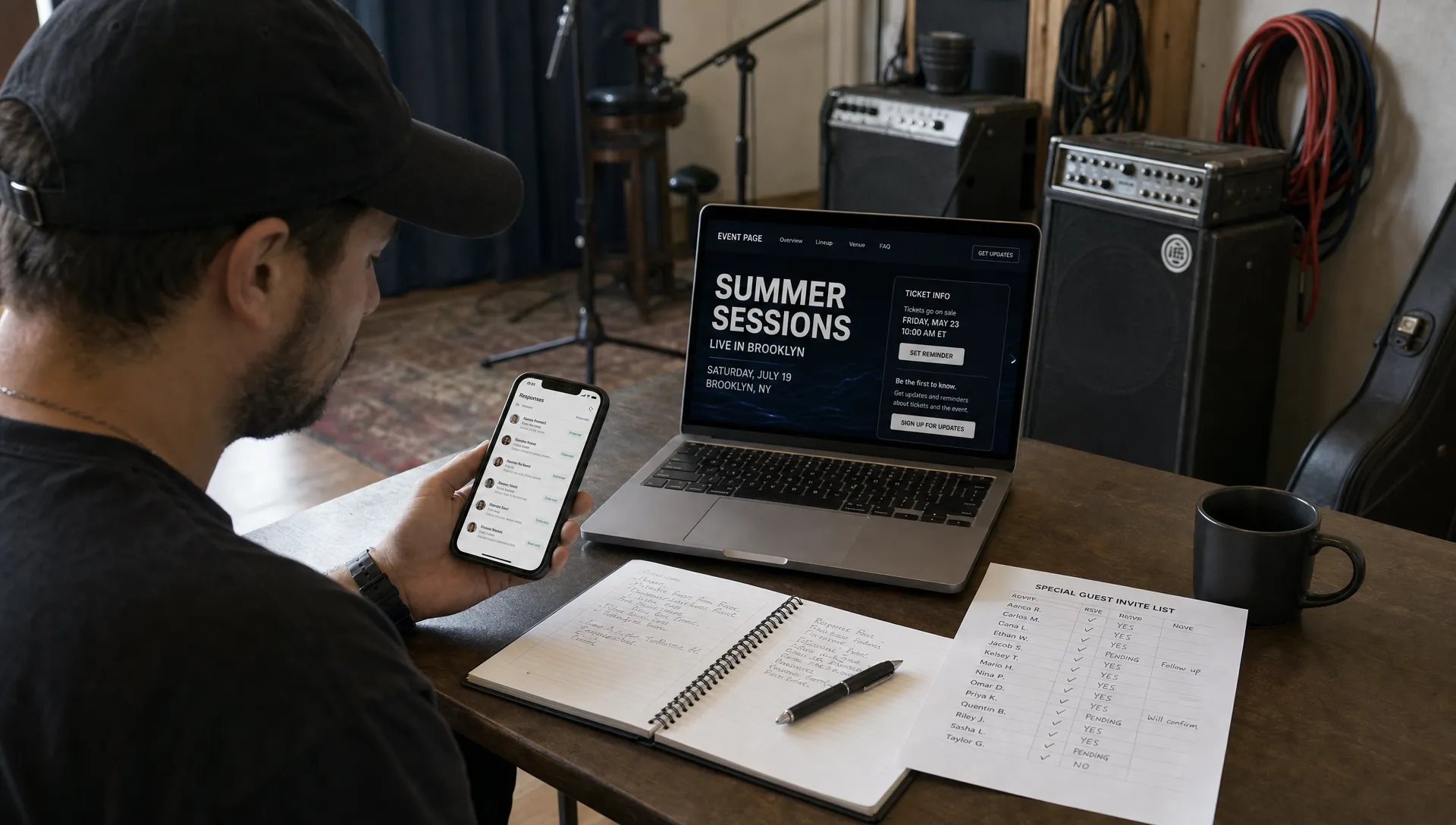
Sell Tickets for Your Event With a Pre-Launch Interest List
A strong ticket launch does not start when the checkout link goes live. It starts days or weeks earlier, when you learn who is likely to buy, why they care and what would make them act quickly.
That is what a pre-launch interest list gives you. Instead of announcing an event to a cold audience and hoping for momentum, you create a focused group of people who have already raised their hand. For event organizers, music producers, venue teams and community hosts, this can make the difference between a slow opening week and a launch that creates visible demand from day one.
A pre-launch interest list is not just an email list. It is a demand signal, a messaging test and a cash flow planning tool. Used well, it helps you sell tickets for your event with more confidence because your first buyers are already warmed up before tickets open.
What a pre-launch interest list actually does
A pre-launch interest list collects potential buyers before tickets are available. People join because they want first access, a reminder, a special price, limited tickets or more information before making plans.
The goal is not to collect the largest possible audience. The goal is to identify the people most likely to buy early.
That distinction matters. A general follower count tells you reach. An interest list tells you buying intent. If 300 people like a flyer, that is useful visibility. If 90 people give you an email or phone number to get first access, that is much closer to demand.
For organizers who care about cash flow, early demand data is practical. It can help you decide how many early tickets to release, whether to add a VIP tier, how hard to push a second announcement and whether your price is creating hesitation. If you are still shaping the overall offer, it pairs well with building a simple sales plan for your ticketed event before the public campaign begins.
Build the list around intent, not curiosity
The wording of your sign-up prompt determines the quality of your list. A vague call to action such as join our newsletter attracts passive interest. A specific promise attracts people closer to purchase.
For an event, the strongest pre-launch prompts usually include one of these angles:
- First access to tickets before the public sale
- A limited early price for people on the list
- Priority access to a small capacity event
- A reminder before a sales phase ends
- A chance to vote on a time, lineup detail or add-on
The key is to make the action feel connected to buying. If someone joins because they want a general update, they may not convert. If they join because they want first access to 50 early tickets, they have already imagined purchasing.
Keep the form short. Ask for what you will actually use. For most events, email, first name, preferred ticket type and expected group size are enough. If your event has multiple cities, sessions or showtimes, ask for preference. If you plan to send SMS reminders, get clear consent before messaging.
| Information to collect | Why it matters | How to use it |
|---|---|---|
| Email address | Lets you send the launch link directly | Send first access and follow-up reminders |
| Preferred ticket type | Reveals demand by tier | Adjust early bird, general admission or VIP quantities |
| Expected group size | Shows potential order value | Write messaging for pairs, crews or teams |
| City or date preference | Helps with multi-date planning | Segment announcements by location or session |
| Main reason for interest | Identifies the strongest hook | Improve copy, creative and sales messages |
You do not need a long survey. In fact, too many questions can reduce sign-ups. The list should feel like a quick hand raise, not a full application.
Give people a reason to join before tickets are live
A pre-launch list works best when it offers a clear advantage. People are more likely to sign up when they understand what they get and when they will get it.
For a producer showcase, that advantage might be first access before the public post goes live. For a workshop, it might be a limited founder price. For a club night, it might be early entry tickets or a lower first-wave price. For a conference, it might be the first chance to choose a session or add a premium experience.
The incentive does not always need to be a discount. Discounts can train buyers to wait for cheaper prices if they are overused. Early access, limited capacity, a better ticket tier or a bonus experience can create urgency without cutting into revenue.
A good pre-launch promise sounds specific:
- Get the private ticket link 24 hours before public launch
- Join the list for first access to the first 100 early tickets
- Get notified when VIP tables open
- Be first to claim limited producer pass pricing
Avoid overpromising. If everyone on the list is told they have exclusive access, but the same link is posted publicly at the same time, trust drops. Treat the list like a real priority group.
Capture interest in the places where demand already exists
Do not wait for people to find a landing page on their own. Place the interest list wherever your audience is already paying attention.
Your best capture points usually include social bios, pinned posts, artist and partner pages, short-form video captions, email signatures, venue screens, QR codes at related events and DMs after someone asks about details. If you work with artists, speakers or collaborators, give them the same short sign-up link and a few approved lines of copy so the message stays consistent.
For music events, the best sign-ups often come from moments of high emotion. A clip from rehearsal, a lineup tease, a behind-the-scenes beat breakdown or a venue reveal can outperform a polished flyer because it makes people feel closer to the event. Add the list link while the audience is reacting.
If your planning notes are scattered across artist bios, interviews, PDFs, comments and long reference materials, an AI-powered reading companion that helps turn content into clearer understanding can help you extract the themes, questions and language worth using in your pre-launch messaging.
The more specific your capture moment, the better your list quality. Someone who signs up after seeing a lineup teaser is usually warmer than someone who signs up from a generic homepage banner.
Warm the list before you ask for the sale
Many organizers collect interest, then disappear until launch day. That wastes the attention they earned.
A pre-launch list should receive a short warm-up sequence. The goal is not to flood inboxes. The goal is to make the buying decision feel easy by the time tickets open.
A simple sequence can look like this:
| Timing | Message goal | Example angle |
|---|---|---|
| 7 to 10 days before launch | Confirm the event promise | The date, venue and reason this event is worth saving |
| 3 to 5 days before launch | Build confidence | Lineup detail, host note, capacity reminder or past proof |
| 24 hours before launch | Set the buying moment | First access starts tomorrow at a specific time |
| Launch moment | Send the direct purchase path | Private link, ticket tiers and what sells first |
| 24 to 48 hours after launch | Convert undecided buyers | Remaining early tickets, price change or social proof |
Keep each message focused on one action. If launch day is about buying early access tickets, do not also ask people to follow three pages, watch a video and fill out a second form. Attention is limited. Spend it on the sale.
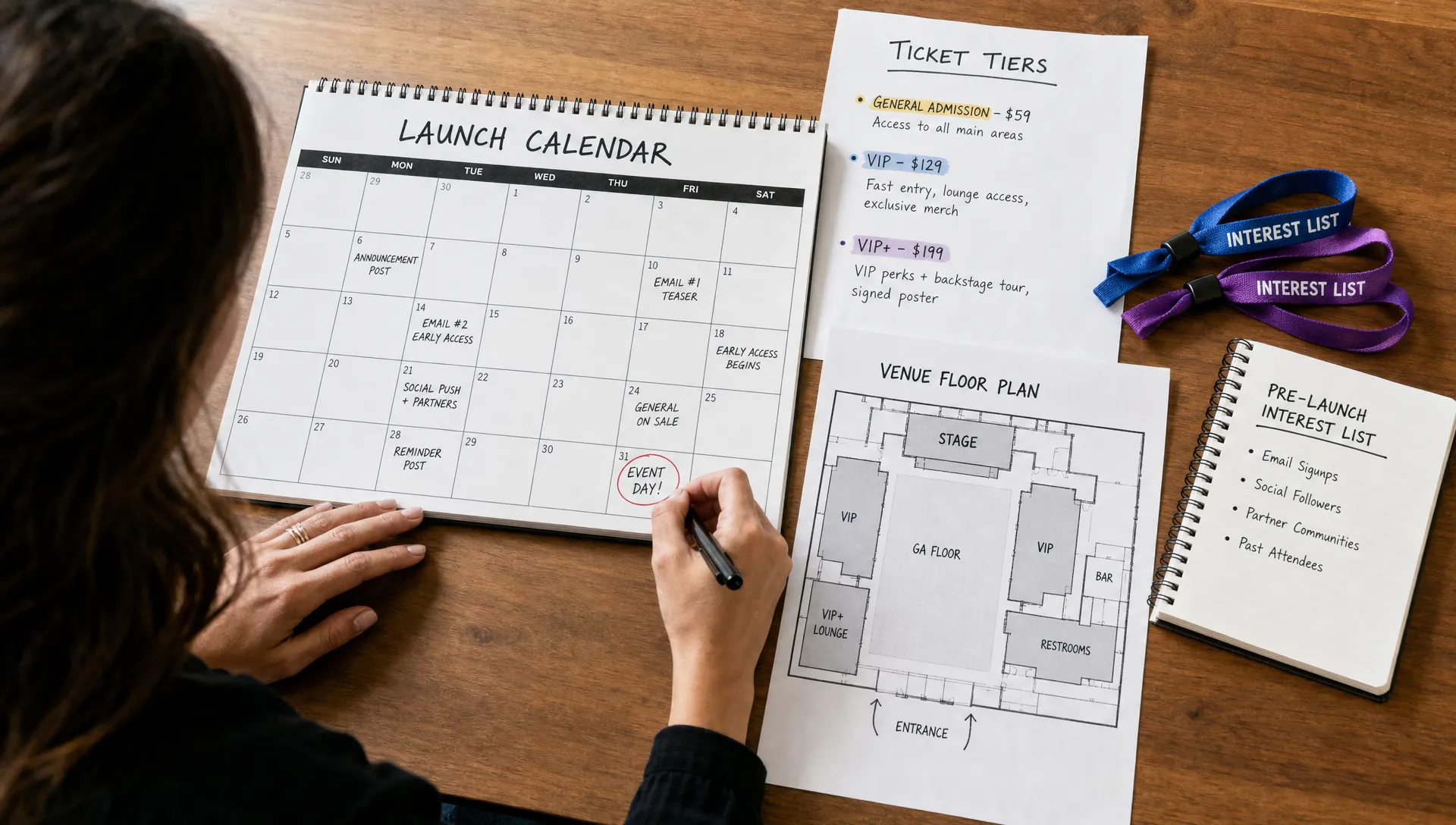
Use the list to design your first ticket release
The list gives you clues about how to structure your opening sale. If most sign-ups are solo buyers, a simple early general admission tier may work. If many people indicate a group size of three or four, bundles or group promo codes may be worth testing. If a high share of the list asks about premium access, you may need a clearly defined VIP or priority tier.
This is where your sales phases matter. You can open with a limited early access phase, then move into general sale once that initial demand is captured. If you need help choosing the right timing, review how to set ticket sale dates for maximum momentum before locking your campaign calendar.
A strong first release usually has three qualities.
First, it is easy to understand. Buyers should know what they are getting, what it costs and why acting now matters.
Second, it has a real limit. That limit might be quantity, time, price or access. Fake urgency is risky because audiences notice when deadlines are constantly extended.
Third, it leaves room for the rest of the campaign. Do not give away your entire pricing strategy in the first wave. The pre-launch list should create the first burst of sales, not exhaust every future announcement.
With a platform like TixFlow, organizers can set unlimited ticket tiers, use automated sales phases and create smart promo codes without building a complicated manual system. That matters when you want the interest list to receive one offer, partners to receive another and the public sale to open later with clean controls.
Make the launch link frictionless
The fastest way to lose a warm buyer is to make them work too hard after they click. Pre-launch interest creates motivation, but checkout friction can still stop the order.
Before sending the launch link, test the full path from a phone. Most buyers will come from mobile social apps, email or text. The event page should answer the basic decision questions quickly: what it is, where it is, when it happens, who it is for and which ticket to choose.
Your checkout should not create unnecessary steps. TixFlow supports no buyer registration, which helps reduce friction for attendees who are ready to purchase. For organizers, customizable event pages, real-time sales control, Stripe Connect integration and digital guest lists help keep the sale connected to operations after the order is complete.
This is especially important for small and mid-sized events where every early buyer counts. If the first 30 people from your list complete checkout smoothly, you have momentum, social proof and cash coming in. If they get confused, you may need to spend the next week recovering demand that was already there.
For a deeper look at the sales page itself, you can also improve the way you turn event listing views into ticket sales before your pre-launch list receives the link.
Measure the list before and after launch
A pre-launch list is valuable because it gives you numbers to work with. You do not need complex analytics to learn from it. Track a few simple metrics and use them to make decisions.
The most useful metrics are:
- Sign-ups per announcement, which shows which channel or creative creates real interest
- List conversion rate, which compares paid orders from the list against total valid sign-ups
- Time to first 25 or 50 orders, which shows launch speed
- Ticket tier demand, which shows whether your offer matches buyer expectations
- Drop-off questions, which come from replies, DMs and support messages before purchase
Do not treat low conversion as failure without context. Sometimes the list reveals a fixable issue. Maybe people want a later entry time. Maybe the ticket description is unclear. Maybe the price is fine, but buyers are waiting to coordinate with friends. These are useful insights if you catch them early.
The best organizers use the list as a feedback loop. They do not rewrite the entire campaign every time one person has a concern, but they do notice repeated patterns. If ten people ask whether tickets are transferable, answer that clearly on the event page. If several people ask when the headliner plays, add schedule expectations if you can share them.
Common mistakes that weaken a pre-launch list
The first mistake is opening the list too early without a follow-up plan. If you collect interest six weeks before launch and stay silent, attention cools. Open the list when you have enough confirmed information to communicate consistently.
The second mistake is using the same message for every segment. Someone who wants VIP access may need a different launch reminder than someone waiting for the lowest general admission price. Even basic segmentation can improve relevance.
The third mistake is making the public launch feel better than the list offer. If list members get no advantage, they may ignore the next pre-launch campaign. Protect the value of joining early.
The fourth mistake is relying only on hype. Hype can start attention, but clear details close sales. Capacity, timing, ticket tiers, venue location, age policy, refund policy and lineup information all reduce hesitation.
The final mistake is waiting too long to convert. Interest is perishable. Once people raise their hand, give them a clear next step and a specific moment to act.
A simple pre-launch interest list plan
If you want a practical starting point, use a 14-day structure.
Days 1 to 3 are for setting the offer. Confirm your event page basics, ticket tiers, list incentive and launch date. Decide what list members get that the public does not.
Days 4 to 10 are for capturing demand. Promote the list through your strongest channels. Use creator posts, partner announcements, short videos, QR codes and direct replies. Track which sources produce the most sign-ups.
Days 11 to 13 are for warming the list. Send a short reminder sequence that explains why the event matters, what ticket options will open and when the private link will arrive.
Day 14 is launch day. Send the direct purchase link first to the list, monitor sales in real time and be ready to answer buyer questions quickly. After the first wave, use sales data to decide whether to extend a phase, move to public sale or adjust messaging.
TixFlow is built for this kind of controlled launch. Instant payouts help organizers manage cash flow, flat per-ticket fees keep costs predictable and real-time sales control lets teams respond as demand changes. Combined with low-friction checkout and flexible ticket setup, a pre-launch interest list becomes more than a marketing tactic. It becomes the first stage of your sales operation.
Frequently Asked Questions
How long before my event should I start a pre-launch interest list? For many small and mid-sized events, 2 to 4 weeks before tickets open is enough. Larger events, conferences or multi-city campaigns may benefit from a longer warm-up, but only if you can keep the list engaged.
Should I offer a discount to people on the interest list? Not always. Early access, limited quantity, better ticket selection or a bonus experience can work without lowering price. Use discounts when they support your margin and create a clear reason to buy early.
What is a good conversion rate for an interest list? There is no universal number because event type, price, audience trust and urgency all matter. Compare each campaign against your own past results, then improve the sign-up source, launch message and checkout flow.
Can I use a pre-launch list for a small audience? Yes. In fact, small audiences often benefit the most because every warm buyer matters. A focused list of 40 serious prospects can be more valuable than thousands of passive impressions.
What should I send on launch day? Send a short message with the direct ticket link, the key ticket options, the deadline or quantity limit and one clear reason to buy now. Avoid adding extra distractions in the launch message.
Turn early interest into paid orders
A pre-launch interest list gives you a cleaner path from attention to revenue. It helps you validate demand, shape your first ticket release and create a launch moment that feels organized rather than rushed.
If you want to sell tickets with flexible tiers, automated phases, smart promo codes, instant payouts and checkout that does not require buyer registration, build your next event on TixFlow. Start with the list, launch with control and give buyers the shortest path from interest to confirmed ticket.