
How to Choose the Right Type of Ticket for Any Event
Choosing the right type of ticket is not just an admin task. It is one of the clearest ways to shape demand, protect your margins, and make the buying experience feel obvious to your audience.
A small workshop, a club night, a conference, and a fundraiser all need different ticket structures. The mistake many organizers make is starting with labels such as Early Bird, VIP, or General Admission before deciding what those tickets are supposed to achieve. A better approach is to start with the event goal, then build a ticket mix that supports it.
The right type of ticket should answer four questions at once: who is this for, why would they buy now, what value do they receive, and how does this help the event’s cash flow or operations?
Start with the job your ticket type needs to do
Before creating tiers, step back from the checkout page and look at the event as a business decision. Every ticket type should have a job. If it does not change buyer behavior, improve logistics, increase revenue, or make the event easier to manage, it may not need to exist.
For example, an early bird ticket is not just a cheaper ticket. Its job is to create urgency, validate demand, and bring in cash before final production costs are due. A VIP ticket is not just a more expensive ticket. Its job is to capture higher willingness to pay from attendees who want a better experience. A free RSVP ticket is not just a zero-dollar option. Its job is to estimate attendance, build a list, and reduce uncertainty.
If you want a full overview of common formats, TixFlow’s guide to event ticket types explained for organizers is a useful primer. This article focuses on the next step: choosing the right structure for your specific event.
A strong ticket setup usually supports one or more of these outcomes:
- Demand creation: Encourage people to commit early or bring friends.
- Revenue protection: Avoid discounting too heavily or giving away premium value.
- Audience segmentation: Give different buyer groups a clear reason to choose different options.
- Operational clarity: Make check-in, capacity planning, and guest access easier.
- Cash flow control: Bring revenue in earlier and reduce dependence on last-minute sales.
When a ticket type does not support any of these goals, it often adds confusion. Confusion is expensive because buyers hesitate, compare too many similar options, or abandon the purchase altogether.
Match the ticket type to attendee intent
The best ticket structures reflect how attendees think. Most buyers are not analyzing your pricing strategy. They are asking simple questions: Is this worth it? Should I buy now? Do I need the better option? Can I come with my group?
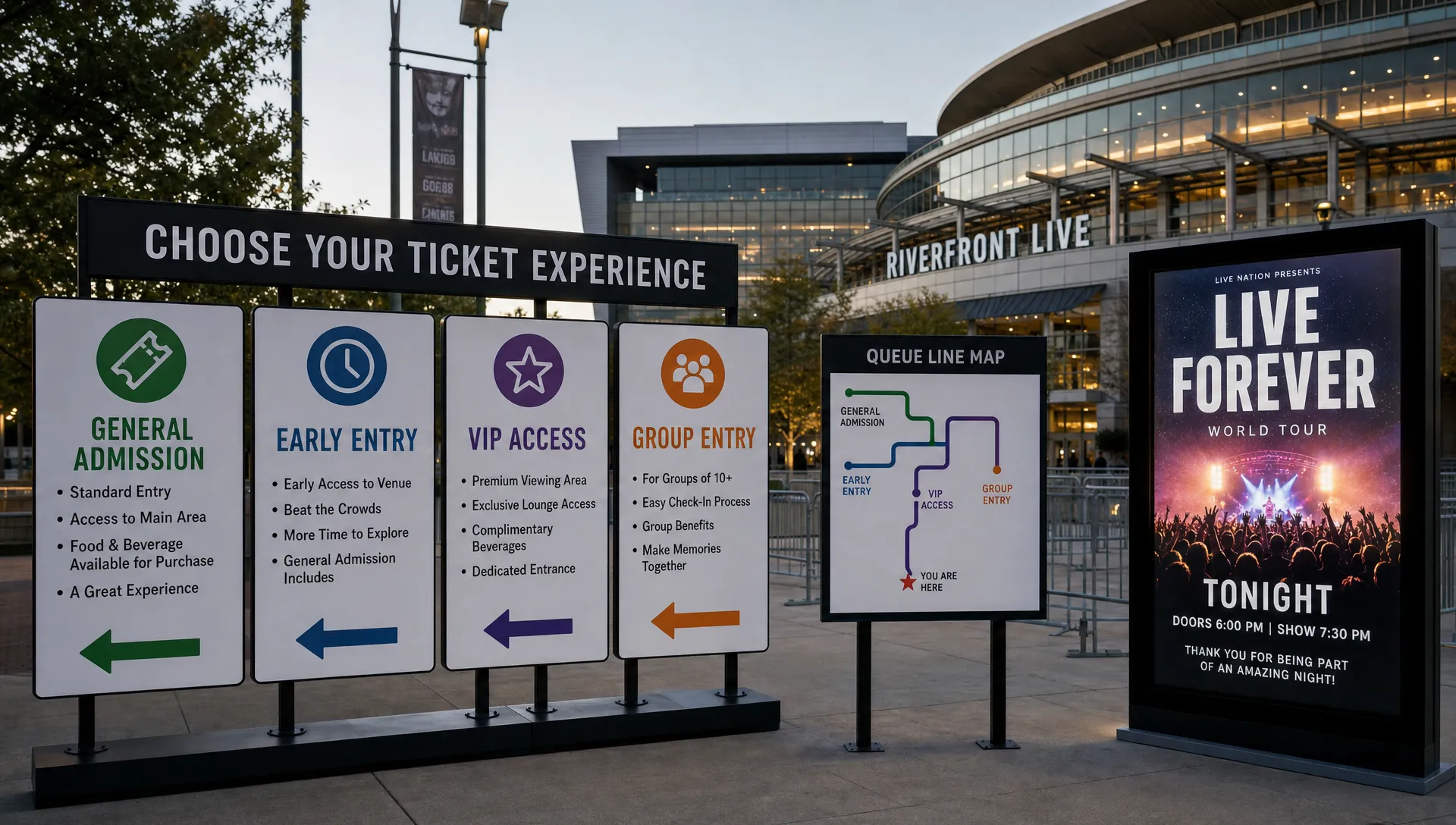
General admission works when the main value is entry. It is usually the cleanest default for concerts, club nights, community events, comedy shows, workshops, and many small conferences. It gives buyers a simple yes-or-no decision.
Early bird tickets work when your audience needs a reason to act before the event date gets close. They are especially useful when you have upfront costs, such as venue deposits, artist fees, production, staffing, or marketing spend. The discount should be meaningful enough to motivate action but not so deep that it trains people to wait for bargains.
Tiered release tickets work well for demand-driven events. Instead of changing the experience, each release changes the price as the event gets closer or as inventory sells. This is common for music events, nightlife, festivals, and high-demand community gatherings. The value is urgency: the earlier you commit, the better the price.
VIP or premium tickets make sense when the experience is genuinely different. Better seating, priority entry, backstage access, meet-and-greet access, reserved tables, premium hospitality, or exclusive areas can justify a higher price. If the VIP ticket is mostly the same as standard admission, buyers may see it as a markup rather than an upgrade.
Group tickets work when attendance is social. If people are likely to come with friends, colleagues, classmates, or teammates, a group ticket can increase order size and reduce the effort needed to sell each seat. This can be powerful for music producers, club promoters, fitness events, student events, and local cultural nights.
Free tickets or RSVP tickets work when attendance growth matters more than direct ticket revenue. They can be useful for launch parties, brand activations, community meetups, open houses, and lead-generation events. The risk is no-shows, so free ticketing works best when you understand expected drop-off and avoid overcommitting capacity.
Build your ticket stack from the event goal
A ticket stack is the set of ticket options buyers see at checkout. It should be simple enough to understand in seconds but flexible enough to match your audience. If you are unsure where to begin, start with the event’s primary goal.
| Event goal | Better ticket choice | Why it works |
|---|---|---|
| Sell faster before production costs are due | Early bird plus standard admission | Creates urgency and improves cash flow before the event |
| Maximize revenue from high-intent fans | General admission plus VIP or premium access | Captures higher willingness to pay without raising the base price for everyone |
| Encourage social attendance | Individual ticket plus group bundle | Increases average order size and makes sharing easier |
| Manage limited capacity | Timed entry, session-based tickets, or release-based tiers | Helps control attendance flow and avoid overcrowding |
| Build an audience list | Free RSVP or low-cost entry | Reduces the barrier to commitment and supports future promotion |
| Serve different budgets | Standard ticket plus limited discounted tier | Keeps the event accessible without devaluing the core ticket |
This is where pricing and ticket type overlap. The label tells the buyer what they are getting, but the price tells them how to evaluate it. If two options are too close in value or price, buyers may freeze. If the difference is obvious, the decision feels easy.
For a deeper look at the pricing side, see this guide on how to build an event pricing strategy that fits your crowd. The most effective ticket type is usually the one that matches both your audience’s intent and your financial reality.
Use ticket types to protect cash flow
For organizers and music producers, cash flow can be just as important as total sales. An event that sells well in the final 48 hours can still create stress if supplier payments, deposits, marketing costs, or artist fees are due earlier.
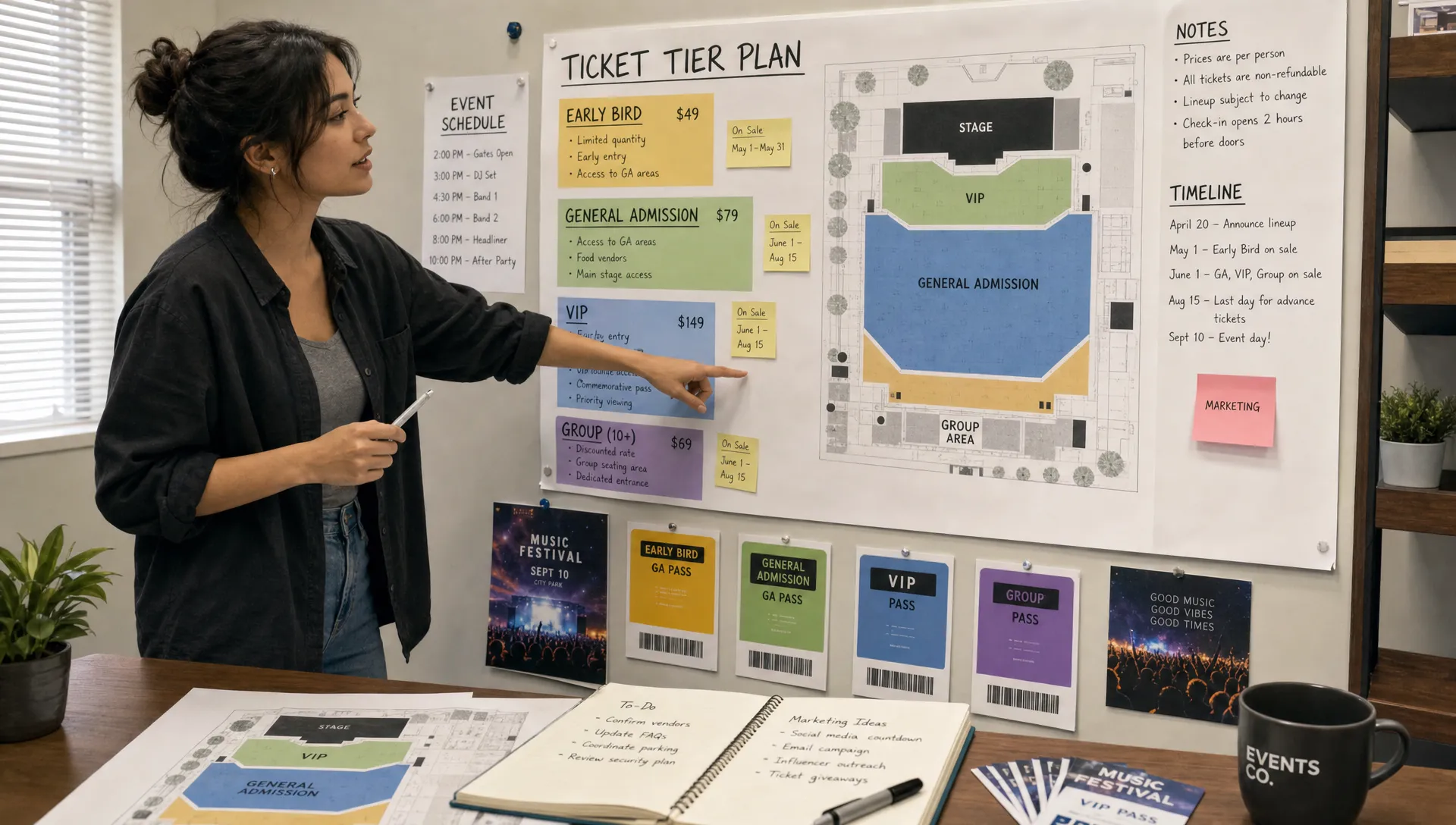
This is why ticket timing matters. Early bird tickets, limited first releases, and scheduled price increases can help bring cash into the event earlier. They also give you useful signals. If early demand is weak, you still have time to adjust marketing, partners, lineup communication, or promo strategy.
Promo codes can also support cash flow when used carefully. A targeted code for a partner, artist fanbase, student group, or previous attendee list can drive action without publicly lowering the perceived value of the event. The key is to avoid constant blanket discounts, which can teach buyers that the listed price is not real.
A practical setup might look like this: launch with a limited early bird allocation, move automatically into standard admission, hold a small VIP or premium allocation for high-intent buyers, and use smart promo codes for selected communities. This keeps the public offer clean while giving you flexibility behind the scenes.
Keep checkout choice simple
More ticket types do not automatically mean more revenue. In many cases, too many options make the buyer work harder. When someone lands on your event page, they should understand the right choice quickly.
A good rule is to create only as many ticket types as you can explain clearly in one short line each. If a buyer needs to compare five nearly identical tickets, the structure is probably too complex.
Strong ticket names are specific and benefit-focused. Standard Admission is clearer than Tier 2 if the experience is the same. VIP Entry with Priority Access is clearer than Premium if the main benefit is faster entry. Group of 4 is clearer than Bundle A.
Your ticket descriptions should answer the buyer’s practical questions:
- What does this ticket include?
- Is the price lower because I am early, or because the experience is different?
- Is this ticket limited by time, quantity, seating area, or attendee type?
- What happens at check-in?
- Are there age, ID, refund, transfer, or arrival requirements?
Clarity at checkout matters because buyers are often on mobile, distracted, or buying under time pressure. If they need to create an account, decode vague tiers, or search for basic details, you increase friction at the worst possible moment.
Choose the right type of ticket by event format
Different event formats usually have different default ticket structures. You can adapt these, but they are useful starting points.
| Event format | Strong starting ticket stack | What to avoid |
|---|---|---|
| Club night or concert | Early bird, first release, general admission, VIP or table option | Too many price releases with no clear difference |
| Workshop or class | Standard admission, limited student or member ticket, optional group ticket | VIP tiers unless there is a real premium experience |
| Conference or summit | Single-day pass, full access pass, premium pass | Making every session a separate decision unless capacity requires it |
| Fundraiser or gala | Standard ticket, supporter ticket, sponsor or table ticket | Hiding the donation value or making benefits unclear |
| Community meetup | Free RSVP or low-cost ticket | Unlimited free tickets without planning for no-shows |
| Festival or multi-act event | Tiered releases, day passes, premium access | Underpricing early tiers so heavily that later tiers feel unfair |
| Small private event | Invite-only ticket, guest list, limited paid allocation | Public ticket options that do not match the event’s access rules |
For music events in particular, the ticket structure should reflect fan behavior. Fans of a specific artist may buy early, while casual attendees may decide closer to the date. A release-based structure lets you reward early commitment while still capturing later demand.
For business events, the decision often depends on budget approval and perceived professional value. In that case, early bird pricing can work, but the ticket page also needs to make the outcomes clear: networking, learning, access, certification, or direct business benefit.
For community events, simplicity often wins. A free RSVP or low-cost general admission ticket can be enough, especially if the main goal is turnout rather than monetization. If you add paid tiers, make the reason obvious.
Check the operational impact before you launch
Every ticket type creates an operational promise. If you sell VIP entry, someone needs to manage VIP entry. If you sell timed tickets, someone needs to control arrival windows. If you sell group tickets, your door team needs a clear check-in process.
Before publishing the event, review each ticket type from the perspective of the team working the door. Can they identify the ticket quickly? Do they know what access it grants? Is the guest list organized in a way that supports the structure? Are capacity limits clear?
This is also where real-time control matters. If a tier sells faster than expected, you may need to pause, adjust, or move to the next phase. If a promo partner drives unexpected demand, you need visibility before capacity becomes a problem. If VIP is underperforming, you may need to adjust messaging rather than lowering the price immediately.
Good ticket management prevents small setup decisions from becoming event-day problems. For more practical planning advice, TixFlow’s article on ticket management tips that keep events running smoothly covers the operational side in more detail.
A simple framework for choosing ticket types
If you are building your ticket structure from scratch, use this five-step framework.
- Define the event goal: Decide whether the priority is revenue, attendance, community growth, early cash flow, premium experience, or capacity control.
- Identify buyer segments: Separate people by intent, not just demographics. Early fans, casual attendees, groups, VIP buyers, members, and sponsors may need different options.
- Choose the fewest useful ticket types: Start with the minimum structure that supports your goals. Add tiers only when they create clear value.
- Set rules for timing and quantity: Decide when each ticket type starts, ends, sells out, or moves to the next phase.
- Test the checkout experience: Read the page as if you were an attendee. If the best option is not obvious, simplify the structure.
This framework works because it keeps the ticket decision connected to the event strategy. Instead of copying another organizer’s setup, you choose ticket types based on your audience, your costs, and your operational capacity.
Frequently Asked Questions
What is the best type of ticket for a small event? For most small paid events, standard general admission is the best starting point. You can add an early bird tier if you need earlier cash flow or a group ticket if people usually attend together.
How many ticket types should an event have? Many events work best with two to four clear options. More can work for conferences, festivals, or complex access levels, but every ticket type should have a distinct purpose.
Should I offer early bird tickets? Early bird tickets make sense when you want to reward early commitment, validate demand, or bring in cash before major costs are due. Keep the allocation limited so the discount does not weaken your standard price.
When should I use VIP tickets? Use VIP tickets when you can offer a real difference in experience, such as priority entry, premium seating, exclusive access, reserved tables, or hospitality. Avoid VIP labels that do not include clear added value.
Are free tickets a good idea? Free tickets are useful for audience building, community events, launch parties, and RSVP tracking. They are less useful when you need reliable attendance or upfront revenue, unless you account for no-shows.
Choose ticket types that make selling easier
The right ticket structure should make your event easier to buy, easier to manage, and easier to forecast. Start with the outcome you need, choose ticket types that support that outcome, and keep the checkout experience clear.
TixFlow helps organizers create customizable event pages, use unlimited ticket tiers, automate sales phases, apply smart promo codes, manage digital guest lists, and receive instant payouts with flat per-ticket fees. If you want less friction for buyers and more control for your team, explore TixFlow’s event ticketing platform before launching your next event.