
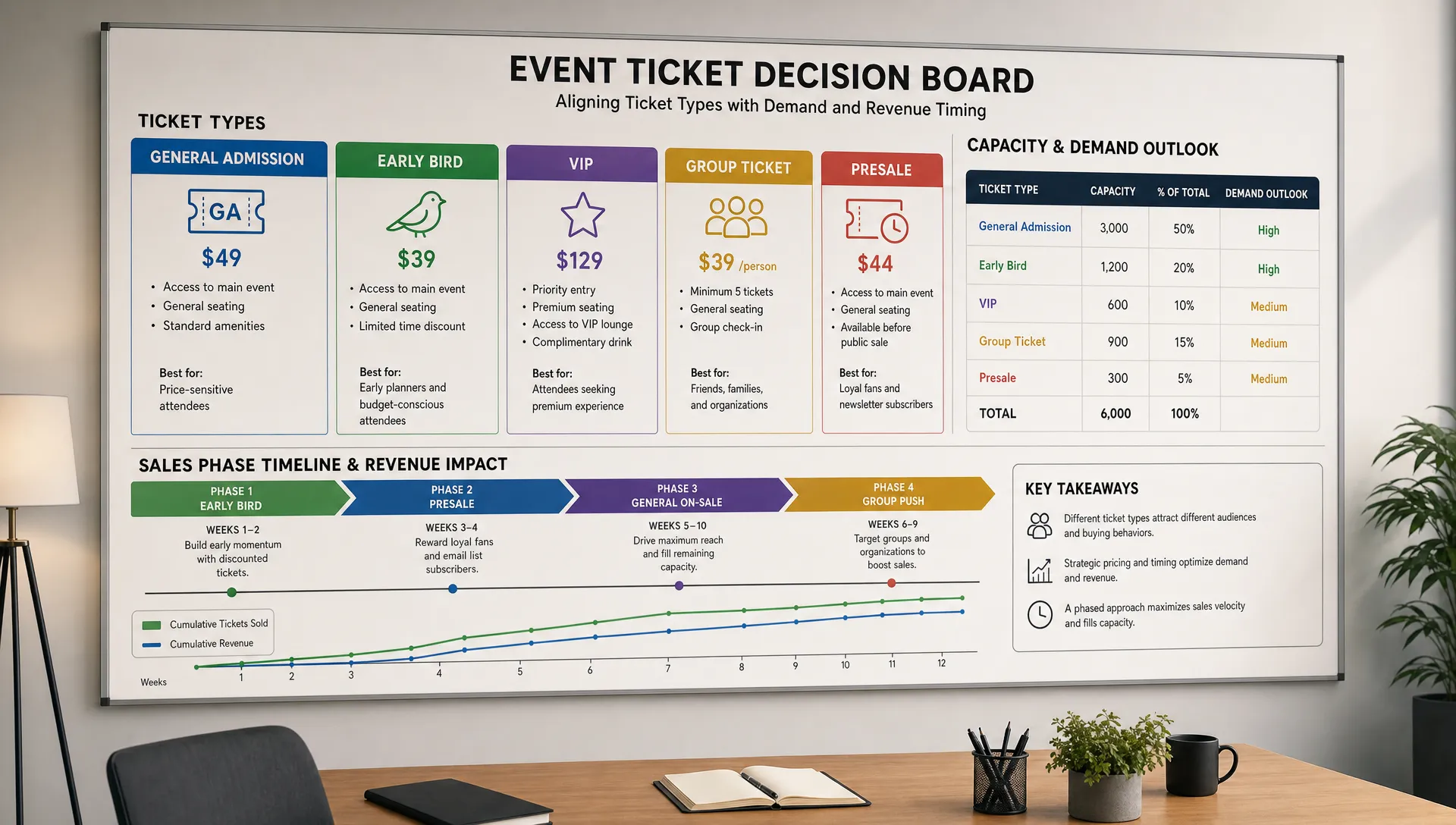
Event Ticket Types Explained for Organizers
The ticket type you choose is more than a label on a checkout page. It shapes buyer behavior, controls demand, protects margins, and determines how predictable your cash flow feels before show day.
For organizers, especially music producers, venue operators, community hosts, and teams working with tight upfront budgets, the right event ticket types can answer practical questions early: Who should buy first? How much should they pay? What access should they receive? How do you reward loyal fans without giving away too much revenue?
This guide breaks down the most common event ticket types, when to use each one, and how to combine them into a simple ticket stack that sells clearly without overwhelming buyers.
What an event ticket type actually does
A ticket type defines the buyer's access, benefits, timing, or purchase conditions. It can be as simple as “General Admission” or as specific as “Early Bird VIP Table for Four.”
Organizers often use “ticket type,” “ticket tier,” and “ticket category” interchangeably, but there is a useful distinction:
A ticket type usually describes what the attendee gets, such as general entry, VIP access, a group pass, or a free ticket. A pricing tier usually describes when or under what condition they buy, such as early bird, standard, or last-minute pricing. A category helps group choices in a way that makes sense to buyers, such as student, member, premium, or sponsor.
That distinction matters because buyers should not have to decode your pricing logic. If your options look too similar, they hesitate. If every option has a clear purpose, the decision feels easy. For a deeper look at the buyer psychology behind this, TixFlow’s guide on how ticket categories shape buyer choice and revenue is a useful companion to this article.
Quick comparison of common event ticket types
Use this table as a starting point. Not every event needs every type. In fact, most events perform better with a small number of clearly differentiated options.
| Ticket type | Best for | Organizer benefit | Watch-out |
|---|---|---|---|
| General Admission | Concerts, parties, talks, community events | Simple to understand and easy to sell | Can underprice high-demand inventory |
| Early Bird | Launch campaigns and demand validation | Brings in cash earlier and rewards fast buyers | Too many early tickets can reduce total revenue |
| Standard Admission | The main sales period | Creates a stable baseline price | Needs a clear value anchor if other tiers exist |
| Last-Minute | Final push before the event | Captures late buyers and urgency | Can train audiences to wait if overused |
| VIP or Premium | Music events, festivals, fundraisers, business events | Raises average order value | Must deliver real benefits, not just a higher price |
| Group Ticket | Social events and team-based attendance | Encourages buyers to bring others | Discounts should protect your margin |
| Reserved Seat or Table | Seated shows, dinners, clubs, conferences | Monetizes limited premium inventory | Requires accurate capacity and entry management |
| Member or Fan Presale | Communities, recurring events, artists, clubs | Rewards loyalty and builds early momentum | Needs clear eligibility rules |
| Complimentary Ticket | Guests, press, partners, artists, sponsors | Supports relationships and promotion | Must be tracked to avoid capacity issues |
| Free RSVP | Lead generation, launches, community events | Lowers attendance barrier | No-shows are common if there is no commitment |
Core event ticket types explained
General Admission
General Admission, often called GA, is the simplest and most widely used ticket type. It gives attendees access to the event without assigning a specific seat, table, or premium area.
GA works especially well for standing concerts, club nights, open seating talks, networking events, workshops, and community gatherings. Its biggest advantage is clarity. Buyers understand it immediately, which reduces friction at checkout.
The risk is that GA can become a default rather than a strategic choice. If your event has limited capacity, strong demand, or premium experiences, selling everything as one GA ticket can leave money on the table. For example, a music producer running an intimate release party may want GA for most fans, but a small VIP tier for meet-and-greet access, front-row area access, or bundled merchandise.
Early Bird tickets
Early Bird tickets reward buyers who commit early. They are useful when you need launch momentum, upfront cash, or proof that your event concept is resonating.
This ticket type is especially valuable for organizers who need to pay deposits, secure production, book artists, or fund marketing before the event date. Early buyers reduce uncertainty. They also create social proof, because a visible first wave of sales makes the event feel real.
The key is to limit Early Bird availability. That limit can be based on quantity, date, or both. If your Early Bird allocation is too large, you may sell too many seats at your lowest price and weaken your final revenue. A good rule is to make Early Bird meaningful, but not so generous that it becomes the real standard price.
Standard Admission
Standard Admission is the core ticket type for your main sales window. It should be the easiest option to understand and the one most buyers choose.
Think of it as your event’s price anchor. Early Bird buyers compare against it and feel rewarded. VIP buyers compare against it and decide whether the premium benefits are worth it. Last-minute buyers compare against it and understand that waiting costs more.
Because Standard Admission carries so much of your revenue, do not hide it behind clever naming. “Standard Entry,” “Regular Admission,” or “General Admission” is usually better than something vague like “Wave Two Access.” Creative names can work for branded events, but only if the buyer still understands the offer instantly.
Last-Minute tickets
Last-Minute tickets are designed for late buyers and final demand capture. They are common for music events, parties, conferences, and experiences where people decide closer to the date.
This type can help you protect margins because the price increases as the event approaches. It also creates urgency. The closer the event gets, the more expensive entry becomes.
Use Last-Minute pricing carefully. If your audience learns that discounts appear at the end, they may wait. In most cases, last-minute tickets should be equal to or higher than Standard Admission, not cheaper. If you need to move remaining inventory, consider targeted promo codes instead of publicly lowering the price for everyone.
VIP or Premium tickets
VIP tickets increase average order value by offering a better experience. For a concert, that could mean priority entry, access to a premium area, a meet-and-greet, a drink package, or exclusive merchandise. For a business event, it could mean reserved seating, a speaker dinner, a workshop add-on, or access to a private networking session.
The most important rule is simple: VIP must mean something specific. “VIP” alone is not a benefit. Buyers need to understand exactly what they receive and why it is worth the higher price.
Premium tickets also help segment demand. Some attendees want the lowest acceptable price. Others want convenience, status, comfort, or exclusivity. If you only sell one ticket type, you force both groups into the same price point.
Group tickets
Group tickets encourage one buyer to bring multiple attendees. This is useful for social events, student nights, club shows, workshops, sports events, and team outings.
The organizer benefit is acquisition efficiency. Instead of convincing five people separately, one motivated buyer can purchase for the group. Group tickets can also make attendance feel more social, which is powerful for events where people prefer not to arrive alone.
The discount should be intentional. A “4 for the price of 3” offer may work for a party with strong bar revenue, but it may be too aggressive for a workshop with limited seats and high per-attendee costs. Always check whether the lower per-person price still supports your event economics.
Reserved seat, table, or section tickets
Reserved ticket types are best when certain inventory is clearly more valuable. This could include front-row seats, balcony access, dinner tables, booths, sponsor tables, or premium viewing zones.
These ticket types are strong revenue tools because they match price to scarcity. A limited table near the stage can justify a higher price than standard standing room. A reserved seat at a conference can justify premium pricing if it improves visibility or convenience.
The operational requirement is higher. You need accurate capacity control, clear buyer communication, and a reliable way to validate access at entry. If the ticket promises a specific section or table, your guest list and door team must be aligned.
Member, fan, or presale tickets
Presale tickets give selected audiences access before the general public. They are particularly useful for artists, venues, creators, clubs, and recurring events with an existing community.
For music producers, this can be a powerful way to reward loyal fans, mailing list subscribers, past attendees, or members of a private community. Presales can also create momentum before your public launch.
Keep the rules clear. If buyers need a code, membership, or invitation, explain that at the point of purchase. Smart promo codes can help you manage this without creating separate public confusion.
Complimentary and free tickets
Free tickets can be strategic, but they should never be unmanaged. Complimentary tickets may go to press, sponsors, partners, artists, staff, influencers, speakers, or VIP guests. Free RSVP tickets may be used for community events, product launches, open houses, or audience-building campaigns.
The advantage is reach. Free entry lowers the barrier and can support promotion. The risk is attendance quality. People who pay nothing are more likely to no-show, which can create planning problems if your capacity, staffing, catering, or seating depends on accurate numbers.
A good approach is to separate complimentary tickets from public free RSVPs. Track who received them, why they received them, and whether they actually attended.
How ticket types affect cash flow
Ticket types are also cash flow tools. This is especially important for organizers who need to cover costs before the event happens.
Early Bird tickets can create upfront revenue. VIP tickets can increase average order value. Group tickets can accelerate volume. Standard and Last-Minute tickets can protect pricing power as demand rises.
| Sales stage | Useful ticket types | Cash flow goal | Main risk |
|---|---|---|---|
| Pre-launch | Member presale, fan presale, invitation-only tickets | Validate demand before public promotion | Too small a list may not create enough signal |
| Launch | Early Bird, limited GA, founding supporter tickets | Generate early revenue and momentum | Discounting too much too soon |
| Main sales window | Standard Admission, group tickets, VIP | Build predictable revenue | Too many options can slow purchase decisions |
| Final week | Last-Minute, door price, targeted promo codes | Capture late demand and protect margins | Public discounts can upset early buyers |
| Event day | Door tickets, limited upgrades | Monetize remaining capacity | Entry delays if sales and guest lists are not synced |
If cash flow is a priority, choose a ticketing setup that does not make you wait unnecessarily for revenue. TixFlow supports instant payouts, low flat per-ticket fees, and Stripe Connect integration, which can help organizers keep ticket revenue closer to the operational timeline of the event.
For events with multiple price phases, the goal is not to create complexity. The goal is to make timing work in your favor. If you want to go deeper on phased pricing, see TixFlow’s guide on how unlimited ticket pricing tiers can increase revenue.
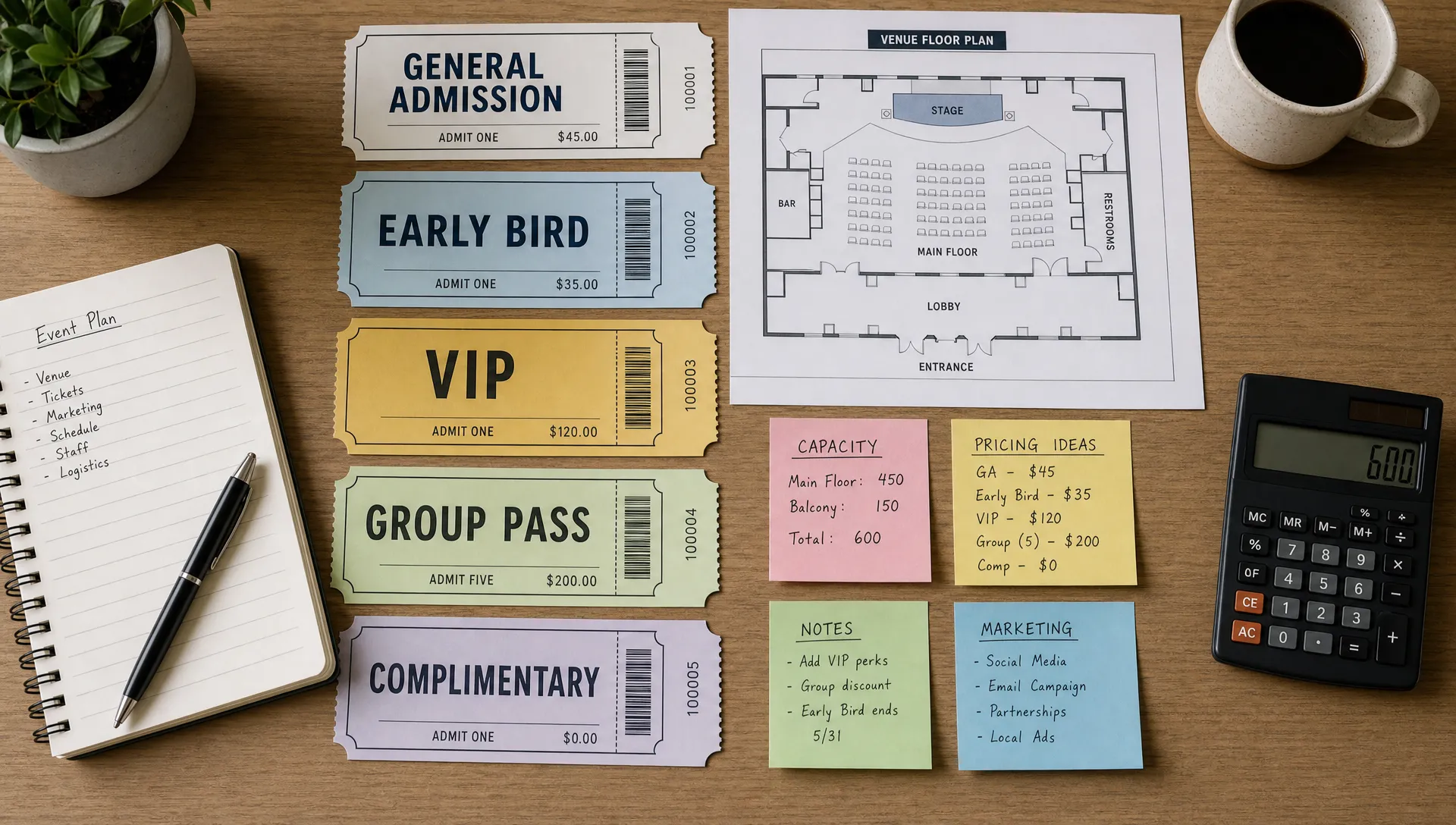
Choosing ticket types by event format
Concerts, club nights, and live music events
For music events, a strong setup often includes Early Bird, General Admission, VIP, and Door or Last-Minute tickets. If the artist has an existing fanbase, add a fan presale before public launch.
The priority is to balance urgency with simplicity. Fans should immediately understand the cheapest legitimate way to get in, the standard way to attend, and any premium experience available.
Avoid having too many similar waves, such as Early Bird 1, Early Bird 2, Regular 1, Regular 2, and Final Release, unless your audience is used to that model. Too many nearly identical options can make the event feel more complicated than it is.
Workshops and classes
For workshops, ticket types should reflect capacity and learning value. Standard Admission may be enough for a small class. If you want to reward fast action, add Early Bird. If you offer additional materials, office hours, or a private session, create a Premium ticket.
Group tickets can work well for companies or teams. Student tickets can work if your audience includes learners with lower purchasing power, but eligibility should be easy to verify or clearly trusted.
Conferences and business events
Conferences often benefit from more segmentation because different attendees have different budgets. Common types include Standard, VIP, Team Pass, Sponsor Pass, and Speaker or Guest tickets.
The premium tier must be tied to business value. Better seating alone may not justify a large price jump, but access to a private networking session, workshop, dinner, or curated introductions might.
For B2B events, ticket types should also support sales follow-up. A team pass, for example, can reveal which companies are sending multiple people and may be worth deeper engagement.
Community events and launches
For community events, product launches, or awareness-driven gatherings, free RSVP or low-cost tickets can make sense. But if attendance matters, consider a small paid ticket instead of a free one. Even a low price creates commitment.
When the event is part of a broader growth strategy, your ticket types should connect to audience development, not just admission. Organizers testing new markets, audience segments, or positioning may benefit from working with a growth marketing and innovation partner like User Story to validate which offers attract the right attendees.
How many ticket types should you offer?
Most events do not need more than three to five public ticket options at one time. A simple structure usually performs better than a complicated one because buyers can compare quickly.
A strong default setup might include Early Bird, Standard Admission, VIP, and Group Ticket. For a smaller event, Early Bird and Standard Admission may be enough. For a premium event, Standard and VIP may be enough.
The more ticket types you add, the more each one must justify its existence. Ask three questions before adding another option:
- Does this ticket type serve a distinct buyer need?
- Does it improve revenue, cash flow, access control, or promotion?
- Can the buyer understand the difference in under five seconds?
If the answer is no, simplify.
A practical framework for building your ticket stack
Use this sequence before publishing your event page.
- Start with capacity: Decide how many total attendees you can safely and comfortably handle before creating any ticket type.
- Set your core price: Define the Standard Admission price first, then build discounts and premiums around it.
- Separate timing from access: Early Bird is about when someone buys, while VIP is about what they receive.
- Limit discounted inventory: Cap Early Bird and group discounts so they support momentum without damaging revenue.
- Automate phase changes: If your ticketing platform supports automated sales phases, use them to avoid manual updates during busy launch periods.
- Keep checkout simple: Reduce unnecessary fields, avoid forcing buyer registration, and make the purchase path feel fast.
- Track every ticket source: Use guest lists, promo codes, and real-time sales control to see what is actually driving orders.
This is where the ticketing platform matters. TixFlow is built around flexible pricing, unlimited ticket tiers, automated sales phases, smart promo codes, digital guest lists, and customizable event pages. Those tools help organizers experiment with ticket types while keeping the buying experience simple.
Common mistakes organizers should avoid
The first mistake is creating too many ticket types too early. Complexity can look strategic from the organizer side, but confusing from the buyer side. If two tickets are almost the same, merge them.
The second mistake is discounting without a reason. Early Bird works because it rewards early commitment. Group pricing works because it increases volume. A random discount simply lowers perceived value.
The third mistake is making VIP vague. Premium buyers need specifics. Tell them whether they get priority entry, a reserved area, included drinks, merchandise, a private session, or another tangible benefit.
The fourth mistake is failing to track complimentary tickets. Free access still uses capacity. If your event sells out but a large number of comped guests do not attend, you may have blocked paying buyers unnecessarily.
The fifth mistake is changing prices manually under pressure. Sales phases are easier to manage when they are planned in advance and automated where possible. That is especially true for organizers running multiple events or managing late-night sales windows.
Frequently Asked Questions
What are the main event ticket types organizers should know? The most common event ticket types are General Admission, Early Bird, Standard Admission, Last-Minute, VIP or Premium, Group, Reserved Seat or Table, Member Presale, Complimentary, and Free RSVP tickets.
What is the difference between a ticket type and a ticket tier? A ticket type usually defines what the attendee gets, such as GA or VIP access. A ticket tier usually defines pricing conditions, such as Early Bird, Standard, or Last-Minute pricing.
Which ticket type is best for a music event? Many music events work well with Early Bird, General Admission, VIP, and Last-Minute or Door tickets. If the artist has a loyal audience, a fan presale can also help create early momentum.
Should I offer free tickets for my event? Free tickets can work for community-building, launches, press, partners, and promotional campaigns. However, free attendees are more likely to no-show, so track them carefully and avoid giving away too much capacity.
How many ticket types should I publish at once? Most events should publish three to five public ticket types at most. Smaller events may only need one or two. The goal is to give buyers meaningful choice without slowing down the decision.
How do ticket types help with cash flow? Early Bird tickets bring in revenue sooner, VIP tickets increase average order value, group tickets accelerate volume, and Last-Minute tickets protect pricing power close to the event date.
Build ticket types that sell clearly
The best ticket stack is not the most complicated one. It is the one that matches buyer intent, protects your capacity, supports your cash flow, and makes checkout feel effortless.
If you want to create flexible event ticket types without adding friction for attendees, TixFlow gives organizers instant payouts, flat per-ticket fees, no buyer registration, real-time sales control, customizable event pages, unlimited ticket tiers, automated sales phases, smart promo codes, digital guest lists, and Stripe Connect integration.
Use ticket types strategically, keep the buying path simple, and your event page can do more than collect orders. It can shape demand before the doors even open.