
Build an Event Pricing Strategy That Fits Your Crowd
A strong event pricing strategy does not begin with a random number. It begins with the people you are trying to bring into the room.
The same $35 ticket can feel like a bargain for a loyal fan, a stretch for a student, and suspiciously cheap for a corporate buyer. That is why pricing is not just math. It is positioning, timing, perceived value, and cash flow planning wrapped into one decision.
For event organizers, music producers, venue teams, and independent promoters, the goal is not to make tickets as cheap as possible. The goal is to set prices that feel fair to your crowd while still protecting the money needed to run the event well.
Start with crowd fit, not a target price
Your ticket price sends a message before the attendee reads the lineup, agenda, location, or schedule. A low price can communicate accessibility, but it can also make the event feel less valuable. A high price can communicate exclusivity, but it can also reduce impulse purchases if the value is not obvious.
Before you build your pricing model, define the buying behavior of your audience. A college crowd buying last minute behaves differently from parents planning a weekend activity. A niche music audience may buy early to support the artist, while a general nightlife audience may wait until friends confirm plans.
Ask yourself a few practical questions:
- Who usually buys first, loyal fans, regular attendees, friends of performers, or people responding to ads?
- Does your audience plan ahead or buy close to the event date?
- Is the event a need, a habit, a social outing, or a premium experience?
- What other costs does the attendee face, such as transport, drinks, parking, childcare, or accommodation?
- What would make someone feel confident buying today instead of waiting?
These answers shape the entire strategy. If your crowd is highly price-sensitive, you may need early access tiers and group deals. If your crowd values status or comfort, premium tiers can outperform discounts. If the audience waits until the final week, your pricing should reward early commitment without relying on panic.
Find your revenue floor before choosing tiers
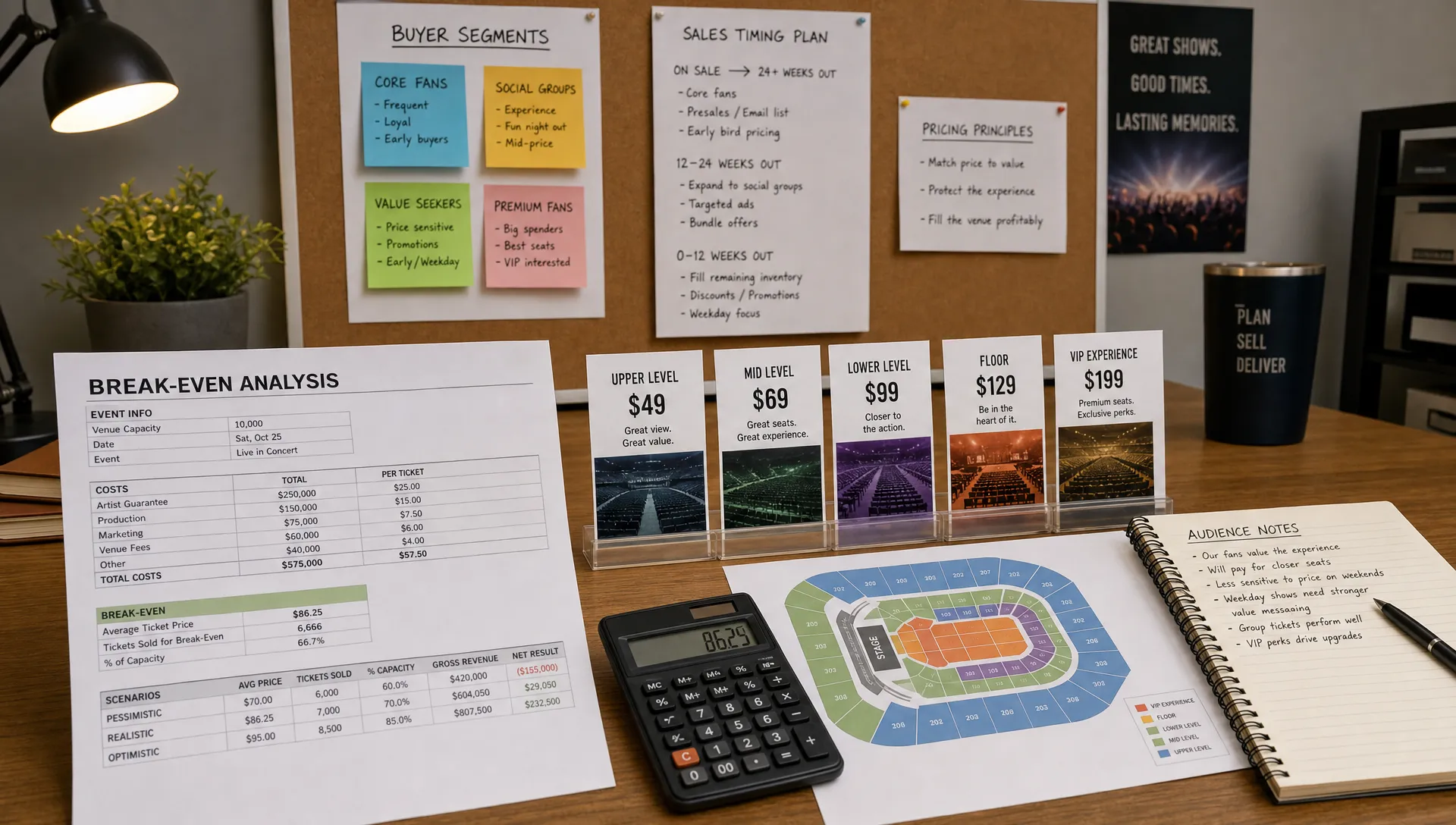
A crowd-friendly price still needs to fund the event. Before testing what buyers might pay, calculate the minimum revenue required to break even and the revenue target that makes the event worth producing.
This gives you a floor. Your final pricing may be higher or more segmented, but it should not ignore the real cost of delivering the experience.
| Pricing input | Why it matters | Example questions to answer |
|---|---|---|
| Fixed costs | These costs exist whether you sell 20 tickets or sell out | Venue, talent, security, insurance, permits, equipment |
| Variable costs | These increase with attendance | Wristbands, seating, staffing, catering, check-in capacity |
| Ticketing and payment costs | Fees affect net revenue per order | Are fees absorbed, passed on, or included in the listed price? |
| Complimentary tickets | Comps reduce sellable capacity | How many tickets are reserved for artists, sponsors, staff, or press? |
| Refund and contingency buffer | Events carry risk | What margin protects you from weather, delays, or last-minute changes? |
| Profit goal | Break-even is not always enough | What surplus funds the next event or pays the team fairly? |
A simple way to think about your baseline is:
Required average net ticket revenue = total event cost plus target profit divided by expected paid attendance
The key word is average. Not every attendee needs to pay the same amount. Some will buy discounted early tickets, some will pay standard admission, and some may choose VIP, group, or add-on options. A smart event pricing strategy uses that range instead of forcing one price to do all the work.
Segment your audience by buying motivation
Most events have more than one buyer type. If you price for only one of them, you leave money on the table or create unnecessary friction.
For example, a music event might have loyal fans who buy immediately, casual followers who wait for social proof, friends of performers who need a simple checkout link, and premium buyers who want the best view or faster entry. Each group values something different.
| Audience segment | What they care about | Pricing move that often fits |
|---|---|---|
| Loyal early buyers | Access, support, certainty | Limited early bird tier or fan presale |
| Social buyers | Group attendance and low friction | Group bundles or bring-a-friend codes |
| Last-minute buyers | Convenience and confidence | Final release pricing with clear availability |
| Premium buyers | Comfort, status, access, better experience | VIP, reserved seating, meet-and-greet, priority entry |
| Price-sensitive buyers | Affordability and fairness | Student, community, or off-peak options where relevant |
| Sponsors or hosts | Visibility and guest access | Package pricing with ticket blocks |
Segmentation does not mean making pricing complicated. It means giving each major buyer type a path that makes sense. If every tier is just a cheaper or more expensive version of general admission, buyers will hesitate. If each tier has a clear reason to exist, decisions become easier.
Build a price ladder with a job for every tier
A useful price ladder is simple enough for attendees to understand and flexible enough for organizers to control revenue. Most public events do well with a small number of visible options, especially when each tier has a distinct purpose.
Early bird exists to create initial momentum. Standard admission exists to anchor the event's normal value. Final release or door pricing exists to reward early action and capture late demand. Premium tiers exist for buyers who want more than access.
The mistake is adding tiers without a strategy. Too many similar options can make buyers pause, compare, and abandon checkout. If your event needs many categories, such as multi-day passes, table packages, artist allocations, partner access, or timed entry, use a platform that supports the structure cleanly. TixFlow's approach to ticket flexibility is especially relevant when unlimited ticket tiers can increase revenue by matching options to real buyer behavior.
A good rule is that every tier should answer one question:
- Why should someone buy this now?
- Who is this ticket designed for?
- What value changes between this tier and the next one?
- What happens when this tier sells out or expires?
If you cannot answer those questions, the tier may be noise rather than strategy.
Use timing to create urgency without punishing your crowd
Urgency works best when it feels fair. If buyers believe a deadline is arbitrary, they may ignore it. If they understand that early buyers help the event happen, reward limited capacity, or secure better access, they are more likely to act.
Time-based phases are usually easier for audiences to understand than sudden unexplained price jumps. For example, you might launch with a small early bird quantity, move to advance pricing after that tier sells out, then shift to final release during the last week.
Quantity-based tiers can work well when capacity is limited. Date-based tiers work well when you need predictable cash flow before certain expenses are due. A hybrid model can be effective, such as early bird ends when 100 tickets sell or by Friday, whichever comes first.
What matters is transparency. If attendees know what changes and when, urgency feels like a clear purchasing decision instead of pressure.
Protect margins from discounts, bundles, and fees
Discounts can help convert hesitant buyers, but they can also train your crowd to wait. If you discount too early or too broadly, you reduce urgency and undermine the perceived value of full-price tickets.
Use promo codes with a specific purpose. A code for a partner list, a performer allocation, or a short social campaign can be useful. A permanent public discount often becomes the real price in the buyer's mind.
Bundles can be stronger than discounts because they increase perceived value without simply cutting the ticket price. For example, a group bundle can encourage friends to buy together. A VIP bundle can include faster entry or premium seating. A merch bundle can work when the merchandise is desirable and the costs are clear. If apparel is part of the offer, quote production early with a custom clothing partner such as Arcus Apparel Group so the bundle price reflects real sourcing and fulfillment costs.
Also watch ticketing fees. A $40 ticket with unexpected fees at checkout may feel worse than a $45 ticket with clear pricing. Whether you absorb fees or pass them to buyers, model the net result before launch. For a deeper look at protecting margin, TixFlow has a practical guide on how to sell your tickets without cutting into revenue.
Match pricing to cash flow, not just attendance
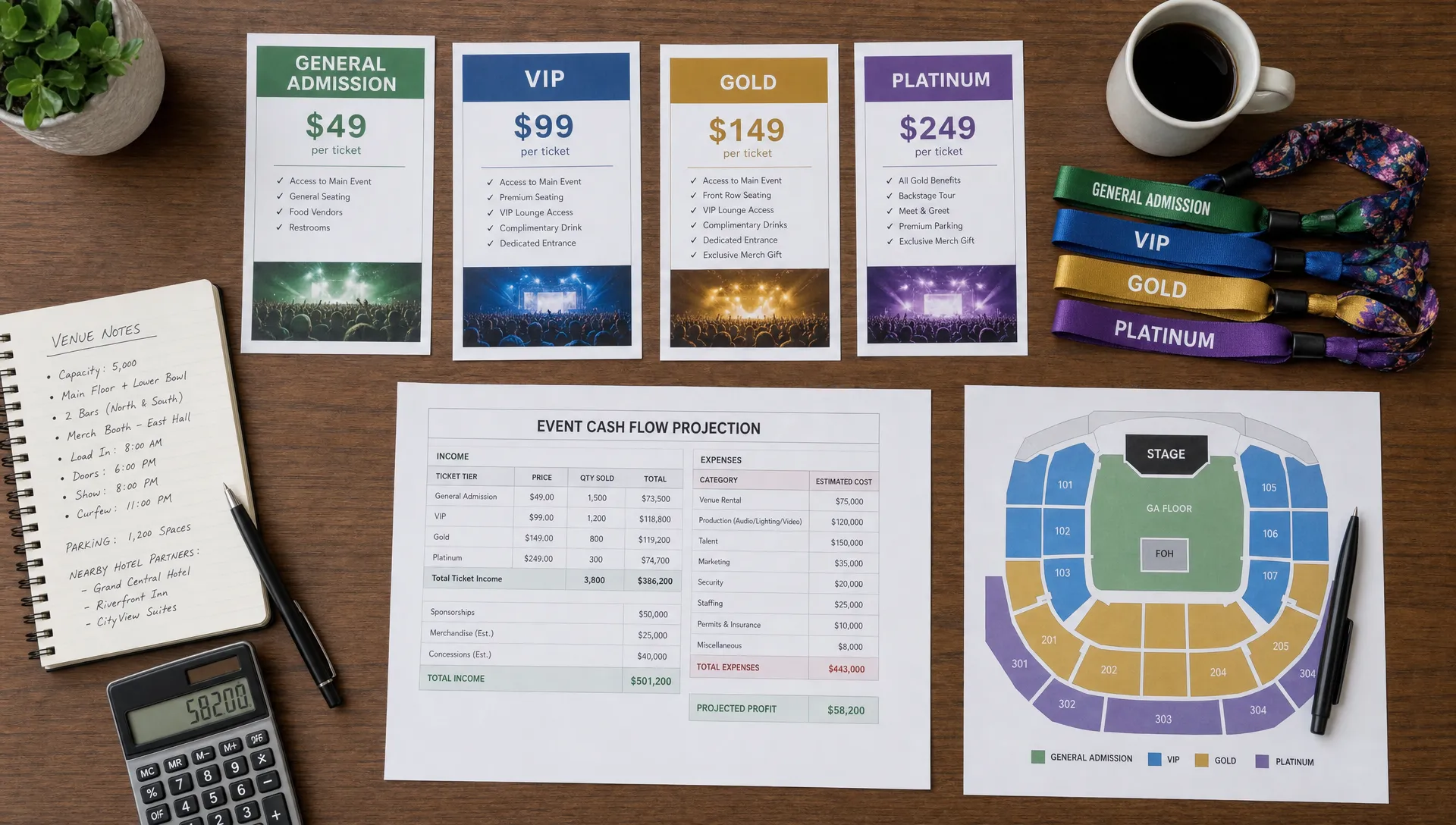
A sold-out event can still create financial stress if the money arrives too late. Many organizers need cash before doors open to pay deposits, production vendors, marketing costs, talent guarantees, or equipment rentals.
That is why the timing of ticket sales matters as much as the final total. Early revenue reduces risk. It also gives you better data for marketing decisions. If your first tier moves quickly, you can raise confidence, increase ad spend, or add capacity. If sales are slow, you can adjust messaging before it is too late.
For organizers who care about cash flow, payout timing should be part of the pricing discussion. A platform that supports instant payouts can make a real operational difference because ticket revenue becomes usable while the event is still being built, not only after the event is over.
You can also design tiers around cash needs. If a major production deposit is due three weeks before the event, an early access phase can help bring revenue forward. If marketing spend peaks in the final ten days, final release pricing can capture late demand while preserving margin.
Test willingness to pay before you go live
You do not need a massive data set to make better pricing decisions. Even small signals can help.
Talk to past attendees, check how quickly similar events sold, review comments and DMs, and compare your event against realistic alternatives in the same city. If people regularly spend $25 to $40 on comparable nights out, a $75 general admission ticket needs a clear value difference. If premium tables or VIP experiences sell out first, your crowd may have more high-intent buyers than you assumed.
Pre-launch testing can be simple. Send a private interest form to loyal fans. Offer a limited presale to a small list. Ask partners which price they believe their audience will accept. Watch not only what people say, but how quickly they commit when payment is required.
The gap between interest and paid orders is where pricing strategy becomes real. A price that gets compliments but no purchases is not working. A price that sells steadily, funds costs, and keeps buyers satisfied is doing its job.
Choose a framework that matches the event type
Different events need different pricing logic. A workshop, underground show, conference, and pop-up market should not all use the same structure.
| Event type | Pricing goal | Suggested structure |
|---|---|---|
| Small music show | Build momentum and reward loyal fans | Fan presale, early bird, standard, door price |
| Club night | Convert groups and last-minute buyers | Group bundle, standard admission, final release |
| Workshop or class | Communicate value and manage capacity | Early registration, standard seat, premium seat with materials |
| Festival or multi-act event | Capture different commitment levels | Single-day, full-pass, VIP, timed release pricing |
| Community event | Balance access with sustainability | Free or low-cost entry, donation add-on, supporter ticket |
| Premium experience | Maintain exclusivity and margin | Limited general admission, reserved access, VIP package |
The best framework is the one your audience can understand quickly. If buyers need to decode the difference between five similar passes, you may lose them. If the value ladder is obvious, they can choose confidently.
Watch for signs your pricing is off
Pricing problems usually appear before the event date if you know what to monitor.
If traffic is strong but conversion is weak, the price may not match perceived value, or checkout may be creating friction. If early bird sells instantly and later tiers stall, the gap between tiers may be too large. If buyers keep asking what is included, the tier names or descriptions need work. If your crowd waits for promo codes, discounts may have become too predictable.
Slow sales do not always mean the price is too high. Sometimes the value is unclear, the audience is wrong, the event page lacks trust signals, or the purchase process asks for too much. For many events, reducing friction can improve conversion without lowering the ticket price.
This is where checkout experience matters. No buyer wants to create an unnecessary account just to buy a ticket. Clear ticket descriptions, mobile-friendly checkout, simple payment steps, and immediate confirmation all support your pricing strategy because they prevent buyer hesitation from turning into abandonment.
Set controls before sales begin
Once sales are live, organizers need control. Pricing is not something you set once and forget. You may need to pause a tier, open a new allocation, extend a phase, close complimentary access, update capacity, or launch a targeted promo code.
Before publishing your event, decide who is responsible for monitoring sales and what actions are allowed. If 50 percent of capacity sells in the first 24 hours, will you close the early tier? If sales are behind target after one week, will you adjust messaging, add a partner code, or change the offer? If VIP sells out fast, can you safely create more premium capacity without hurting the experience?
Real-time sales control helps organizers respond without guessing. Digital guest lists also matter because overselling, duplicate entries, and messy check-in can damage the value attendees thought they paid for.
A pricing strategy only works if operations can support it.
Frequently Asked Questions
What is an event pricing strategy? An event pricing strategy is the plan for setting ticket prices, tiers, sales phases, discounts, and fee handling so the event attracts the right crowd while meeting revenue and cash flow goals.
Should I start with a low early bird price? A low early bird price can help create momentum, but it should be limited by quantity or time. If it is too cheap or available for too long, it can weaken the perceived value of the event.
How many ticket tiers should an event have? Most events should use only as many public tiers as buyers can understand quickly. Three to five clear options often work better than many similar choices. Larger or more complex events may need more behind-the-scenes ticket categories.
Is it better to discount tickets or create bundles? Bundles are often better when they add value, such as group admission, premium access, or merchandise. Discounts should be targeted and time-limited so they do not train buyers to wait.
How does pricing affect event cash flow? Early ticket sales can fund deposits, marketing, production, and staffing before the event happens. Pricing phases that encourage earlier purchases can reduce financial pressure and improve planning decisions.
Turn your pricing plan into paid orders
The right price is not just the number people will pay. It is the number that fits your crowd, funds the experience, protects your margin, and gives your team enough control to adjust as sales unfold.
TixFlow helps organizers put that plan into action with instant payouts, flat per-ticket fees, unlimited ticket tiers, automated sales phases, smart promo codes, customizable event pages, digital guest lists, Stripe Connect integration, and a checkout experience that does not require buyer registration.
If you want pricing that feels clear to attendees and practical for your team, build the strategy first, then use the right ticketing setup to execute it cleanly.