
How Stripe Ticket Sales Give Organizers Faster Access to Cash
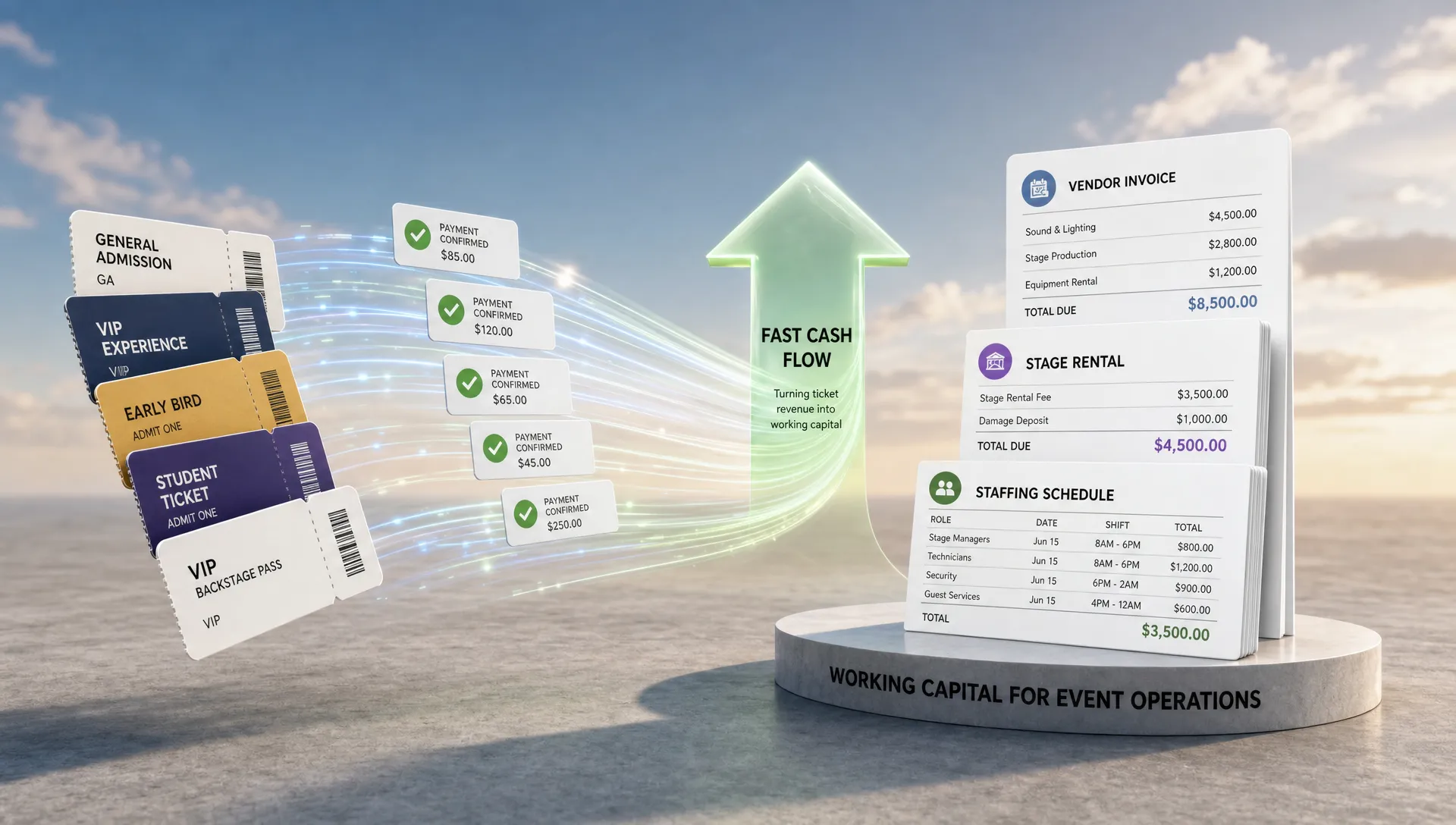
For event organizers, ticket revenue is not just a number on a dashboard. It is the working capital that pays venue deposits, artist advances, staffing, security, marketing, production rentals and the last-minute costs that always appear before doors open.
That is why payout speed matters. If your ticketing platform collects money today but releases funds days or weeks later, your event may look successful while your bank account still feels tight. Stripe ticket sales can help solve that gap by connecting checkout, payment processing and payouts in a cleaner flow, especially when your ticketing platform is built around Stripe Connect and faster payout options.
The advantage is not only speed. A well-designed Stripe-based ticketing setup gives organizers more control over when sales happen, how revenue is tracked and how quickly cash can be used to keep momentum going.
Why faster access to cash changes event planning
Event budgets rarely move in a straight line. You might sell 40 percent of capacity during an early-bird push, then need to turn that revenue into paid ads before the next price tier opens. You might need to pay a lighting vendor before the weekend, cover a hotel block, confirm a DJ or increase staffing after a strong sales day.
Slow payouts turn those decisions into tradeoffs. Organizers start fronting money from personal accounts, delaying supplier payments or underfunding promotions even when ticket demand is clearly there. For independent promoters, club nights, workshops and smaller festivals, that timing can decide whether the event grows or gets stuck.
Faster payout access gives you room to act earlier. You can use live demand to fund the next operational step instead of waiting until after the event or until a platform clears a batch payout.
What “Stripe ticket sales” actually means
Stripe ticket sales usually means your ticket checkout is powered by Stripe’s payment infrastructure. Attendees pay through a checkout flow, Stripe processes the payment and the ticketing platform records the order, issues the ticket and manages the organizer’s access to funds.
The key part for organizers is how the ticketing platform is connected to Stripe. Stripe Connect is designed for platforms and marketplaces that need to onboard sellers, route payments and support payouts to connected accounts. In an event ticketing context, that can help create a more direct path between a buyer’s payment and the organizer’s payout.
Stripe also explains in its payouts documentation that payout timing depends on factors such as country, account status, payment method, risk checks and payout schedule. That means the platform setup still matters. Stripe is the payment infrastructure, but the ticketing product determines how cleanly your sales, fees, refunds, reporting and attendee flow work around it.
How Stripe-based ticketing improves cash access
The biggest benefit is reducing unnecessary handoffs. In older ticketing workflows, ticket money may pass through several operational layers before an organizer sees it: ticketing account, platform balance, manual approval, batch payout, bank transfer and reconciliation. Every extra step introduces delay and uncertainty.
A Stripe-based ticketing flow can make the movement of money more direct. Payments are processed through a modern payments system, organizer accounts can be connected through Stripe and payout activity can be tracked with clearer timing. When a platform also supports instant payouts, the gap between sale and usable cash can become much shorter.
Stripe Instant Payouts are available to eligible accounts and let businesses send funds to a supported debit card or bank account more quickly than a standard payout schedule. Eligibility, availability and timing depend on Stripe’s requirements, but the principle matters for organizers: payout speed becomes something you can plan around rather than a vague backoffice process.
For event teams, that changes how ticket sales are used. Revenue from an early push can fund more promotion. Revenue from VIP tickets can help lock in premium production. Revenue from a group sale can cover staff deposits. The cash flow loop gets tighter.
Why the ticketing layer matters as much as Stripe
Stripe can process payments and support payouts, but it does not automatically create a strong event sales operation. Organizers still need a ticketing layer that reduces buyer friction, supports pricing strategy and keeps the team in control.
That is where a platform like TixFlow becomes important. TixFlow combines Stripe Connect integration with event-focused features such as instant payouts, no buyer registration, flat per-ticket fees, real-time sales control, customizable event pages, unlimited ticket tiers, automated sales phases, smart promo codes and digital guest lists.
Here is how the payment layer and ticketing layer work together:
| Organizer challenge | How Stripe helps | Why the ticketing platform still matters |
|---|---|---|
| Slow access to ticket revenue | Processes payments and supports payout workflows | Needs instant payout support, clean account setup and clear revenue tracking |
| Checkout drop-off | Supports secure online payments | Needs a fast attendee flow with no forced registration and simple ticket selection |
| Hard-to-forecast net revenue | Provides payment records and fee visibility | Needs flat per-ticket fees and real-time sales reporting |
| Manual pricing changes | Handles payments for each order | Needs automated sales phases, unlimited tiers and promo code control |
| Entry disputes and fraud concerns | Confirms payment status | Needs digital tickets, guest lists and reliable order matching |
A fast payout workflow is only useful if people complete checkout in the first place. If buyers abandon the purchase because they are forced to create an account, confused by fees or slowed down by clunky forms, the organizer has less cash to access no matter how good the payout system is.

The cash flow difference in real event scenarios
Imagine an independent concert promoter selling tickets for a 500-capacity show. The first 150 tickets sell quickly after the lineup announcement. With slow payouts, the promoter may still need to pay for ads, posters, hotel rooms and production deposits from another account. With faster access to Stripe ticket sales, that first wave of demand can help fund the next wave of marketing while the audience is still paying attention.
For music producers and nightlife organizers, timing is often even tighter. A Friday event may need paid social promotion on Tuesday, staff confirmation on Wednesday and vendor payment before doors open. If ticket revenue is locked until after settlement or platform review, the organizer carries the cash burden. Faster payout access lets the event’s own sales support the final push.
For conferences, workshops and community events, the benefit is predictability. Early registrations can cover venue commitments, catering estimates or speaker travel before the final attendee count is known. If your pricing tiers and payout timing are aligned, ticket revenue becomes an operating tool instead of a delayed reimbursement.
If you want to think about this more strategically, TixFlow’s guide on building predictable cash flow from ticketed events explains how ticket timing, pricing structure and revenue planning work together.
How to structure ticket sales for faster usable cash
Faster payouts are strongest when paired with a deliberate sales plan. The goal is not simply to open sales and wait. It is to create cash flow at the moments when the event needs it most.
Start by mapping your biggest pre-event costs. Venue deposits, artist payments, production rentals, insurance, staffing and marketing usually have different due dates. Then design ticket tiers and sales phases around those dates. An early-bird tier can help cover deposits. A general admission tier can fund marketing. A VIP or table tier can support higher production costs. Promo codes can stimulate demand during quiet periods without permanently lowering your headline price.
TixFlow’s unlimited ticket tiers and automated sales phases are useful here because they let organizers plan the revenue curve instead of manually changing prices under pressure. Real-time sales control also helps you see whether demand is ahead or behind schedule, then adjust promotions before the event gets too close.
Buyer friction affects cash flow too. No buyer registration means attendees can complete checkout faster. A customizable event page helps keep the purchase experience aligned with your brand. Clear pricing reduces hesitation, especially when people are buying on mobile or making a quick decision after seeing a post, text or ad.
For a deeper look at removing payment bottlenecks, see TixFlow’s guide on simplifying ticketing payments for faster payouts.
What to check before relying on instant payouts
Instant access to cash is powerful, but it still depends on a clean setup. Before you build an event budget around fast payouts, confirm the basics.
- Organizer identity and verification are complete: Payment platforms may require business, individual or bank verification before payouts are fully available.
- Bank details are accurate: Incorrect account details can delay payouts even when sales are strong.
- Your payout method is eligible: Instant payout availability can depend on country, account status and supported bank or debit card networks.
- Refund and dispute exposure is understood: Organizers should keep enough buffer for chargebacks, canceled orders or attendee support issues.
- Sales phases match your cost deadlines: Fast payouts help most when ticket revenue arrives before your major payments are due.
A common mistake is treating payout speed as only a payment processor setting. In reality, your event account setup, seller details, bank information and team process all affect how quickly money can move. TixFlow covers this in more detail in its article on why ticketing account setup affects payout speed.
Fees matter because cash flow is about net revenue
Fast access to money is only useful if you can forecast how much money will actually arrive. Organizers should look at net revenue, not just gross ticket sales.
That means understanding payment processing fees, ticketing fees, refunds, taxes where applicable and any discounts or promo codes. A platform with flat per-ticket fees can make forecasting easier because each sale has a clearer expected contribution. When fees feel unpredictable, it becomes harder to decide whether you can safely book another vendor, increase ad spend or release a new ticket batch.
This is especially important for smaller events where margins are narrow. A sold-out room can still create financial stress if the organizer misjudges fees, refund exposure or payout timing. Faster payouts should be paired with clear reporting so the team can separate available cash from gross sales.
Stripe ticket sales are a cash flow strategy, not just a payment method
It is easy to think of Stripe as the thing that accepts cards at checkout. For event organizers, the larger opportunity is using Stripe-connected ticketing as part of a cash flow strategy.
The right setup helps you sell without forcing buyer registration, adjust pricing in real time, collect revenue through a modern payment layer and access funds faster. It also gives your team cleaner records for guest lists, ticket tiers, promo codes and sales phases.
That combination matters because event operations move quickly. You do not just need payments to be successful. You need ticket revenue to be available at the right time, with enough clarity to make confident decisions.
Frequently Asked Questions
Do Stripe ticket sales always mean instant payouts? No. Stripe supports payout workflows and Instant Payouts for eligible accounts, but availability depends on factors such as location, account status, supported payout methods and verification. Your ticketing platform setup also affects the experience.
Why use a ticketing platform instead of Stripe alone? Stripe processes payments, but event organizers also need ticket tiers, sales phases, promo codes, guest lists, attendee checkout, order management and event pages. A ticketing platform connects payment processing to the full event sales workflow.
How can faster payouts help music event organizers? Faster payouts can help promoters and producers pay deposits, increase ad spend, confirm talent, cover production costs and handle last-minute staffing needs before the event happens.
What is the biggest cause of payout delays? Common causes include incomplete verification, incorrect bank details, platform payout schedules, risk reviews, disputes and unclear account ownership. A clean account setup reduces avoidable delays.
Can faster payouts improve ticket sales? Faster payouts do not directly make buyers purchase, but they let organizers reinvest sales revenue sooner. That can support stronger marketing, better production decisions and more confident pricing changes during the sales cycle.
Turn ticket demand into usable cash faster
If your event sells tickets today, your operations should not have to wait unnecessarily to benefit from that demand. TixFlow is built for organizers who want faster access to revenue, low-friction checkout and clearer control over ticket sales.
With instant payouts, Stripe Connect integration, flat per-ticket fees, flexible pricing tools and no buyer registration, TixFlow helps event teams turn ticket sales into working capital without adding complexity for attendees.