
How Ticketed Events Can Build Predictable Cash Flow
For organizers, cash flow is not a finance detail that appears after the show. It decides when you can confirm the venue, how confidently you can book talent, how much you can spend on marketing and whether the next event starts from strength or stress.
Ticketed events are powerful because revenue can arrive before the experience is delivered. That gives organizers something many businesses do not have: the ability to finance part of the event through demand itself. The catch is that ticket sales only create predictable cash flow when pricing, timing, fees and payouts are designed as one system.
A sold-out room can still create cash pressure if too much revenue arrives late, discounts are uncontrolled or payout timing does not match supplier deadlines. A smaller event can feel financially stable if early tickets cover deposits, general sales fund operations and late demand protects profit.
This guide shows how to use ticketed events as a cash-flow engine, especially for event organizers, music producers and teams that need tighter control over money in and money out.
Why ticketed events can create predictable cash flow
Most events have a cash-flow mismatch. Expenses start early, often weeks or months before doors open. Revenue may arrive gradually, then spike near the event date. If you treat ticketing as a simple sales page, that mismatch can leave you guessing.
Ticketed events give you several levers to reduce that uncertainty:
- You can open sales before the biggest expenses are due.
- You can split demand across presale, early bird, general admission and final release phases.
- You can use tiers to match different levels of willingness to pay.
- You can monitor sales velocity and adjust marketing before it is too late.
- You can choose ticketing tools that reduce checkout friction and speed up access to funds.
The goal is not just to sell more tickets. The goal is to know, as early as possible, whether the event is funding itself.
Start with a cash-flow map before tickets go live
Before you announce a ticketed event, map when cash leaves your account. This sounds basic, but many organizers start with a target attendance number and only later realize their first major payment is due before meaningful sales have arrived.
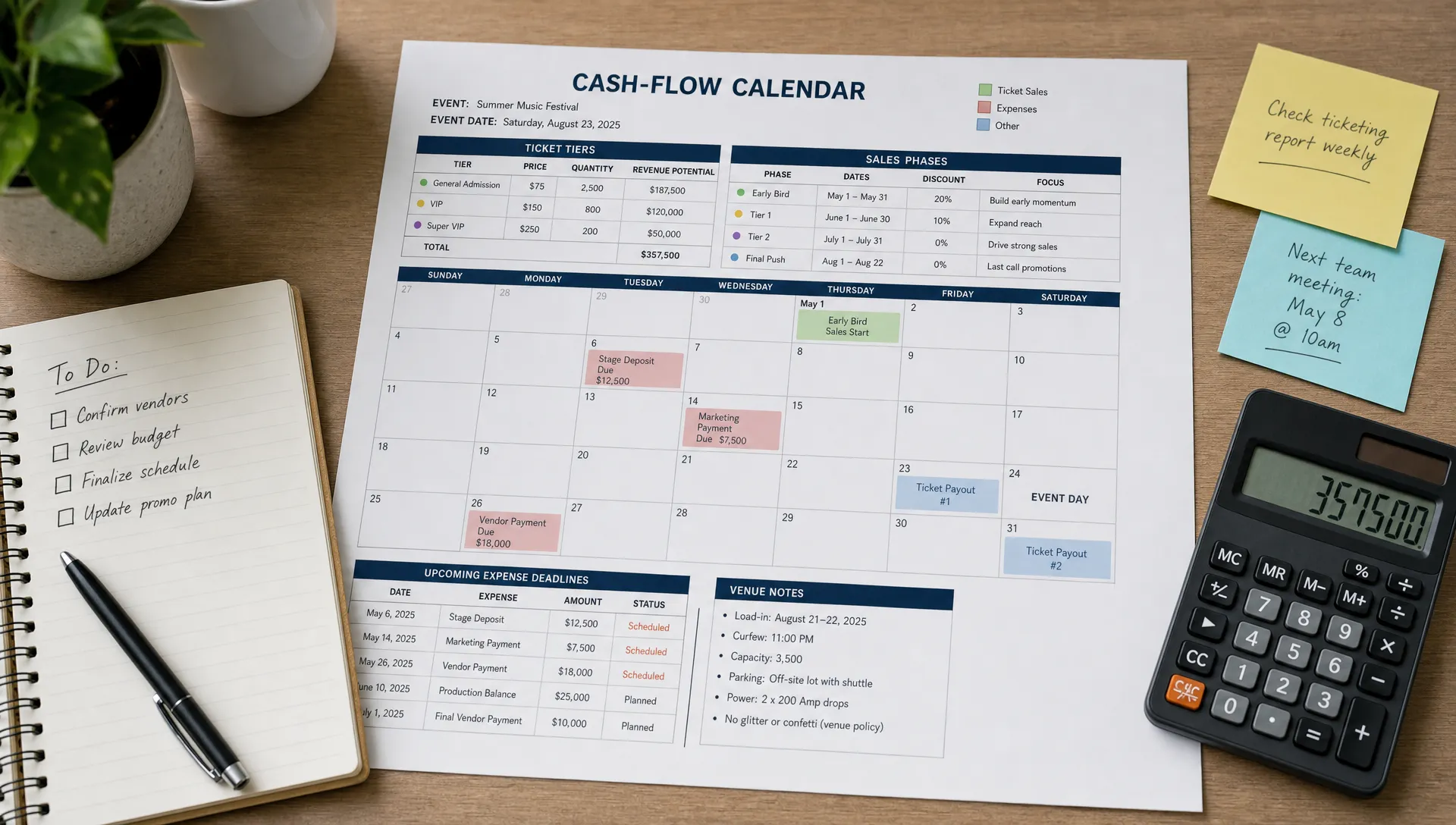
A simple cash-flow map should show every major cost, the amount due and the deadline. For music events, that may include venue deposits, artist advances, production, security, hospitality, insurance and marketing. For conferences or community events, it may include speakers, catering, equipment rental, staffing and permits.
| Cost category | Common timing | Cash-flow risk to watch |
|---|---|---|
| Venue deposit | Before announcement or shortly after | Large upfront payment before demand is proven |
| Talent or speaker deposit | Before public launch | Commitment may be due before sales momentum is visible |
| Production and equipment | Mid-campaign | Costs can increase if requirements change |
| Marketing spend | Throughout the sales window | Easy to overspend if ticket data is not reviewed weekly |
| Staffing and operations | Close to event day | Often underestimated until final planning starts |
| Ticketing and payment fees | At each sale or payout | Small percentages can materially affect net cash |
| Refunds and contingencies | Before and after the event | Needs a reserve, not leftover cash |
Once those dates are clear, work backward. If the venue deposit is due in 14 days, your first ticket phase has a job: generate enough net cash to cover or reduce that payment. If artist settlement is due on event night, your later sales phases must be strong enough to protect that obligation.
This is also where a pricing model matters. If you do not yet know your break-even point, use a structured approach like an event ticket price calculator that protects profit before setting public prices.
Build prices from net cash, not gross ticket revenue
Gross revenue is the number that looks good on a dashboard. Net cash is the number that pays bills.
A $40 ticket is not $40 of usable event cash if you absorb ticketing fees, payment processing, taxes, refunds, promo discounts or comp allocations. The more complex your pricing gets, the more important it is to calculate the net amount per ticket tier.
A practical formula is:
Expected net ticket revenue = ticket price minus fees minus discounts minus tax obligations minus expected refunds or chargebacks.
Taxes, refund rules and fee treatment vary by location and event type, so organizers should confirm their obligations with qualified accounting or legal support. The main operating principle is simple: every ticket tier needs a net revenue target.
| Pricing decision | Cash-flow effect | Better approach |
|---|---|---|
| Absorbing all fees | Makes the public price cleaner but lowers usable cash | Model the net amount before publishing the price |
| Unlimited early bird tickets | Creates urgency but may sell too much inventory at low margin | Cap early inventory and move automatically to the next tier |
| Broad promo codes | Can fill the room but make revenue harder to forecast | Use limited, tracked codes with clear expiration dates |
| Large comp lists | Helps relationships but lowers average revenue per attendee | Set a comp budget before launch |
| One flat price | Simple for buyers but may miss higher willingness to pay | Use a small number of meaningful tiers |
Pricing for cash flow does not mean charging the highest possible amount. It means knowing the minimum viable net amount, then designing tiers that make sense for your audience.
Align ticket sale phases with expense deadlines
A strong sales calendar does more than create hype. It pulls revenue forward so you are not waiting for last-minute buyers to fund fixed commitments.
For many ticketed events, a four-phase structure works well:
| Sales phase | Primary purpose | Cash-flow role |
|---|---|---|
| Presale | Reward loyal fans, members or past attendees | Test demand and bring in early cash before full spend |
| Early bird | Create a reason to act soon | Cover deposits and validate capacity assumptions |
| General admission | Capture the main market | Fund production, marketing and operations |
| Final release | Convert urgency near event day | Protect margin and offset late cost increases |
The key is to attach each phase to a financial purpose. A presale is not only a marketing tactic. It can be the phase that pays the first venue installment. General admission is not just the default tier. It may be the phase that determines whether you can increase ad spend or add production value.
If you are unsure how early to open sales, the timing should be based on both buyer behavior and your payment schedule. This guide to setting ticket sale dates for maximum momentum explains how to plan sale windows without losing urgency.
Use tiers to smooth revenue, not just segment access
Ticket tiers often get treated as a way to label access: general admission, VIP, backstage, group entry and so on. That can work, but the cash-flow value of tiers is bigger than the label.
Good tiers let different buyers support the event at different price points. A fan who wants the cheapest possible entry can buy early. Someone who values convenience, premium access or supporting the project can pay more. A group buyer may commit sooner if the package makes planning easier.
For music producers, this is especially useful. A small number of higher-value tickets can improve early cash without forcing every attendee into a higher price. For local shows, a supporter tier or limited VIP ticket can help fund production while keeping standard admission accessible.
Avoid building too many tiers. Too many choices can slow buyers down and make forecasting harder. Most events are better served by a clear price ladder with limited quantities and automatic phase changes.
Reduce checkout friction so demand turns into cash
Predictable cash flow depends on completed purchases, not interest. If buyers have to create an account, navigate a confusing checkout or pay surprise fees at the end, more of your demand leaks out before it becomes revenue.
A clean checkout helps cash flow in two ways. First, it improves conversion, which means your forecast is based on more real transactions. Second, it shortens the distance between marketing activity and money received.
For organizers, the buyer experience should be reviewed like part of the financial plan. Ask whether the event page answers the basic questions buyers need before purchasing. Check that ticket names are clear. Make sure fees are transparent enough that buyers do not feel misled. Test checkout on mobile, since many ticket purchases happen after a social post, message or artist announcement.
TixFlow is built around this problem with no buyer registration, customizable event pages and a checkout experience designed to reduce friction. Those details matter because every abandoned purchase weakens cash-flow predictability.
Track sales velocity before cash pressure builds
By the time an event feels financially stressful, the warning signs were usually visible earlier. Sales velocity, tier performance and promo code activity can show whether cash is arriving fast enough.
A weekly review is enough for many small and mid-sized ticketed events. Larger events, fast-selling shows and final-week campaigns may need daily monitoring.
| Metric | What it tells you | Cash-flow action |
|---|---|---|
| Tickets sold per day | Whether demand is speeding up or slowing down | Adjust marketing before the event falls behind pace |
| Net revenue by tier | Which tiers are actually funding the event | Open, close or promote tiers based on margin |
| Sales by channel | Which campaigns create paid demand | Move budget toward channels that convert |
| Promo code usage | Whether discounts are controlled | Pause codes that reduce net revenue too much |
| Remaining inventory | How much revenue is still available | Decide whether to raise price, hold inventory or push urgency |
| Payout timing | When money becomes usable | Match expected funds with supplier deadlines |
Do not wait until final numbers are in to make decisions. A slow week during early bird sales may mean your messaging needs work. A strong presale may justify confirming production sooner. A weak high-value tier may show that your audience prefers affordability over premium access.
Make payout timing part of your event plan
Two events can have the same ticket revenue but very different cash-flow outcomes depending on when funds become available.
If ticket revenue sits pending until after the event, organizers may still need personal funds, credit or loans to pay upfront expenses. If payouts happen sooner, ticket sales can directly support deposits, production and marketing.
That is why payout timing belongs in the planning conversation before launch. Confirm how your ticketing platform handles payouts, payment processing, disputes and refunds. Then compare that timing with your cash-flow map.
TixFlow offers instant payouts and Stripe Connect integration, which can help organizers access ticket revenue faster and operate with more control. For teams managing venue deposits, artist payments or marketing spend, faster access to funds can reduce the gap between sales success and usable cash.
Fast payouts do not remove the need for discipline. Keep a reserve for refunds, disputes and late expenses. If every dollar from early sales is spent immediately, a refund wave or production change can still cause stress.
Use promo codes without making revenue unpredictable
Promo codes can be useful when they are specific. They become dangerous when they are broad, permanent or impossible to measure.
A good promo code has a job. It may track a partner, reward an email list, support a street team or create a short sales push. It should also have limits: a redemption cap, an expiration date and a clear net revenue threshold.
For predictable cash flow, avoid training buyers to wait for discounts. If your audience learns that cheaper codes always appear near the end, full-price sales slow down and your early cash becomes weaker.
Smart promo code control lets you measure what is working without giving away margin blindly. If a partner code sells 40 tickets that would not have sold otherwise, it may be valuable. If a public discount mostly reduces revenue from buyers who were already ready to purchase, it hurts predictability.
Build a rolling cash forecast during the campaign
A ticket launch plan is only the starting point. Once sales begin, replace assumptions with actual numbers.
A rolling forecast should update expected cash based on current sales pace, remaining inventory, upcoming costs and confirmed payouts. It does not need to be complicated. A spreadsheet can work if it is reviewed consistently.
| Forecast line | Example question | Decision it supports |
|---|---|---|
| Cash received so far | How much ticket revenue is already usable? | Whether deposits can be paid without outside funds |
| Expected cash before next deadline | What will likely arrive before the next bill? | Whether to increase marketing or reduce spending |
| Required cash reserve | What must stay untouched for refunds and uncertainty? | Whether current cash is truly available |
| Remaining revenue capacity | How much can still be earned from unsold inventory? | Whether pricing or promotion needs to change |
| Break-even progress | How close is the event to covering total costs? | Whether to add costs, hold steady or cut back |
This habit also improves future events. When you know how fast your audience usually buys, which tiers move first and which channels create paid demand, your next budget becomes less speculative.
Negotiate expenses around ticket milestones
Predictable cash flow is not only about the revenue side. Expense timing matters just as much.
When possible, negotiate supplier payments around ticket milestones instead of arbitrary dates. A venue may require a deposit upfront, but other costs might be split across confirmation, production week and event day. Talent, production vendors and marketing partners may have standard terms, yet there is often room to align payments with the sales cycle.
This does not mean pushing risk onto suppliers unfairly. It means being honest about the event timeline and structuring commitments so the event can remain healthy. Reliable organizers pay on time, communicate early and avoid making promises based on hoped-for sales.
For recurring event teams, this becomes easier over time. Vendors who see that you run clean campaigns, sell consistently and pay as agreed are more likely to work with practical schedules.
Protect cash flow after the event
Cash-flow planning does not end when doors close. Settlements, refunds, chargebacks, staff payments and post-event vendor invoices can all affect the final result.
After each ticketed event, review the difference between projected cash and actual cash. Look for gaps. Did one tier underperform? Did discounts reduce margin more than expected? Were payouts available when needed? Did final-week sales arrive too late to help with major expenses?
A short post-event financial review can improve every future launch. The best organizers build a playbook from real numbers, not memory.
A practical cash-flow checklist for your next ticketed event
Use this checklist before your next launch:
- Map every major expense by due date before tickets go live.
- Set a net revenue target for each ticket tier.
- Align presale, early bird, general admission and final release phases with payment deadlines.
- Cap discounted inventory so low-margin tickets do not dominate sales.
- Review checkout friction on mobile before announcing the event.
- Track sales velocity and net revenue at least weekly.
- Confirm payout timing before committing to large expenses.
- Keep a reserve for refunds, disputes and late costs.
- Review actual cash flow after the event to improve the next one.
This process may feel more financial than creative, but it protects the creative work. When cash flow is predictable, organizers can make better production decisions, communicate more calmly and plan the next event with confidence.
Frequently Asked Questions
How do ticketed events improve cash flow? Ticketed events can bring revenue in before the event happens. When sales phases, pricing and payouts are planned around real expense deadlines, ticket revenue can help fund deposits, production, marketing and operations.
What is the biggest cash-flow mistake event organizers make? The biggest mistake is planning around gross ticket sales instead of net usable cash. Fees, discounts, refunds, taxes and payout timing can all reduce or delay the money available to pay event costs.
Should early bird tickets be used for every event? Early bird tickets can help build momentum and bring in early cash, but they should be capped. If too many tickets sell at a low price, the event may fill without generating enough margin.
How often should I review ticket sales during a campaign? Weekly reviews work for many events, but final-week campaigns or high-volume shows may need daily checks. Focus on sales velocity, net revenue by tier, promo code usage and cash expected before the next expense deadline.
Can faster payouts make an event more profitable? Faster payouts do not change the ticket price, but they can improve cash-flow control. When funds are available sooner, organizers may rely less on personal cash or credit to cover upfront expenses.
Build steadier event cash flow with TixFlow
Predictable event cash flow comes from structure: clear pricing, controlled sales phases, low-friction checkout and payout timing that supports real expenses.
TixFlow helps organizers sell tickets with instant payouts, flat per-ticket fees, flexible pricing, real-time sales control, unlimited ticket tiers, automated sales phases, smart promo codes and digital guest lists. If you want ticketed events to fund themselves more smoothly, start with a ticketing setup designed for control from launch to doors.