
How Promoters Make Money Selling Tickets Ethically
Promoters can absolutely make money selling tickets without manipulating attendees, hiding fees or creating pressure that damages trust. The healthier model is simple: create a real event people want, price it with discipline, communicate clearly and protect both the buyer experience and the organizer’s cash flow.
That matters more than it used to. In 2026, attendees compare events quickly, share bad checkout experiences publicly and notice when “limited” offers feel fake. A promoter who earns a reputation for fair pricing and smooth entry can sell the next event more easily. A promoter who burns trust has to spend more on every future sale.
Ethical ticket revenue is not soft or idealistic. It is a practical business strategy.
What “ethical” means for ticket promoters
For promoters, ethical selling starts with the difference between profit and extraction. Profit is the reward for taking real risk, curating talent, renting space, marketing the event, coordinating operations and delivering a valuable experience. Extraction is when you use confusion, pressure or hidden charges to get more money than the buyer knowingly agreed to pay.
A practical ethical standard looks like this:
- The buyer understands the final price before payment.
- Scarcity claims are based on real capacity, real ticket allocations or real deadlines.
- Ticket tiers reflect timing, access, perks or risk, not arbitrary punishment.
- Refund, transfer, age, entry and lineup policies are visible before checkout.
- The promoter keeps enough cash available to handle refunds, vendor obligations and event changes.
This does not mean every ticket must be cheap. A premium event can charge premium prices ethically if the value is clear. A small underground show can use early bird pricing ethically if early buyers are genuinely helping fund the event earlier. The issue is not whether you make money selling tickets. The issue is whether your method respects the attendee’s ability to make an informed decision.
How promoters actually make money selling tickets
Ticket profit is only one part of the revenue picture. Strong promoters think in terms of the full event model, then use ticketing to make that model predictable.
| Revenue source | Ethical version | Risk if handled poorly |
|---|---|---|
| General admission tickets | Price based on costs, demand and clear event value | Overpricing without delivering a matching experience |
| Tiered ticket releases | Reward earlier buyers and protect margin as capacity fills | Fake scarcity or unexplained price jumps |
| VIP or premium access | Offer real perks such as better viewing, seating or hospitality | Selling vague “VIP” labels with little added value |
| Group tickets | Encourage friends to attend together with transparent savings | Making terms confusing or hard to redeem |
| Promo codes | Track partners, reward communities and fill specific sales gaps | Blanket discounts that train buyers to wait |
| Sponsorships | Match brands with relevant audiences and visible value | Cluttering the event or misaligning with the crowd |
| Ancillary revenue | Add merch, food, drinks or upgrades that improve the night | Designing the event around upsells instead of experience |
The ethical promoter’s job is to balance these levers. If all the profit depends on one overpriced ticket tier, the event becomes fragile. If revenue is diversified across ticket tiers, partnerships and on-site opportunities, pricing can stay fair while the event remains profitable.
Start with honest unit economics
Before you publish a ticket page, you need to know your break-even point. Promoters get into trouble when they price based on vibes, competitor screenshots or what they wish the market would pay. Ethical pricing starts with math because it prevents desperate tactics later.
A simple ticket pricing formula is:
Minimum average net ticket revenue = fixed costs divided by expected paid attendance, plus variable cost per attendee, plus target profit per attendee.
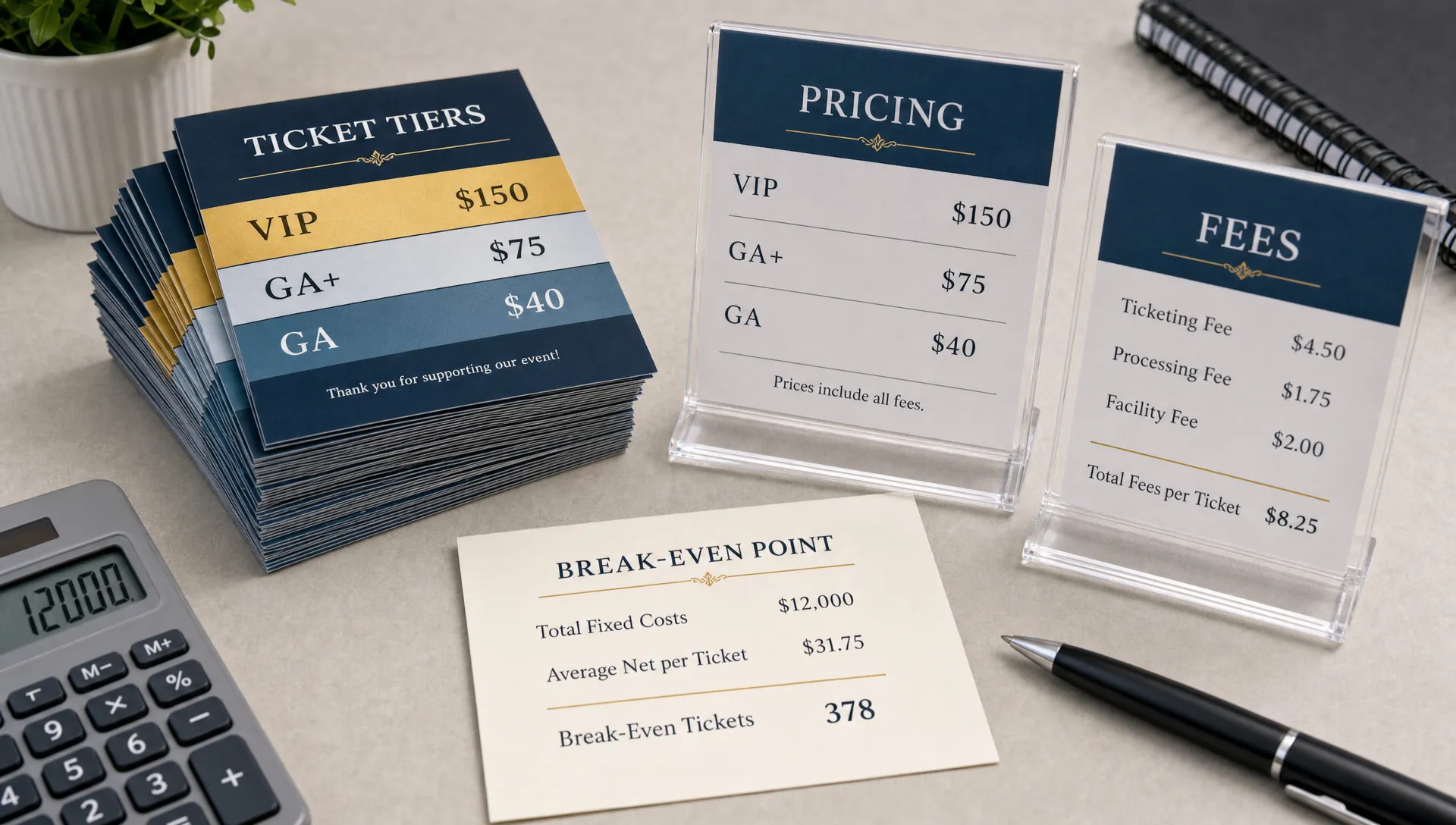
Imagine a 300-capacity event where you realistically expect 240 paid attendees. If fixed costs are $6,000, the event needs $25 per expected attendee just to cover fixed costs. If variable costs add $4 per attendee and you want $6 per attendee in profit, your minimum average net ticket revenue is $35.
That does not mean every ticket must be $35. You could sell a limited early bird at $25, a main release at $35 and final release tickets at $45, as long as the weighted average protects the event. The mistake is selling too many low-priced tickets, then trying to recover with aggressive last-minute pricing or surprise fees.
If you want a deeper framework for setting floors, tiers and margins, TixFlow’s guide to event ticket pricing strategies that protect your margins is a useful next step.
Use tiered pricing as a fair exchange, not a trap
Tiered pricing is one of the cleanest ways promoters make money selling tickets ethically. The key is to make the reason for each tier understandable.
Early bird tickets work because early buyers give you cash and confidence before the event is proven. They take a small risk, so they receive a better price. Main release tickets reflect the standard value of the event. Final release tickets can cost more because remaining inventory is limited and demand is clearer.
This becomes unethical when tiers are unclear, constantly reset or designed to make buyers feel misled. If you say “final release,” it should mean something. If you hold back tickets for partners, production guests or door allocation, plan those quantities in advance and avoid implying that all remaining capacity is public.
A clean tier structure might include:
- Early supporter ticket for a limited quantity or fixed date range.
- Standard general admission ticket as the core public price.
- Final release ticket when public inventory is genuinely lower.
- VIP or premium ticket with specific perks listed plainly.
TixFlow supports unlimited ticket tiers and automated sales phases, which helps organizers build this structure without manually changing prices at the wrong time or relying on chaotic spreadsheets.
Be transparent about fees and the final price
Few things damage trust faster than a ticket that looks affordable until checkout. Hidden charges may increase short-term revenue, but they also create abandoned carts, complaints and lower repeat attendance.
Promoters have choices. You can absorb fees into the listed price, pass them on clearly or use a mix depending on the event. The ethical standard is not that one model is always correct. The ethical standard is that the buyer can see what they are paying before committing.
Flat per-ticket fees, clear checkout pages and a direct path to payment make this easier. A buyer should not need to create an account, decode service charges or wonder whether the price will change after the next click. Every extra surprise creates friction, and friction quietly reduces sales.
This is also where the promoter’s business interest and the attendee’s interest line up. A faster, clearer checkout usually improves conversion. TixFlow’s no buyer registration flow is built around that principle: reduce unnecessary steps so people can buy when intent is high.
Treat scarcity with care
Scarcity is not unethical by itself. Venues have capacity limits. VIP areas have limited space. Discount allocations can be finite. Last call messaging can be useful when a buyer might otherwise miss the event.
The problem is fake scarcity. If buyers learn that “only 10 left” was not true, or that a “sold out” release keeps returning without explanation, they stop believing your next campaign. That hurts more than one event.
Use scarcity only when it is connected to something real:
- A fixed venue capacity.
- A published ticket allocation.
- A real price change date.
- A limited seating area or access perk.
- A genuine production deadline, such as catering, staffing or table layout.
Good urgency helps buyers act. Bad urgency makes them feel tricked. If you need practical ways to create momentum without sounding pushy, this guide on how to promote tickets on sale now and drive urgency covers the marketing side in more depth.

Protect cash flow without spending tomorrow’s obligations
Promoters care about payouts because events require money before doors open. Deposits, marketing, rentals, staffing and production costs often come due before the first attendee walks in. Slow payout cycles can force organizers to use credit, delay vendor payments or reduce the quality of the event.
Fast access to sales revenue can be a major advantage, especially for independent promoters and music producers. TixFlow offers instant payouts through Stripe Connect integration, which can help organizers keep operations moving without waiting through long settlement delays.
Still, ethical cash flow management requires discipline. Gross ticket sales are not the same as available profit. A portion of the cash may belong to taxes, refunds, venue balances, artist guarantees, production invoices or partners. Spending early sales as if every dollar is profit can create serious problems if the event changes or attendance expectations shift.
A useful habit is to split ticket revenue into buckets as it comes in:
| Cash bucket | Purpose | Why it matters |
|---|---|---|
| Fixed cost coverage | Venue, talent, production and required deposits | Keeps core promises funded |
| Variable cost reserve | Security, scanning, wristbands, staffing and per-attendee costs | Prevents a full room from becoming a cash problem |
| Refund and issue reserve | Cancellations, duplicate orders or support cases | Protects buyer trust |
| Marketing reinvestment | Ads, creators, street teams and content | Lets strong sales fund more reach |
| Promoter profit | The margin after obligations are covered | Makes the business sustainable |
This mindset helps promoters stay aggressive without becoming reckless. Real-time sales control also matters here. When you can see what is selling, adjust phases, monitor promo code performance and understand guest list pressure, you can make decisions earlier instead of reacting at the door.
Use promo codes without training buyers to wait
Promo codes are useful when they have a job. They can reward a partner community, measure a street team’s impact, fill a low-demand time slot or help a sponsor bring their audience. They become harmful when they are random, constant or too generous.
An ethical promo code strategy is specific. A music producer might give each supporting DJ a tracked code for their audience. A conference organizer might create codes for partner newsletters. A nightlife promoter might use short-lived codes for past attendees, not public discounts that undercut everyone who bought early.
The buyer should not feel punished for paying full price. If your biggest discounts always appear at the last minute, your audience learns to wait. Over time, that makes early cash flow worse and forces you into more discounting.
Smart promo codes help solve this. Instead of guessing who moved tickets, you can track which partners and campaigns actually converted. For larger teams that want to connect ticketing data with CRM workflows, ad reporting or internal dashboards, working with a partner that builds custom web and AI solutions can help automate reporting without turning outreach into spam.
Make the event promise match the price
Ethical ticket selling depends on a simple question: does the buyer get what the listing led them to expect?
That includes the obvious details, such as date, time, location, lineup, age rules and entry requirements. It also includes the emotional promise. If your copy sells an intimate listening session, the room should not feel like an overcrowded club night. If you sell a premium networking event, attendees should not arrive to a disorganized check-in and vague programming.
A ticket page does not need to be long, but it should remove doubt. Clear event pages, specific ticket descriptions and an easy checkout experience give buyers confidence. If you want to sharpen the conversion side, TixFlow’s article on event selling tactics that turn interest into paid orders pairs well with the ethical pricing approach in this guide.
Customizable event pages can help promoters present the event accurately rather than forcing every experience into the same generic template. That matters for music nights, workshops, pop-ups, tastings, community events and creator-led shows because each one has a different reason to buy.
Increase margin by reducing waste, not squeezing attendees
The cleanest path to higher profit is not always a higher ticket price. Many events leak money through poor planning, unclear offers and operational friction.
A promoter can improve margin ethically by negotiating better production costs, reducing checkout abandonment, tightening guest list policy, matching ad spend to actual ticket movement and designing ticket tiers before sales open. Even small operational improvements compound across events.
Digital guest lists are a good example. A messy door process can create delays, disputes and lost trust, especially when comps, VIPs and paid buyers are mixed together. A clean guest list protects the attendee experience and helps the promoter understand how many people entered through each channel.
Another overlooked margin lever is capacity discipline. Over-comping a room can make an event look busy but weaken revenue. Underselling because the event page is unclear can leave money on the table. The ethical middle is to know how many free, discounted and full-price entries the event can support before profitability suffers.
Watch for ethical red flags
Some tactics may produce a short-term bump, but they make future sales harder. If a strategy would embarrass you if attendees saw the internal plan, it probably needs to be changed.
Common red flags include:
- Advertising a lineup, perk or venue feature that is not confirmed.
- Hiding mandatory costs until the last checkout step.
- Reopening “sold out” tiers repeatedly with no explanation.
- Overselling capacity and hoping no-shows solve the problem.
- Using promo codes that make early buyers feel foolish.
- Spending ticket revenue without reserving money for refunds or vendor obligations.
- Making refund or transfer policies hard to find.
Ethics do not require promoters to reveal every internal detail. They do require enough clarity that buyers can decide fairly.
Measure trust as part of revenue
If you only measure gross sales, you may miss the warning signs. A profitable event with angry buyers, high support volume and poor repeat attendance is not as healthy as it looks. A slightly lower-margin event with strong retention can become more valuable over time.
Track a mix of financial and trust indicators:
| Metric | What it tells you | Healthy direction |
|---|---|---|
| Net revenue per paid ticket | Whether pricing covers real costs | Stable or rising without buyer complaints |
| Checkout conversion | Whether interested visitors become buyers | Rising as friction decreases |
| Sales velocity by tier | Whether pricing phases match demand | Predictable movement through releases |
| Promo code performance | Which partners drive real orders | Concentrated around quality channels |
| Refund and dispute rate | Whether expectations match reality | Low and explainable |
| Support questions before purchase | Whether the listing is clear | Falling over time |
| Repeat buyer rate | Whether trust is compounding | Rising across similar events |
This is where promoters move from guessing to operating. A platform with real-time sales control helps teams see what is happening while there is still time to adjust.
Frequently Asked Questions
Can promoters make money selling tickets ethically? Yes. Ethical profit comes from clear pricing, disciplined costs, real value, transparent policies and a smooth buying experience. Promoters take financial and operational risk, so earning a margin is reasonable when the event delivers what was promised.
Is tiered ticket pricing ethical? Tiered pricing is ethical when each phase is based on real timing, allocation, demand or access. It becomes questionable when tiers are fake, constantly reset or presented in a way that misleads buyers about availability.
Should promoters absorb ticket fees or pass them to buyers? Either can work. The ethical priority is transparency. Buyers should understand the final cost before payment, and promoters should model whether absorbing or passing on fees protects both conversion and margin.
How much profit should a promoter make per ticket? There is no universal number because costs, risk, venue size, talent fees and market demand vary. A better approach is to calculate fixed costs, variable costs, expected attendance and a target margin before setting tiers.
Are promo codes bad for event revenue? Promo codes are helpful when they are targeted and measurable. They hurt revenue when they are overused, too broad or released late in a way that teaches buyers to delay purchasing.
Build profit around trust, not pressure
The most durable way for promoters to make money selling tickets is to make the buyer feel confident before checkout and satisfied after the event. Clear tiers, transparent fees, honest urgency and disciplined cash flow are not just ethical choices. They are revenue tools.
TixFlow is built for organizers who want that kind of control, with instant payouts, flat per-ticket fees, no buyer registration, customizable event pages, unlimited ticket tiers, automated sales phases, smart promo codes, real-time sales control and digital guest lists. If your goal is to sell more tickets without sacrificing trust, the right ticketing setup is part of the strategy.