
Event Ticket Pricing Strategies That Protect Your Margins
A full room does not guarantee a profitable event. You can sell every ticket and still walk away with weak margins if your pricing ignores fees, discounts, payment timing, refunds, staffing, production costs, or the real cost of getting people through the door.
That is why strong event ticket pricing strategies start with one question: what do we need to keep, not just what do we want to charge?
For organizers, promoters, music producers, and teams managing tight cash flow, pricing is not only a marketing decision. It is an operating decision. The right model helps you sell earlier, protect profit, avoid last-minute panic discounts, and keep enough cash moving before event day.
Start with net revenue, not the headline ticket price
Many organizers price tickets by looking at similar events and choosing a number that feels competitive. That can be useful market research, but it is not enough to protect your margin.
A $40 ticket is not $40 of usable revenue. Depending on your setup, you may need to account for ticketing fees, payment processing, taxes you are responsible for, included perks, staffing costs, check-in costs, and other per-attendee expenses.
Use this simple framework before you publish any ticket tier:
Net revenue per ticket = ticket price - ticketing and payment costs - taxes you are responsible for - per-attendee variable costs
Then separate your expenses into fixed and variable costs. Fixed costs stay mostly the same whether 80 or 300 people attend. Variable costs increase with each attendee.
| Cost type | Examples | Why it matters for pricing |
|---|---|---|
| Fixed costs | Venue rental, artist guarantees, production, permits, insurance, core staff | These must be covered before the event becomes profitable |
| Variable costs | Wristbands, drink tokens, seating materials, attendee gifts, security add-ons | These reduce the contribution of every ticket sold |
| Sales costs | Ticketing fees, payment processing, affiliate payouts, promo costs | These can quietly shrink margin if not modeled early |
| Revenue leakage | Excessive discounts, comps, refunds, untracked guest list entries | These reduce the average paid ticket value |
If you only look at gross sales, you may think demand is healthy. If you track contribution margin per ticket, you can see whether the event is actually moving toward profit.
Set a price floor before you create tiers
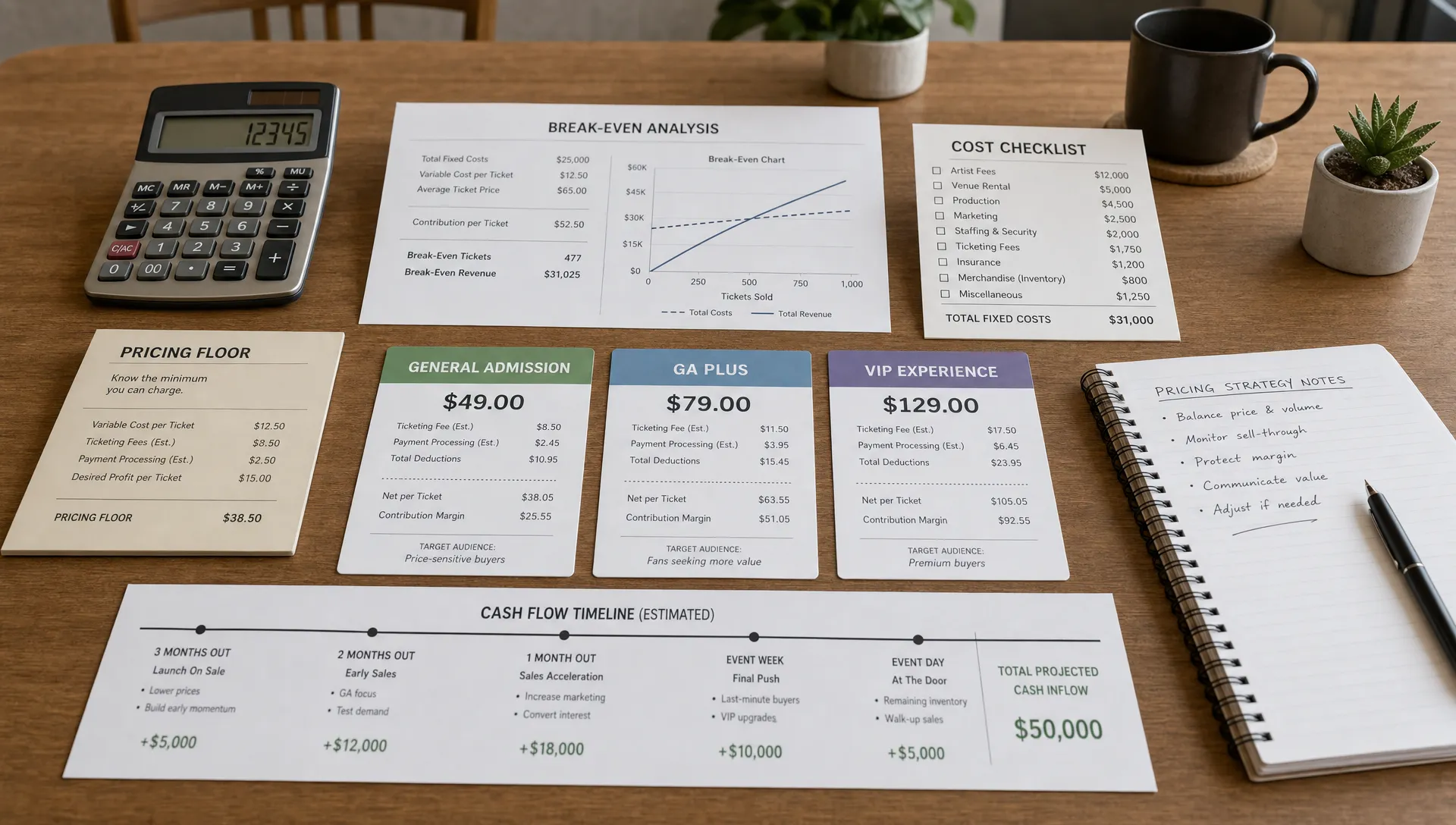
Your price floor is the lowest average ticket price you can accept while still covering costs and reaching your profit target. It is not necessarily your cheapest ticket. It is the weighted average you need across all paid orders.
For example, imagine a small music event with these planning numbers:
| Planning input | Example amount |
|---|---|
| Fixed costs | $12,000 |
| Target profit | $3,000 |
| Capacity | 300 attendees |
| Variable cost per attendee | $8 |
| Estimated sales cost per ticket | $2.50 |
In this example, the organizer needs to cover $15,000 in fixed cost plus target profit. At 300 attendees, that is $50 per attendee before variable costs. Add $8 in variable cost and $2.50 in sales cost, and the minimum average paid ticket becomes $60.50.
That does not mean every ticket must be $60.50. You might sell a limited early tier at $45, standard tickets at $65, and final tickets at $80. But the final mix needs to average out above the floor.
This is where many events lose margin. They sell too many low-priced tickets early, then discover that the remaining inventory must be priced unrealistically high to recover. A margin-safe strategy caps cheaper inventory before launch.
Use tiers to reward urgency, not to train buyers to wait
Ticket tiers should create movement. They should not simply give away margin to people who would have paid more.
A simple structure often works better than a complicated one:
- Early supporter tier for people willing to commit first, capped tightly.
- Standard tier for the main sales window, priced around your needed average.
- Final release tier for late buyers, higher because flexibility and urgency have value.
- Premium or VIP tier only if you can offer a clear value difference, such as better access, reserved seating, or a meaningful experience upgrade.
The key is to connect each tier to either timing, quantity, or value. If the early tier has no cap, you risk selling too much inventory below your average target. If the final tier is not meaningfully higher, late buyers have no reason to act early next time.
For a deeper look at structuring multiple releases, TixFlow has a helpful guide on how unlimited ticket pricing tiers can increase revenue without forcing every attendee into the same price point.
Make fees predictable before you go live
Fees are one of the most common margin problems in event ticketing. The issue is not only whether the organizer or attendee pays them. The bigger problem is uncertainty.
If your platform costs are unclear, your margin model is unclear. If buyer-facing fees appear late in checkout, conversion can suffer. If you absorb every fee without modeling the impact, your profit target can disappear quickly.
There are three basic approaches:
| Fee approach | Best fit | Margin risk |
|---|---|---|
| Absorb fees | Premium events where one clean price supports conversion | Margin drops unless the listed price already includes the cost |
| Pass fees to buyers | Price-sensitive events where organizer margin must be protected | Checkout must stay transparent to avoid frustration |
| Build fees into listed prices | Events that want a simple buyer experience and predictable net revenue | Requires careful price rounding and tax awareness |
None of these is automatically right or wrong. The right answer depends on your audience, your market, and how much pricing transparency matters to your brand.
What matters is deciding before launch. TixFlow is built with flat per-ticket fees, which can make it easier for organizers to model net revenue instead of guessing how much each sale will cost. If fee absorption is a recurring issue for your events, this guide on how to stop absorbing ticket fees is worth reviewing before your next launch.
Control discounts like inventory, not like a panic button
Discounts can help activate partners, reward loyal fans, fill off-peak sessions, or create urgency. But uncontrolled discounts are one of the fastest ways to damage margins.
A 20 percent discount does not reduce profit by 20 percent. It can reduce profit by much more if your costs stay fixed. If a $60 ticket produces $20 of contribution after costs, a $12 discount cuts contribution to $8. That is a 60 percent reduction in contribution, not a 20 percent reduction in revenue.
Use promo codes with rules. Limit the number of redemptions. Assign codes to specific partners, phases, or ticket types. Track which codes produce incremental buyers versus buyers who would have purchased anyway.
A margin-safe discount strategy should answer four questions before any code goes live: who gets it, why they get it, how many redemptions are allowed, and when the code expires.
Price for cash flow, not only attendance
Many event teams fail because revenue arrives too late. Even profitable events can create pressure if deposits, production costs, artist payments, or marketing spend are due before ticket revenue is accessible.
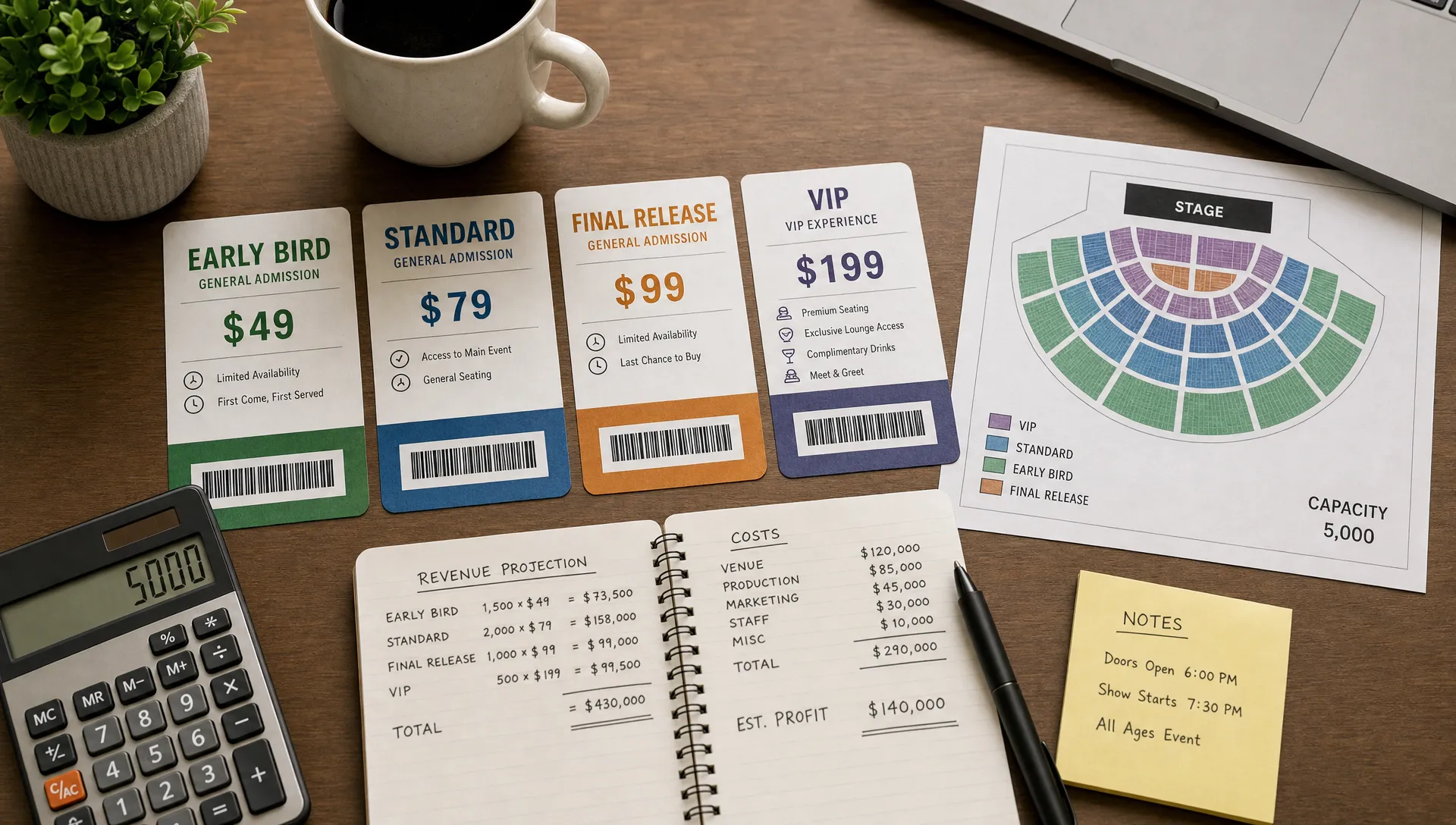
That makes cash flow an important part of pricing. Early sales are not just proof of demand. They can fund the next phase of promotion, reduce out-of-pocket risk, and give your team more confidence when making production commitments.
To improve cash flow, consider pricing mechanics that reward early commitment while protecting the average ticket value. Limited early tiers, deposit-based group sales, timed price increases, and premium tiers can all help. The goal is not simply to sell cheap tickets early. The goal is to bring cash in earlier without giving away too much margin.
This is also where payout speed matters. TixFlow offers instant payouts, which can help organizers avoid waiting unnecessarily to access ticket revenue. For teams producing recurring events, that can make planning, vendor payments, and marketing reinvestment easier to manage.
Watch sales velocity and adjust before panic sets in
Pricing should not be static once the event is live. You do not need to change prices every hour, but you do need to monitor whether sales are moving at the right pace for your capacity, marketing calendar, and cash needs.
The most useful signals are simple:
| Signal | What it can tell you | Possible action |
|---|---|---|
| Early tier sells out quickly | Price may have been too low or demand is strong | Shorten future early tiers or raise the next release |
| Sales slow after a price jump | Value may not be clear enough at the new price | Improve messaging before discounting |
| Promo code use is high but total sales are flat | Discounts may be replacing full-price sales | Cap codes or restrict them to specific channels |
| Many checkout starts but few orders | Friction or surprise costs may be hurting conversion | Simplify checkout and review fee presentation |
| Late sales are weak | Urgency is not strong enough or audience is saturated | Add deadline-based messaging or partner outreach |
The best pricing decisions come from combining sales data with audience context. If you want to use data more confidently, this article on how to use ticket statistics to improve event sales explains which metrics matter most for organizers.
Borrow pricing discipline from B2B sales
Event organizers can learn from industries where pricing is highly structured. In B2B commerce, sellers often use customer-specific pricing, controlled order portals, and automated invoicing to protect margin while still offering tailored terms. A platform such as a B2B wholesale portal with personalized pricing shows how pricing control, segmentation, and operational automation can work together.
Events are different, but the principle is similar. Not every buyer needs the same offer. Sponsors, groups, loyal fans, last-minute buyers, VIP guests, and partners may all require different pricing logic. The mistake is treating every variation as an improvised exception.
Instead, define your pricing rules in advance. Decide which groups deserve different access, what limits apply, and how those orders will be tracked. This protects both margin and operations.
Build a margin-safe pricing model before launch
Before publishing your next event, pressure-test the model. A pricing plan that looks good in a spreadsheet should still make sense if sales are slower than expected, discounts are used, or a key cost increases.
Use this pre-launch checklist:
- Confirm your fixed costs, variable costs, sales costs, and target profit.
- Calculate your minimum average paid ticket, not just your lowest ticket price.
- Cap early tiers so they cannot pull the total average below your floor.
- Decide how fees will be handled before tickets go live.
- Limit promo codes by quantity, date, channel, or ticket type.
- Track sales velocity by tier and phase.
- Keep guest lists and comps controlled so attendance does not hide weak paid demand.
This is also a good moment to review buyer friction. If attendees must create an account before buying, if checkout feels slow, or if pricing changes are confusing, even a smart pricing model can underperform. TixFlow supports no buyer registration, customizable event pages, real-time sales control, automated sales phases, smart promo codes, and digital guest lists, which are all useful when you want pricing control without adding unnecessary operational complexity.
Frequently Asked Questions
What are the best event ticket pricing strategies for protecting margins? The best strategies start with a net revenue target, set a minimum average ticket price, cap discounted inventory, use clear tiers, control promo codes, and monitor sales velocity throughout the campaign.
Should I offer early bird tickets? Yes, but only with limits. Early bird tickets can create momentum and improve cash flow, but they should be capped so they do not pull your average ticket value below the margin you need.
Is it better to absorb ticket fees or pass them to attendees? Both can work. Absorbing fees may create a cleaner buyer experience, while passing fees can protect organizer margin. The important part is modeling the impact before launch and keeping the checkout experience transparent.
How often should I change ticket prices? Most events do not need constant price changes. Use planned sales phases, inventory caps, or date-based increases, then adjust only when sales data shows a clear reason to act.
How do promo codes affect event profitability? Promo codes reduce average ticket value, so they should be limited and tracked. A small discount can have a large impact on contribution margin if most of your costs are fixed.
Protect your margin from the first ticket sold
Profitable events are built before sales open. When you know your price floor, structure your tiers carefully, control fees, and monitor sales in real time, you can sell with confidence instead of reacting under pressure.
If you want a ticketing setup built for fast checkout, flexible pricing, instant payouts, and clearer control over sales phases, explore TixFlow before your next launch.