
Discount Ticket Prices That Fill a Slow Sales Week
A slow sales week is not always a sign that your event is in trouble. Sometimes buyers are waiting for payday, comparing weekend plans or assuming tickets will still be there later. The job is to create a reason to act without turning your event into a bargain bin, and that is where smart discount ticket prices can help.
For event organizers, music producers and small teams watching cash flow, the goal is not just more orders. The goal is more orders at a price that still supports your venue costs, talent fees, production spend and marketing. A discount should solve a specific problem in the sales curve, not become your default answer every time momentum dips.
What a Slow Sales Week Actually Tells You
Before changing the price, look at what slowed down. A flat week after launch often means the first wave of warm buyers has already purchased. A flat week near the event date can mean people need urgency, proof of demand or a clearer reason to choose your event over everything else happening that weekend.
This is where sales velocity matters. If you track daily ticket volume, conversion rate and promo code performance, you can see whether the problem is low traffic, low checkout intent or weak follow-up. A small pocket of discount ticket prices can restart motion when the audience is interested but not committing.
If you already review your event numbers, connect the discount to the metric that needs help. If not, TixFlow has a deeper guide on how organizers can use ticket statistics to improve event sales before making pricing decisions.
| Sales signal | What it may mean | Better response |
|---|---|---|
| Page visits are steady but orders are low | Buyers are hesitating at checkout | Short private promo code or stronger value message |
| Orders dropped after a tier closed | The next price jump felt too sharp | Limited bridge offer before the next push |
| Group buyers are missing | People need a social reason to commit | Pair or group bundle |
| Traffic is low across all channels | The issue is attention, not price | Partner outreach and email before discounting |
How to Use Discount Ticket Prices Without Training Buyers to Wait
The biggest risk of discounting is not the lower price itself. It is teaching your audience that patience gets rewarded. If buyers see public discounts every week, early urgency disappears and your most loyal fans may feel punished for buying first.
Use discount ticket prices with boundaries: limited time, limited quantity, limited audience or a clear reason. For example, a Tuesday code for newsletter subscribers feels different from a public price cut that appears desperate. One rewards engaged fans. The other tells everyone the event is struggling.
Start with your revenue floor
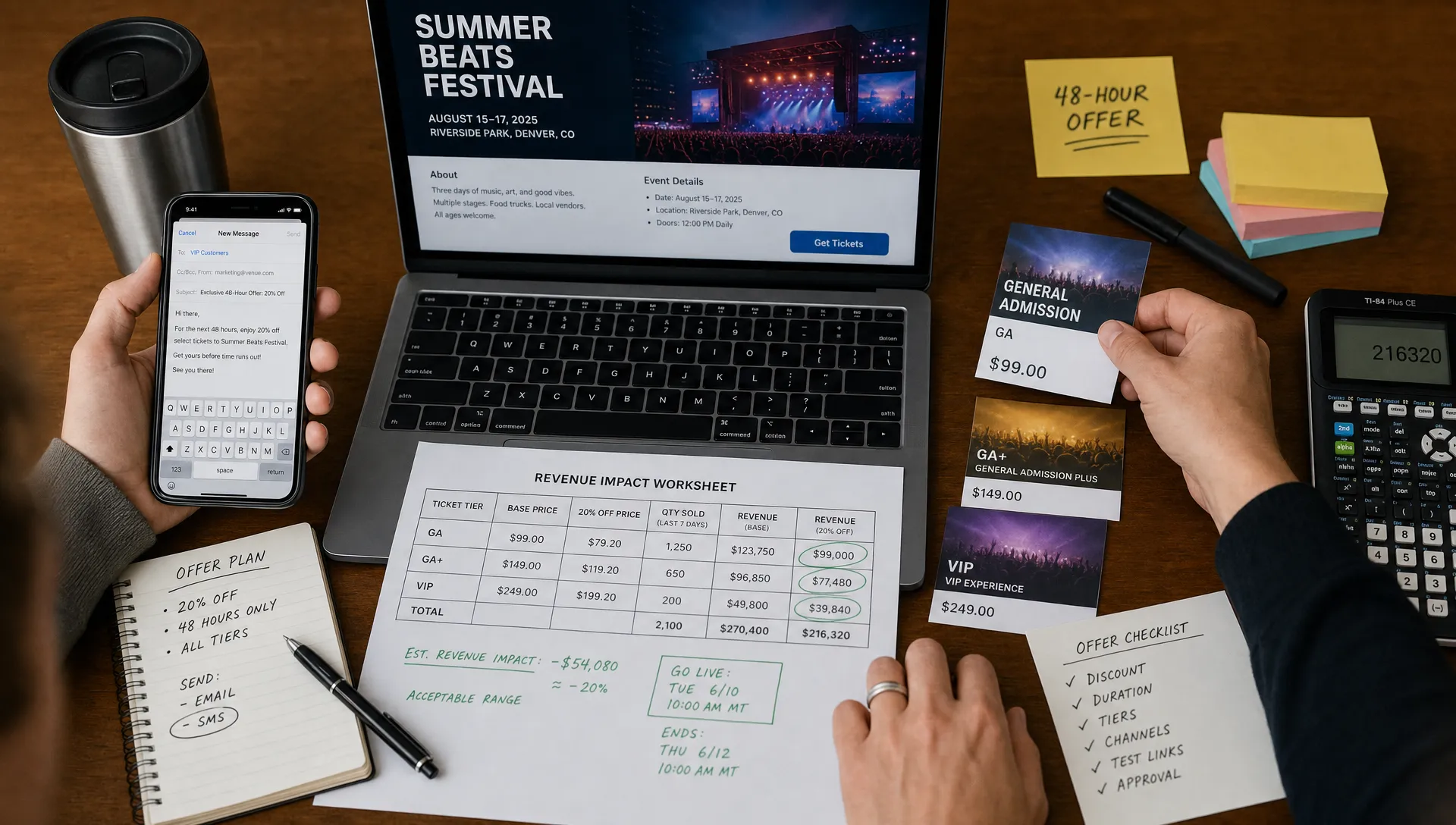
Before launching any offer, calculate the lowest acceptable net revenue per ticket. Use a simple formula: ticket price minus ticketing fees, payment processing, taxes where relevant and any per-attendee cost such as drinks, wristbands, staffing or included merch.
If your general admission ticket is $30 and your variable cost per attendee is $6, a 20 percent discount might look harmless until you realize it cuts the contribution from $24 to $18. That may be fine for a short push, but only if the extra volume is realistic.
For a broader margin view, the TixFlow guide on selling tickets without cutting into revenue pairs well with this kind of slow-week plan.
Keep the full price visible
A discount works best when the buyer can see what they are getting relative to the standard ticket. Do not hide your normal tier or replace it entirely unless you are intentionally changing the whole campaign. Showing the regular price preserves the perceived value of the event and makes the temporary offer feel like a real opportunity.
Five Discount Structures That Can Fill the Gap Fast
Not every slow week needs the same promotion. The safest way to use discount ticket prices is to match the structure to the behavior you want: faster decisions, more groups, stronger partner sales or better early cash flow.
1. The 48-hour private code
A short private code is ideal when you have a warm audience that has not bought yet. Send it to email subscribers, past attendees, artist fan lists or people who clicked a ticket link but did not complete checkout. Keep the message direct: the code is open for 48 hours, then the regular price returns.
This tactic works because it creates urgency without changing the public value of the event. It also gives you a clean measurement window. If the code performs, you know the audience was close. If it does not, the problem is probably not the price.
2. The pair or group offer
For club nights, producer showcases, workshops and local concerts, many buyers do not want to attend alone. A group offer gives one person permission to pull friends in. Instead of discounting every ticket, create a two-pack, four-pack or small crew package that improves the total order value.
A $30 ticket discounted to $25 lowers revenue per attendee. A four-ticket bundle at $100 may feel like a deal to buyers while bringing in more cash per transaction. It also helps the room feel fuller, which matters for atmosphere and bar spend.
3. The weekday recovery code
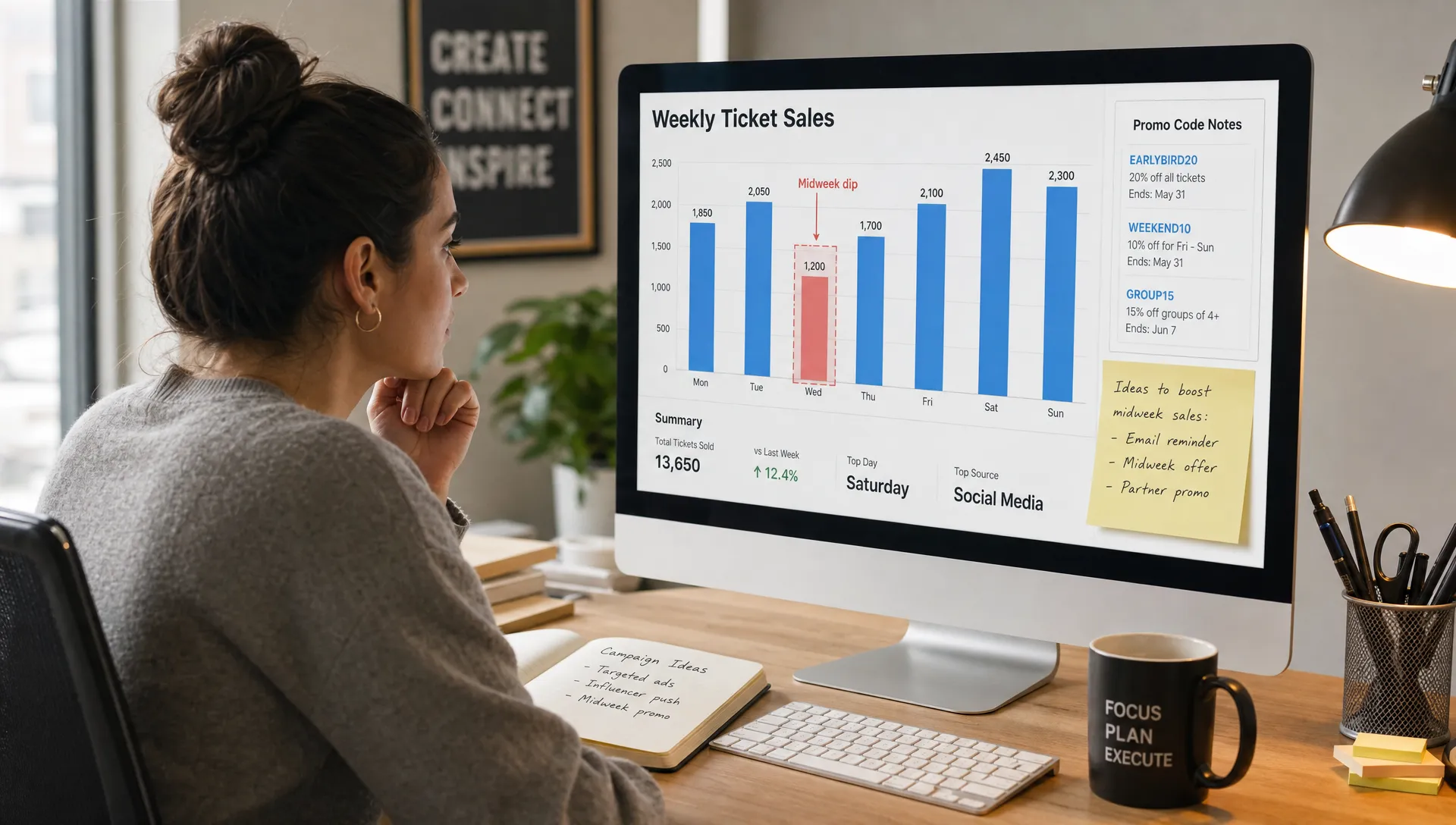
If sales always go quiet between Monday and Thursday, use a midweek-only offer. The point is to convert quiet days into buying days, not to discount the entire campaign. Announce it to a specific channel, close it before the weekend and return to your main price.
4. The price bridge before the next tier
If your next tier is about to open at a higher price, a small bridge offer can pull undecided buyers forward. This is useful when early bird has ended but general admission is still slow. Make the message simple: buy before the next tier, use the code today or pay the new price tomorrow.
This approach protects the logic of tiered pricing. You are not apologizing for the increase. You are giving buyers one last clean reason to act before the campaign moves on.
5. The value-add instead of a lower price
Sometimes the better discount is not a discount. Add early entry, a drink token, a limited merch item or access to a short pre-show session if those perks are already feasible for your team. This can lift perceived value without reducing the headline ticket price.
For music producers, value-adds can be especially strong when the event includes community, networking or education. A small bonus attached to a standard ticket can feel more premium than a $5 cut.
Protect Your Cash Flow While You Discount
Cash flow is the reason many organizers discount too aggressively. Rent, deposits, staff and artist payments do not wait until doors open. That pressure is real, but discount ticket prices should bring cash forward without damaging the final week of sales.
Limit the number of discounted tickets before you launch. Decide whether you want 25 discounted sales, 50 group buyers or one strong afternoon of activity. Once the cap is reached, close the offer. Scarcity works better when it is operationally true.
This is also where your ticketing setup matters. With TixFlow, organizers can use unlimited ticket tiers, smart promo codes, automated sales phases and real-time sales control to adjust offers without rebuilding the event page from scratch. Flat per-ticket fees make it easier to understand the impact of each order, and instant payouts can help teams keep cash moving as sales come in.
No buyer registration also matters during a short promotion. If someone clicks a limited code during a lunch break or after seeing an artist story, a forced account step can slow them down. Fewer checkout steps usually means less friction between interest and purchase.
A Simple Promotion Calendar for a Slow Sales Week
A discount is only as strong as the message around it. If people do not see the offer, understand it or trust that it expires, it will not move sales. Plan the week before you touch the price.
Use discount ticket prices as one part of a coordinated push, not as the entire campaign. Pair the offer with artist posts, partner messages, email, SMS if you have permission and direct outreach to group leaders. For ideas outside the usual feed posts, TixFlow has a guide to ticket promotion ideas beyond social media posts.
| Day | Action | Purpose |
|---|---|---|
| Monday | Review sales velocity and choose the offer cap | Avoid discounting blindly |
| Tuesday | Send the private code to the warmest list | Convert high-intent buyers first |
| Wednesday | Ask artists, partners or hosts to share the deadline | Add trust and reach |
| Thursday | Send a last-call reminder with the exact close time | Create urgency |
| Friday | Close the offer and return to the main tier | Protect full-price weekend sales |
Keep the copy specific. “Slow week special” sounds like the event is weak. “48-hour crew price for our mailing list” sounds intentional. Buyers respond to confidence, especially when the event depends on vibe, social proof and timing.
Mistakes That Make Discounts Backfire
The first mistake is leaving the offer open too long. A seven-day discount often becomes background noise. A 24-hour or 48-hour window gives buyers a clearer decision point.
The second mistake is discounting the wrong audience. If someone was already likely to buy at full price, a public code may simply reduce revenue. Start with hesitant but warm buyers before broadcasting a deal to everyone.
The third mistake is ignoring your early buyers. If you offer a steep public discount after loyal fans paid full price, you can create frustration. When you need a larger public offer, consider adding value for early buyers too, such as earlier entry or a small on-site perk if your operations allow it.
The fourth mistake is using discount ticket prices when the real problem is unclear value. If the lineup, schedule, venue details or ticket inclusions are vague, price may not be the main barrier. Fix the event page before cutting the ticket.
Finally, do not run a discount without a measurement plan. Use a unique promo code for each channel or partner so you can see what worked. That information makes the next slow week easier to handle and prevents the team from guessing under pressure.
Frequently Asked Questions
How much should I discount tickets during a slow sales week? Start with the smallest discount that can change behavior, often 10 to 15 percent or a small fixed-dollar code. Calculate your net revenue first, then cap the number of discounted tickets.
Should I make the discount public or private? Private offers are usually safer because they protect your main price and reward warmer audiences. Public offers can work close to the event date, but they should still have a clear deadline and limited quantity.
Can discount ticket prices hurt early sales for future events? Yes, if buyers learn that every event gets cheaper later. Use limits, vary the structure and avoid repeating the same public discount pattern every campaign.
What is better, a promo code or a lower ticket tier? Use a promo code for short, targeted pushes. Use a ticket tier when the price change is part of your planned sales phase, such as early bird, general admission or last chance.
How do I know if the discount worked? Compare sales during the offer window with your recent daily average, then review promo code usage, order value and channel performance. A good discount improves both volume and cash flow without erasing margin.
Turn a Slow Week Into a Controlled Sales Push
A slow week does not have to become a panic week. When you define the revenue floor, choose the right audience, cap the offer and measure the result, discount ticket prices can create momentum while keeping your event financially healthy.
TixFlow gives organizers the tools to run those offers with less friction, including smart promo codes, flexible ticket tiers, real-time sales control, customizable checkout, digital guest lists and instant payouts. If you want a ticketing setup built for faster decisions and cleaner cash flow, explore TixFlow before your next sales push.