

Why Ticket Sales Without Fees Still Need a Refund Reserve
Offering ticket sales without fees can make your checkout simpler and your advertised price more credible. It does not make every dollar collected safe to spend. If a show is canceled, a premium benefit disappears or a buyer successfully disputes a payment, you may need to return money after venue deposits and production bills have already been paid.
A refund reserve is cash you deliberately keep available to meet those obligations. It protects the gap between receiving ticket revenue and delivering the experience you sold. The right amount depends on your event’s refund exposure, not just its processing fees.
What a no-fee ticket actually promises
“No fees” can describe several different arrangements: buyers pay no additional checkout charge, organizers absorb transaction costs or certain platform charges are waived. Those arrangements do not necessarily eliminate payment processing, taxes or other third-party costs.
For organizers, the useful distinction is between the buyer’s total price, your net proceeds and the amount potentially refundable. If someone pays $50, your refund obligation could be $50 even when less than that reaches your account.
Our explanation of what ticket processing fees cover breaks down those costs. For reserve planning, the central question is simpler: how much cash would you need to return if you could not deliver the event?
Why ticket sales without fees still need cash behind them
Removing a buyer-facing fee does not remove cancellation risk. A venue problem, artist withdrawal or postponed date can create a refund obligation regardless of how clean the checkout looked.
Refunds also do not necessarily reverse every expense associated with a sale. Check your platform and processor agreements for the treatment of original charges, refund costs and disputes. Stripe’s refund documentation explains how refunds use your available Stripe balance and what can happen when that balance is insufficient.
Fast payouts solve an access problem, not a liability problem. Money arriving in your bank account does not mean the underlying transaction can never be refunded or disputed.
For a music producer, this distinction matters most when early sales fund nonrefundable artist or venue deposits. Those deposits may be necessary, but once paid they cannot also serve as cash available for buyer refunds.
Calculate two reserve numbers, not one
Your routine refund allowance
For ticket sales without fees, calculate expected refunds using the amount buyers may receive back, rather than your net proceeds after deductions.
Start with eligible refund requests from comparable events. Adjust for changes in audience, ticket price, refund policy and event format. If you lack history, model several explicit scenarios instead of treating a guessed percentage as an industry standard.
A practical planning formula is:
Routine reserve = expected refund payments + prospective dispute costs + an uncertainty buffer.
Keep those categories distinct. Do not count the same ticket as both a full refund and a separate full chargeback loss in one scenario. Likewise, fees already deducted from your payout should not be added again as future cash costs.
This allowance handles ordinary activity. It does not establish that you could afford to cancel the entire event.
Your full-cancellation funding gap
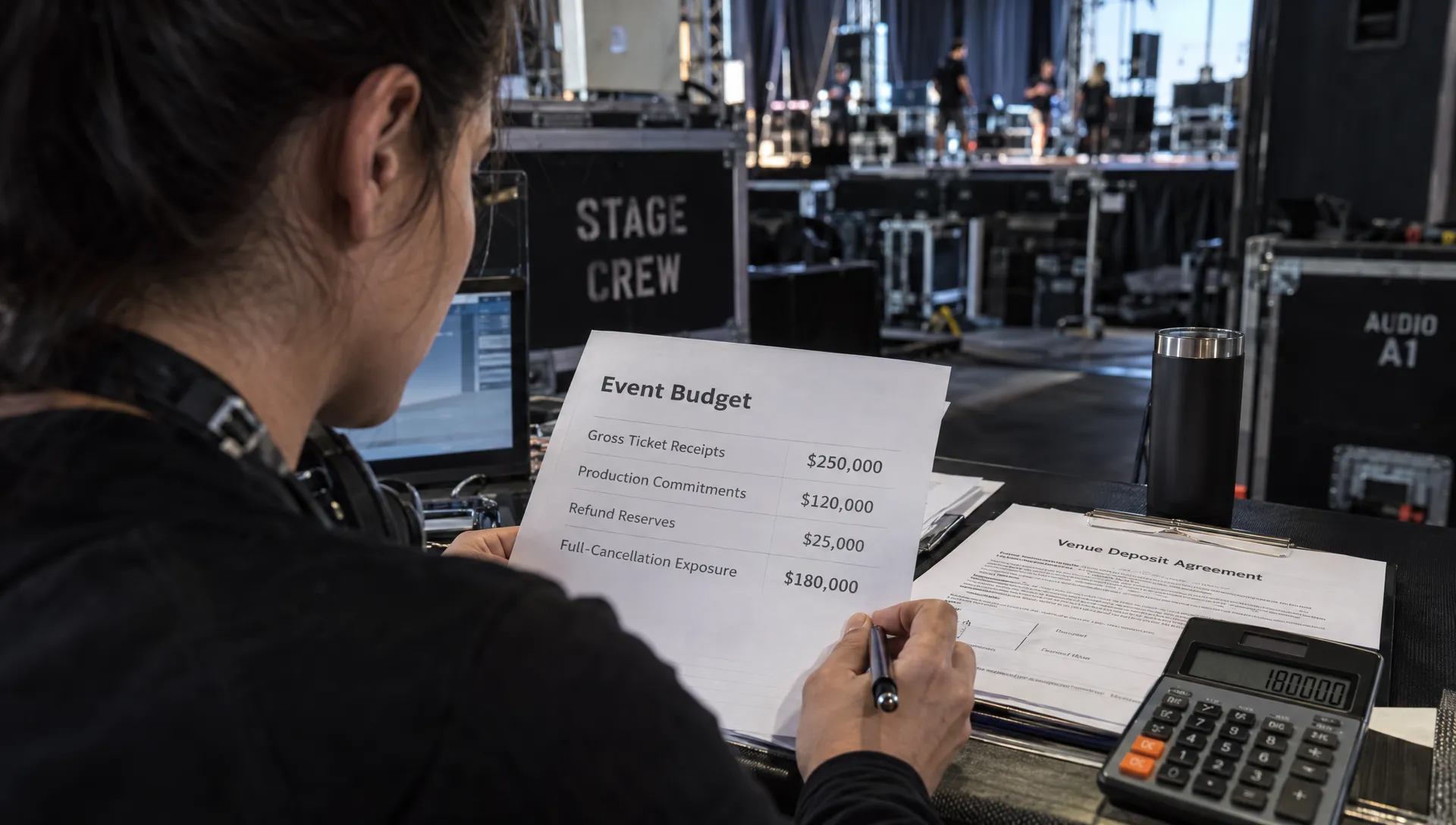
Separately, calculate what would happen if every eligible buyer needed a refund:
Cancellation funding gap = total refundable obligations + additional cancellation costs − funds available in time.
Include refundable taxes or add-ons where required by the applicable terms and law. Then identify genuinely available funding: your dedicated reserve, other unrestricted cash or financing you can actually access when needed.
Do not count nonrefundable production deposits as available cash. Treat insurance proceeds cautiously until you understand the covered causes, exclusions, deductible and likely payment timing. A potentially valid claim is not the same as money available for refunds today.
A routine reserve can be relatively small while your cancellation exposure remains large. Both numbers belong in the event budget.
A worked example for a 300-ticket show
With ticket sales without fees, a $50 advertised ticket might also be the buyer’s $50 total. That makes pricing straightforward, but it does not mean the organizer receives or retains all $50.
Consider this illustrative budget, excluding taxes and add-ons. The deductions below are hypothetical, not TixFlow pricing.
| Item | Calculation | Amount |
|---|---|---|
| Gross ticket receipts | 300 tickets × $50 | $15,000 |
| Assumed transaction costs already deducted | Illustrative total | $600 |
| Net cash received | $15,000 − $600 | $14,400 |
| Routine refund scenario | 30 tickets × $50 | $1,500 |
| Additional prospective costs and uncertainty buffer | Planning assumption | $300 |
| Working refund reserve | $1,500 + $300 | $1,800 |
| Cash remaining outside that reserve | $14,400 − $1,800 | $12,600 |
The $12,600 is not profit. It still has to cover production commitments, taxes where applicable and other obligations.
The $1,800 reserve supports the selected routine scenario. It does not fund full cancellation. If you spend the remaining $12,600 and retain only $1,800, returning all $15,000 would leave a $13,200 shortfall before additional cancellation costs.
That is the decision your budget must address: reduce commitments, retain more cash, secure reliable backup funding or change the event’s risk profile before spending the proceeds.
Keep the reserve usable as sales change
Separate refund cash from operating cash
Your reserve for ticket sales without fees should be identifiable and accessible, not merely a number on a spreadsheet beside an almost-empty bank account.
A separate bank account or clearly tracked cash allocation can help prevent accidental spending. This is a management practice, not a claim that the money has a particular legal or escrow status.
Record the reserve target, actual available cash and any shortfall. Assign one person responsibility for approving transfers out of the reserve. Before a major production payment, check whether the remaining liquidity still supports both your routine scenario and your cancellation funding plan.
Avoid depending on next week’s ticket sales to pay this week’s approved refunds. That creates a cash-flow dependency precisely when sales may slow because buyers are worried about the event.
Recalculate after meaningful changes
Review the forecast at a cadence that matches your sales activity, and immediately after a material change. A weekly review might suit steady sales, while a busy launch or emerging venue issue may require daily attention.
Use current ticket counts and actual prices paid. A discounted early-bird ticket and a VIP package do not create the same refund exposure. Track pending refunds separately from completed ones, and account for outstanding disputes without duplicating the underlying ticket amount.
Revisit the assumptions after a postponement, venue change, major lineup announcement or increase in group purchases. Concentrated orders can create larger individual cash outflows than a history dominated by single-ticket purchases suggests.
Write refund terms your cash plan can honor
Your policy and your budget should describe the same promise. If the event page offers refunds until a specified deadline, reserve planning needs to cover requests that arrive before that deadline, including approved requests not yet paid.
Explain what happens when the event is canceled, postponed or materially changed. State how buyers request refunds, which ticket components are covered and how you will communicate processing expectations. Do not promise a bank-credit date you cannot control.
Package detail matters too. For a wellness workshop, distinguish the group session from optional services such as personal training, nutrition coaching and testing. If a separately priced component cannot be delivered, clear descriptions help you determine which part of the purchase is affected. The same principle applies to concert admission bundled with merchandise or a meet-and-greet.
Clear terms make ticket sales without fees easier to administer, but wording alone cannot eliminate statutory rights or card-network dispute processes. Have policies reviewed for the jurisdictions in which you operate.
For premium packages, defining VIP upgrade and refund rules before launch helps separate the value of admission from benefits that could change independently.
Release the reserve in stages
The reserve should change as exposure changes, rather than remain untouched forever or disappear immediately after doors close.
Before the event, release cash only when the updated forecast supports it and you still have a credible cancellation funding plan. After delivery, reconcile attendance, canceled benefits, pending refund requests and open disputes before reducing the balance.
An event ending is not the same as every payment becoming final. Disputes can arise afterward, and relevant timelines depend on the payment method, network rules and circumstances. Use your processor’s guidance rather than assuming one universal release date.
Keep a written release decision showing the remaining obligations, retained amount and person approving the transfer. This makes it easier to explain why cash is available for the next production without overlooking unfinished obligations from the last one.
How TixFlow fits the cash-control plan
If your goal is ticket sales without fees added at checkout, distinguish that pricing choice from the costs of operating the ticketing system. TixFlow offers flat per-ticket fees, so do not treat a buyer-facing no-fee promise as a claim that the platform has no charges.
TixFlow offers instant payouts, real-time sales control and Stripe Connect integration. Those features are relevant to managing revenue access and tracking sales, but they do not replace your own reserve calculation or cancellation funding plan. Confirm the applicable payout and payment-account terms for your setup.
Unlimited ticket tiers and automated sales phases also make it useful to calculate exposure by tier and actual selling price. A sold-out early-bird allocation should not be valued at today’s higher general-admission price when forecasting refunds.
Frequently asked questions
Is there a standard refund reserve percentage for events? No single percentage fits every event. Use your refund terms, comparable event history, ticket mix and delivery risks to model routine activity. Assess full-cancellation funding separately rather than assuming the routine allowance covers it.
Do ticket sales without fees reduce chargeback risk? Clear pricing removes one possible source of dissatisfaction, but it does not prevent disputes over cancellation, non-delivery or unauthorized payments. Keep purchase records, event communications and evidence of delivery where appropriate.
Can a no-refund policy eliminate the need for a reserve? No. Applicable law, cancellation obligations and payment disputes may still require money to be returned. A policy also does not fund the costs of responding to disputes or resolving exceptions you approve.
What if a buyer requests a refund while a dispute is open? Follow your processor’s instructions before issuing a separate refund. Paying through the wrong route can complicate the case or create a risk of duplicate reimbursement.
Check your next payout before spending it
Before committing ticket proceeds, write down three figures: your routine reserve target, full-cancellation funding gap and cash available after existing commitments. If those numbers do not support the next production payment, address the shortfall first. A transparent ticket price earns trust at checkout; available refund cash helps you honor that trust when plans change.