
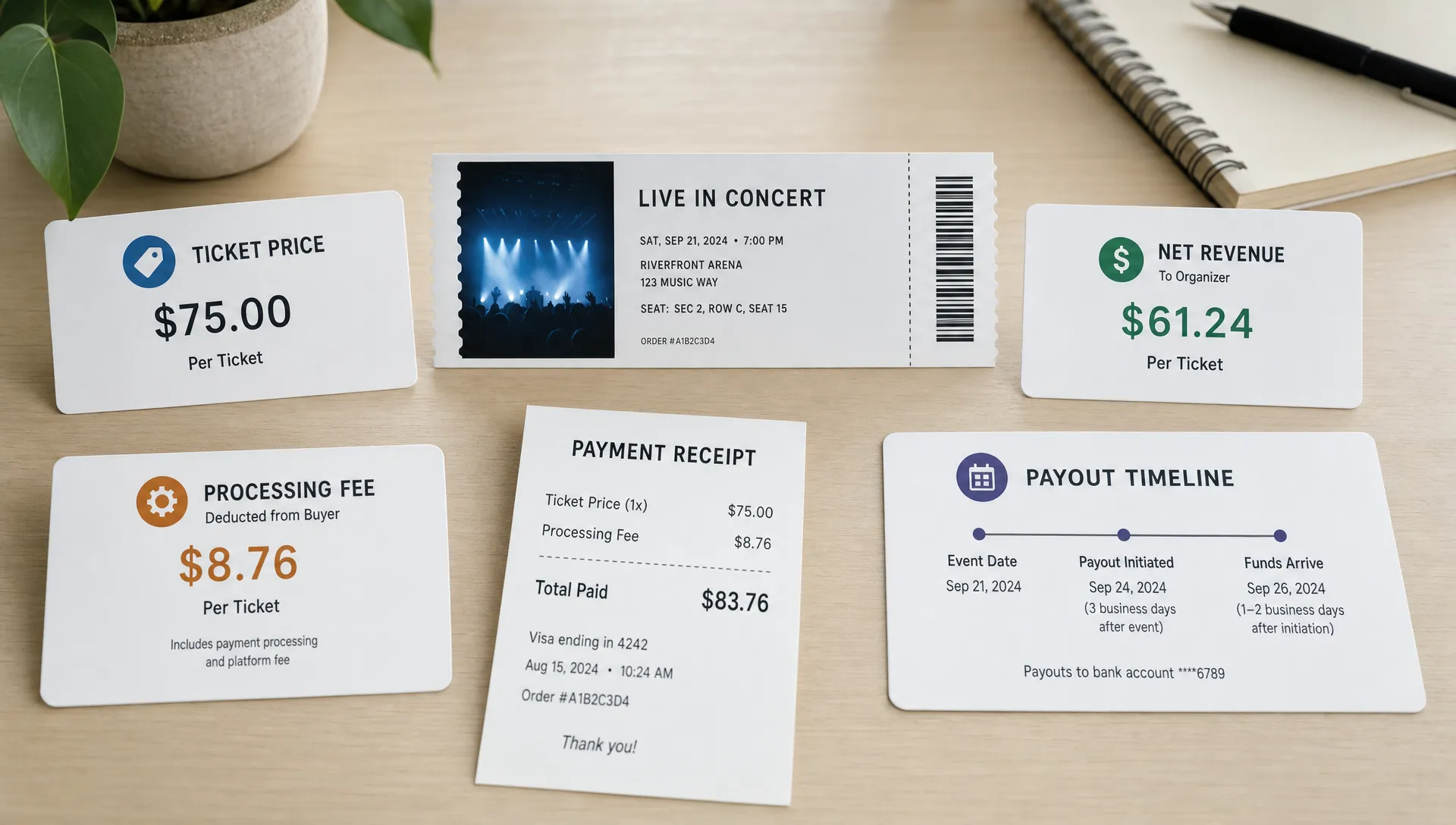
Ticket Processing Fee Explained Without the Confusion
Few line items create more confusion at checkout than a ticket processing fee. Attendees see the total price move, organizers worry about margins, and everyone wants to know the same thing: what is this fee actually paying for?
For event organizers, music producers, venue teams, and promoters, the answer matters because fees are not just a checkout detail. They influence buyer trust, conversion rate, payout timing, refund expectations, and the real revenue you can use to pay artists, staff, vendors, and production costs.
The good news is that ticket processing fees are not hard to understand once you separate the parts. This guide breaks down what the fee covers, who usually pays it, why platforms structure it differently, and how to explain it clearly without making your event feel more expensive than it is.
What is a ticket processing fee?
A ticket processing fee is a charge connected to selling and delivering a ticket, especially when the transaction happens online. It may appear as a separate line item at checkout, be included in the ticket price, or be paid by the organizer behind the scenes.
In plain English, it helps cover the systems and services required to process the order. That can include card payment costs, ticket delivery, fraud prevention, platform operations, support, sales tracking, guest list management, and payout handling.
The confusing part is that every ticketing platform uses slightly different wording. One platform may call it a processing fee. Another may call it a service fee, booking fee, platform fee, convenience fee, or order fee. Some of these labels overlap, while others refer to different costs.
For organizers, the most useful question is not only what the fee is called. It is this: how does the fee affect the final buyer price and my net revenue per ticket?
What a ticket processing fee usually covers
A ticket purchase looks simple to the attendee, but several things happen in the background between clicking buy and showing up at the door. The fee often supports that workflow.
| Fee component | What it helps cover | Why organizers should care |
|---|---|---|
| Payment processing | Card network costs, payment gateway costs, wallet payments, failed payment handling | Affects the cost of each transaction and refund planning |
| Ticketing platform operations | Event pages, checkout, ticket delivery, order management, reporting | Determines how easy it is to sell and manage tickets |
| Security and fraud controls | Duplicate prevention, suspicious transaction checks, secure digital delivery | Helps reduce chargebacks and fake ticket issues |
| Customer support and admin | Order questions, resend requests, refund workflows, attendee changes | Reduces manual work for the event team |
| Payout infrastructure | Moving funds from buyers to organizers, sometimes through connected payment accounts | Impacts when cash is available before the event |
Not every platform includes all of these in one fee. Some separate payment processing from platform fees. Others bundle everything into a single buyer-facing charge. This is why two platforms can both say they charge a processing fee but produce very different economics for your event.
Why ticket processing fees vary so much
Ticket processing fees vary because platforms make different choices about pricing models, payment partners, risk, and organizer control.
A percentage-based fee rises with the ticket price. For example, a $100 VIP ticket produces a larger fee than a $20 general admission ticket if the fee is calculated as a percentage. A flat per-ticket fee is more predictable because the organizer can estimate cost based on ticket volume rather than ticket value.
Fees can also change depending on whether the buyer pays by credit card, debit card, wallet, or another payment method. Cross-border payments, currency conversion, higher fraud risk, chargebacks, and refunds may add complexity too.
For organizers, predictable fee structure matters. When you are deciding whether to release early bird tickets, add VIP tiers, offer group pricing, or run promo codes, unclear fees make it harder to forecast real revenue. That is one reason platforms with flat per-ticket fees can be appealing for event teams that want cleaner planning.
If you are comparing ticketing tools, look beyond the headline fee. Ask whether the platform charges per ticket, per order, as a percentage of ticket price, or through a mix of all three.
Who pays the ticket processing fee?
There are three common ways to handle ticket processing fees: pass them to the buyer, absorb them as the organizer, or build them into the listed ticket price.
| Fee approach | How it works | Best fit | Main risk |
|---|---|---|---|
| Buyer pays separately | The fee appears at checkout in addition to the ticket price | Events where buyers expect standard online ticketing fees | Can create checkout friction if the total price feels surprising |
| Organizer absorbs it | The organizer pays the fee from ticket revenue | Premium events, invite-only events, or simple pricing campaigns | Reduces net revenue per ticket if not priced carefully |
| Fee included in ticket price | The public price already accounts for the fee | Events that want all-in pricing and fewer surprises | Requires careful margin planning before launch |
There is no universal right answer. A club night, music showcase, conference, workshop, and festival may each handle fees differently.
The main mistake is choosing a fee strategy without running the numbers. Absorbing fees can make the checkout look cleaner, but it can quietly cut into your budget. Passing fees to buyers can protect margins, but it needs clear communication. If you are weighing that tradeoff, TixFlow has a deeper guide on how to stop absorbing ticket fees without hurting your revenue.
The best choice depends on your audience, ticket price, demand level, and how sensitive buyers are to the final checkout total.
Why this matters for cash flow
For event teams, cash flow is often more important than the advertised ticket price. You may need ticket revenue before the event to pay deposits, secure vendors, confirm production, cover marketing, or guarantee artists.
A ticket processing fee can affect cash flow in two ways. First, it changes how much money you keep per ticket. Second, the ticketing platform’s payout schedule determines when that money reaches your account.
This is especially important for independent promoters and music producers. If payouts are delayed until after the event, the event team may have to front more costs. If fees are unpredictable, the team may overestimate available funds.
A strong ticketing setup should make both parts clear: what each ticket nets and when funds are available. If payout timing is a major concern for your team, this guide to simplifying ticketing payments for faster payouts explains how fewer payment handoffs can reduce operational friction.

How to explain fees without hurting trust
Attendees are not always angry about fees. They are angry when fees feel hidden, inflated, or revealed too late.
Clear fee communication protects conversion because buyers understand the total cost before they feel trapped at checkout. This is no longer just a best practice. In the United States, the FTC has targeted hidden and misleading fees in live-event ticketing through its final rule on junk fees for live-event tickets and short-term lodging, with a focus on upfront total price disclosure and truthful fee presentation.
Even when you are not thinking about compliance, transparency is better for the buyer experience. The fee should not feel like a penalty for being ready to purchase.
Use plain language. Instead of vague copy like processing charges may apply, use simple wording such as ticket processing helps cover secure checkout and digital ticket delivery. Keep it short, factual, and close to the price.
There is a useful product lesson here: trust often breaks at the moment a user is asked to take action. Product teams use tools like the AI Product Adoption Deck to diagnose where adoption breaks and improve user confidence. Event teams can apply the same thinking to ticket checkout by identifying the exact moment buyers hesitate, then removing surprise, friction, and unclear language.
The goal is not to overexplain every backend cost. The goal is to make the buyer feel that the final price is fair, expected, and safe to pay.
How to calculate your real revenue after fees
To understand your true ticket revenue, start with net revenue per ticket rather than the public ticket price.
A simple formula is:
Net revenue per ticket = ticket price minus any organizer-paid processing costs minus discounts minus taxes or other required deductions
If the buyer pays the processing fee separately, your net revenue may be closer to the listed ticket price. If you absorb the fee, your net revenue is lower. If you include the fee inside the ticket price, you need to set the public price high enough to preserve your target margin.
Here is a simplified example using hypothetical numbers:
| Scenario | Public ticket price | Buyer-facing fee | Organizer-paid fee | Net before event costs |
|---|---|---|---|---|
| Buyer pays fee | $40 | $2 | $0 | $40 |
| Organizer absorbs fee | $40 | $0 | $2 | $38 |
| Fee built into price | $42 | $0 | $2 | $40 |
Now multiply that by volume. If you sell 500 tickets, a $2 organizer-paid fee equals $1,000. That could be the difference between covering a sound engineer, adding security, funding ad spend, or protecting your profit.
This is why ticket processing fees should be part of pricing strategy, not an afterthought. If you are building a full pricing model, you may also want to review these event ticket pricing strategies that protect your margins.
Processing fee vs service fee vs platform fee
The terms are often used interchangeably, but they can mean different things depending on the ticketing provider.
A processing fee often refers to payment and transaction handling. A service fee usually refers to the platform’s role in hosting the sale, managing ticket delivery, and supporting the order. A platform fee may be the organizer-facing cost for using the software. Some platforms bundle all of this into one visible charge.
Before you launch ticket sales, ask your provider these questions:
- Is the fee charged per ticket, per order, or as a percentage?
- Is payment processing included or separate?
- Can I choose whether the buyer or organizer pays the fee?
- Are refunds, chargebacks, or failed payments handled separately?
- When are payouts released?
- Does the attendee see the full price early in checkout?
These questions matter because they help you compare platforms accurately. A low advertised fee may not be low if extra costs appear later. A higher-looking fee may be acceptable if it includes faster payouts, better fraud protection, or fewer manual tasks.
Best practices for organizers
The cleanest fee strategy is the one your team understands before tickets go live and your attendees understand before they pay.
Start by deciding your target net revenue per ticket. Then work backward into the public price, discounts, fees, and expected sales volume. This prevents the common mistake of choosing a ticket price that looks good on a flyer but fails to cover real costs.
Next, decide how fees should appear. If your audience is highly price-sensitive, an all-in price may reduce checkout hesitation. If your audience is used to ticketing fees, passing the fee through may protect your budget. Either way, avoid surprises late in checkout.
Use ticket tiers intentionally. Early bird tickets can reward fast buyers, but only if the lower price still covers costs. VIP tickets can support margins, but percentage-based fees may rise with higher prices. Promo codes can drive urgency, but broad discounts can erase the revenue you thought fees were protecting.
Finally, watch sales in real time. If a ticket tier is moving faster than expected, you may need to close it, adjust the next tier, or limit promo codes. If sales are slow, you need enough visibility to respond while there is still time to fix the campaign.
Where TixFlow fits
TixFlow is built for organizers who want ticketing to feel simple for buyers and controllable for event teams. The platform supports flat per-ticket fees, instant payouts, no buyer registration, real-time sales control, customizable event pages, unlimited ticket tiers, automated sales phases, smart promo codes, digital guest lists, and Stripe Connect integration.
That combination matters because fee clarity is only one part of a healthy ticketing setup. Organizers also need fast access to funds, flexible pricing, low checkout friction, and operational control before the event starts.
For attendees, a smooth checkout can make the purchase feel trustworthy. For organizers, predictable fees and real-time control make it easier to protect margins and plan cash flow.
Frequently Asked Questions
Is a ticket processing fee the same as a service fee? Not always. Some platforms use the terms interchangeably, but a processing fee often relates to payment and transaction handling, while a service fee may also include ticket delivery, platform operations, and support.
Should I pass ticket processing fees to attendees? It depends on your pricing strategy and audience. Passing fees can protect your margin, but the fee must be clearly shown so buyers do not feel surprised. Absorbing fees can simplify checkout, but you need to price tickets high enough to cover the cost.
Do ticket processing fees affect payouts? They can. Fees affect how much revenue remains from each ticket, while the ticketing platform’s payout policy affects when you receive funds. Both matter when you need cash before event day.
Why do some platforms advertise no ticket fees? Sometimes no ticket fees means the organizer pays instead of the buyer, or the cost is built into the ticket price or another part of the platform model. Always compare net revenue, not just the marketing claim.
How can I make fees feel less confusing for buyers? Show the total price early, use plain language, avoid surprise charges at the final step, and keep checkout fast. A clear, low-friction purchase experience reduces hesitation.
Make ticket fees easier to manage
A ticket processing fee should not be a mystery for your team or a surprise for your attendees. When fees are clear, pricing is easier to plan, checkout feels more trustworthy, and your event budget becomes more predictable.
If you want a ticketing setup with flat per-ticket fees, instant payouts, flexible ticket tiers, no buyer registration, and real-time sales control, explore TixFlow and build a checkout experience that protects both conversion and cash flow.