

Sell VIP Tickets With Clear Upgrade and Refund Rules
If you sell vip tickets, buyers need to know more than what happens inside the lounge. They also need to understand whether they can upgrade an existing ticket, how much the upgrade costs and what happens if the premium experience changes. Those answers affect purchase confidence, support workload and the money you can safely spend before event day.
The most useful policy separates admission from VIP benefits, explains upgrade pricing and distinguishes buyer-requested refunds from organizer-caused changes. Here is how to build those rules into a workable sales process without promising more than your team can deliver.
Separate admission from the VIP upgrade
Start by stating whether VIP is a complete admission ticket or an add-on that requires a separate entry ticket. A buyer should never discover at the door that their premium purchase does not include admission.
Describe each benefit precisely. “Priority entry” needs a designated entrance and operating hours. “Artist access” needs a defined format, eligibility rules and a plan for cancellations. Avoid wording that implies a guaranteed meet-and-greet when you are only offering access to a shared hospitality area.
If you are still developing the offer, focus first on VIP packages that buyers actually want. This guide addresses the next step: keeping the purchase, upgrade and refund conditions consistent with that offer.
Keep a dated copy of the package description and terms associated with each sale. That gives staff a reliable reference when benefits or prices change later.
How do you sell vip tickets with clear upgrade rules?
An upgrade policy should answer four questions: who is eligible, what they pay, when requests close and what happens to their original ticket. Apply the same published rules across checkout, email support and the entry desk.
Calculate the price difference consistently
A straightforward approach is to credit the eligible admission amount actually paid against the current VIP admission price. Do not automatically credit the original ticket’s undiscounted face value.
For example, suppose a buyer paid a $65 admission subtotal and the current VIP admission subtotal is $120. Their upgrade difference is $55 before any applicable taxes or separately assessed charges. If the buyer paid $55 after a discount, the difference under this policy is $65.
| Pricing component | Illustrative amount |
|---|---|
| Current VIP admission subtotal | $120 |
| Eligible admission credit | $65 |
| Upgrade difference before applicable taxes or charges | $55 |
Explain whether the credit includes original booking fees, how promo codes affect the calculation and whether an earlier VIP sales-phase price remains available. Do not leave those decisions to individual support agents.
When you sell vip tickets across multiple pricing phases, specify whether an upgrade uses the price available when the request is approved or a previously guaranteed price. Quote the final payable amount before the buyer commits.
Check capacity before collecting payment
VIP capacity may be smaller than the venue’s admission capacity. A sold-out lounge cannot accommodate another upgrade simply because general admission tickets remain available.
Treat an upgrade as moving one attendee between categories, not adding another attendee to the venue. Reconcile premium allocations, complimentary guests and pending requests using capacity rules that prevent overselling.
Set an operational cutoff too. Your team may need time to finalize hospitality orders, prepare wristbands or update access lists. Publish the deadline with a time zone rather than saying upgrades close “before the event.”
Leave only one valid admission entitlement
After payment is confirmed, update the attendee’s entitlement through a supported ticket-change process or a controlled manual workflow. If you issue a replacement admission ticket, make the original unusable. If you issue an add-on, clearly identify the original admission ticket it belongs to.
Before you sell vip tickets through an upgrade route, test what entry staff will see. The buyer’s confirmation, guest-list record and access credentials should all describe the same entitlement. Decide separately whether upgrades are allowed after check-in or after a ticket has been transferred.
Distinguish voluntary refunds from undelivered benefits
“VIP tickets are nonrefundable” is not a complete policy. A buyer changing their mind is different from an organizer canceling the event or removing a promised premium benefit. Contract terms cannot override applicable consumer rights.
Use separate rules for separate situations:
| Situation | What your policy should explain |
|---|---|
| Buyer changes their mind | Whether voluntary refunds are available, the deadline and any lawful deductions |
| Buyer wants to downgrade | Whether downgrades are allowed and how any price difference is handled |
| Event is canceled | The refund process, scope of repayment and expected timeline, subject to applicable law |
| Event is postponed | The options offered, response deadline and treatment of buyers who cannot attend |
| A promised VIP benefit is removed | The remedy offered and whether the buyer can keep admission while receiving an appropriate refund |
For a missing benefit, do not assume that refunding an arbitrary portion of the upgrade resolves the issue. The remedy depends on what was promised, the significance of the change and applicable law. A canceled headline artist encounter may affect the purchase more substantially than a replacement welcome drink.
You can sell vip tickets with a firm voluntary-refund deadline while still explaining how organizer-caused changes will be handled. Buyers should see that distinction before paying, not only after submitting a complaint.
Explain fees and timing without overpromising
State whether an approved refund covers admission, the VIP upgrade, mandatory fees and taxes. Your obligations to the buyer and the payment processor’s treatment of its own fees are separate matters.
For US live-event ticket sales covered by the rule, the FTC’s guidance on unfair or deceptive fees explains requirements for displaying the total price inclusive of mandatory fees. Refund wording should be just as explicit about which amounts will be returned.
Separate your team’s decision time from the bank’s posting time. “We review requests within three business days” is different from promising that the money will reach the buyer in three days. Publish only response targets your team can meet, then provide payment-specific timing when a refund is issued.
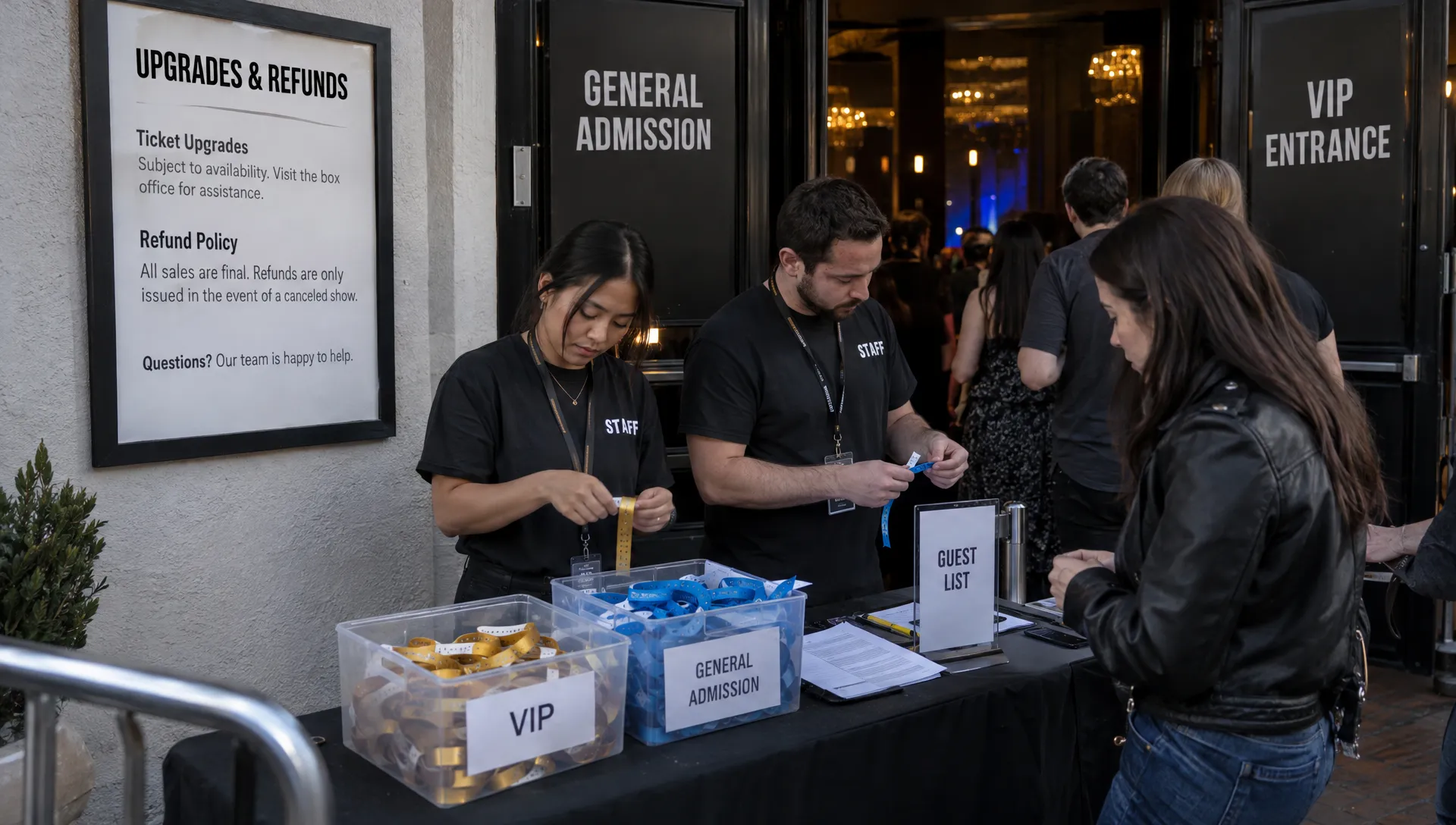
Adapt a plain-language policy template
The following is an illustrative policy for an event on March 20, 2027. The dates and commercial choices are examples, not TixFlow defaults or legal requirements. Adjust them to your event, payment arrangements and local law before publishing.
Admission and benefits: This VIP ticket includes event admission, access to the designated VIP lounge and priority entry during the hours listed on the event page. Benefits not listed in the package description are not included.
Upgrade eligibility: Holders of unused general admission tickets may request an upgrade until 5 p.m. Eastern Time on March 18, 2027, subject to available VIP capacity. Each approved upgrade applies to one admission ticket.
Upgrade pricing: We credit the admission subtotal actually paid toward the current VIP admission subtotal. We provide the complete additional amount payable before collecting payment. Original booking fees are not included in the admission credit, where permitted by law.
Ticket validity: After an upgrade is completed, we confirm which admission credential remains valid and how VIP access will be verified. An upgrade does not create a second admission entitlement.
Voluntary refunds: Requests for refunds of unused tickets are accepted through March 6, 2027. After that deadline, buyer-requested refunds are unavailable except where required by law. Approved refund amounts and any lawful deductions are confirmed before processing.
Cancellation or benefit changes: If we cancel the event, we refund the total amount paid, including mandatory fees. If a listed VIP benefit becomes unavailable, we explain the change and available remedies. Nothing in this policy limits applicable consumer rights.
Only publish commitments you can fund and fulfill. Before you sell vip tickets under a full-payment cancellation promise, account for any processor fees you may have to absorb yourself.
Protect refund money even after a payout
Fast access to ticket revenue helps cover deposits and production costs, but available cash is not the same as money free of refund obligations. Keep a reserve based on your outstanding exposure rather than spending every payout immediately.
Model at least two scenarios: the event is canceled, or the event proceeds but a major VIP benefit cannot be delivered. Include mandatory fees you have promised to return, nonrecoverable supplier deposits and potential payment disputes. There is no universal reserve percentage that fits every event.
Stripe’s refund documentation explains refund funding and processing behavior. For a Stripe Connect setup, responsibility for refunds and balance effects also depends on the integration and charge configuration. Confirm those details rather than assuming that an instant payout eliminates refund liability.
If you sell vip tickets to finance premium hospitality in advance, align supplier cancellation terms with your buyer commitments where possible. Otherwise, you may owe refunds for an experience whose suppliers will not return your deposits.
Give staff a repeatable decision process
Every request should start with the order reference, current ticket type, admission amount paid and the policy version attached to the purchase. Staff should then check eligibility, available capacity and the requested outcome before offering a price or remedy.
For upgrades, confirm payment before changing access. For refunds, record the reason, authorized amount and payment status. Keep a short exception log when a manager approves something outside the normal policy, so a one-off decision does not accidentally become an advertised promise.
For larger teams, this is also an operational growth issue. Founder Engine’s approach to growing revenue per head centers on building growth systems with the people doing the work. In ticketing operations, a useful application is documenting recurring decisions so additional sales do not produce an equal increase in manual support.
Track upgrade requests, completed upgrades, refund reasons and resolution time. When you sell vip tickets with consistent rules, those records help reveal whether unclear wording, pricing friction or delivery problems are creating avoidable work.
Frequently asked questions
Should a VIP upgrade cost the difference between ticket prices? That is a clear starting point, but specify which prices you use. The amount actually paid for admission, current VIP price, discounts and fee treatment can all affect the calculation. Show the final additional payment before purchase.
Can VIP tickets be nonrefundable? You may be able to restrict voluntary refunds, depending on applicable law and your terms. That does not automatically remove obligations arising from event cancellation, significant changes or undelivered benefits. Avoid an unqualified “no refunds under any circumstances” statement.
What happens to the original ticket after an upgrade? Either replace it with one valid upgraded admission credential or retain it as the admission ticket linked to a separate VIP add-on. Do not leave two independent admission tickets usable for one attendee.
How should we sell vip tickets when benefits might change? Describe only benefits you can reasonably commit to, explain relevant conditions and publish a change-handling process. If something material changes, notify affected buyers directly and explain their options rather than silently editing the event page.
Put the rules beside the offer
Use TixFlow’s customizable event pages and unlimited ticket tiers to present admission and premium options clearly. Its real-time sales control and digital guest lists can support your event operations, but your team still needs an explicit upgrade and refund procedure.
Before launch, test one discounted upgrade, one sold-out request and one cancellation refund calculation. If staff cannot resolve each consistently, revise the policy before accepting payments.