
What to Look For in a Ticket Selling Site in 2026
In 2026, choosing a ticket selling site is not just about finding a place to list an event and collect payments. It is about protecting your sales momentum, your attendee experience, and your cash flow from the first announcement to the final check-in.
For event organizers, music producers, venue teams, and independent promoters, the wrong platform can quietly drain revenue. A slow checkout creates drop-off. Confusing fees reduce trust. Delayed payouts put pressure on production budgets. Limited ticket controls make it harder to react when demand changes.
The right platform does the opposite. It helps buyers complete purchases quickly, gives organizers control in real time, and keeps operations simple enough that your team can focus on the event itself.
What a ticket selling site must do in 2026
A modern ticket selling site should support the full sales cycle, not just the transaction. That means it needs to help you launch quickly, present your event clearly, price tickets strategically, process payments securely, and manage entry without unnecessary manual work.
The best way to evaluate a platform is to ask one simple question: does this make it easier for the buyer to say yes and easier for my team to deliver the event?
If the answer is unclear, look deeper. In 2026, buyers expect mobile-first checkout, transparent costs, instant confirmation, and no unnecessary account creation. Organizers expect faster access to funds, flexible ticket tiers, real-time visibility, and tools that do not require a technical team to manage.
A checkout that removes friction
Checkout friction is one of the biggest revenue leaks in online ticketing. Someone may be ready to buy, but if the form is too long, the page loads slowly, the fees appear late, or the site forces registration, the purchase can stall.
A strong ticket selling site should make the path from event page to confirmed ticket feel almost effortless. That means clear ticket selection, a simple payment flow, mobile-friendly design, and no mandatory buyer account unless it is truly necessary.
No buyer registration is especially important for live events. Many ticket purchases happen in the moment, after a friend sends a link, after a social post gains traction, or shortly before a price phase ends. If the buyer has to create an account before paying, you have added a step at the worst possible time.
If checkout performance is a major concern for your team, it is worth studying what makes a high-converting ticketing website before you commit to a platform. The details that feel small, such as event clarity, fee visibility, and mobile layout, often have an outsized impact on completed sales.
Transparent fees and predictable margins
Fees are not just an accounting detail. They affect pricing strategy, buyer trust, and your final margin.
In 2026, organizers should be wary of ticket selling sites that make pricing difficult to understand. Some platforms charge percentage-based fees, buyer fees, organizer fees, payment processing costs, payout charges, or extra fees for features that seem basic. None of those models are automatically wrong, but they should be easy to understand before you launch.
Predictability matters because event budgets are built around assumptions. If you expect to sell 500 tickets, you should be able to estimate what you will actually receive without building a spreadsheet full of hidden variables.
This demand for fee transparency is visible far beyond event ticketing. Sellers increasingly compare predictable pricing models in categories as different as software, creator tools, and even flat-fee MLS listing services like NetRealtyNow, because clear costs make planning easier and reduce unpleasant surprises.
For ticketing, flat per-ticket fees can be especially helpful because they make unit economics easier to model. Whether you are selling general admission, VIP passes, early access, or multi-phase releases, you can better understand how each ticket contributes to the event.
Faster payouts for better cash flow
Cash flow is one of the most practical reasons to take ticketing seriously. Ticket revenue often funds production deposits, artist payments, venue costs, staffing, marketing, and vendor commitments. If your ticket selling site holds funds too long, you may be forced to cover expenses before the event has generated usable cash.
Look for a platform that clearly explains payout timing, payout conditions, refund handling, and payment processor setup. Instant payouts can give organizers more flexibility, especially when events are self-funded or promotion budgets need to be adjusted while sales are still active.
Payment infrastructure matters here. A platform with Stripe Connect integration, for example, can help streamline payment flows, but you should still understand how payouts, disputes, refunds, and account verification work. The goal is not just to collect money. The goal is to access it in a way that supports your event timeline.
For a deeper look at this part of the workflow, review how to simplify ticketing payments for faster payouts. Payment operations can become a bottleneck quickly if they are not considered before sales begin.
Real-time sales control
Events are dynamic. Demand can change after an artist announcement, influencer post, venue update, weather shift, or last-minute group purchase. A ticket selling site should let you respond without waiting for support or rebuilding the event page.
Real-time sales control allows you to adjust availability, monitor performance, pause or activate ticket types, and make decisions based on actual demand. This is especially valuable for organizers using limited-capacity venues or tiered pricing.
Unlimited ticket tiers can also be powerful when used intentionally. You might run early bird tickets, general admission, VIP, backstage access, student pricing, table packages, or sponsor allocations. The platform should make those structures easy to create and manage without cluttering the buyer experience.
Automated sales phases are another feature to look for. Instead of manually changing prices at midnight or switching tiers during a busy launch weekend, automation helps enforce your strategy accurately. Smart promo codes can add another layer of control, letting you reward partners, track campaigns, or create urgency without permanently discounting your core offer.
Customizable event pages that build trust
Your ticket page is often the first serious buying moment. If it feels generic, confusing, or disconnected from your brand, buyers may hesitate. If it looks polished, clear, and aligned with the event experience, it can increase confidence.
A customizable event page should let you present the essentials clearly: event name, date, time, location, ticket options, refund policy, age restrictions, lineup details, and the value of each ticket type. For music events, nightlife, conferences, workshops, festivals, and pop-ups, the page should also reflect the tone of the event.
Brand control matters even more when your audience discovers the event through social media. They may not know the organizer personally. The ticket page has to reassure them that the event is real, the purchase is secure, and the experience is worth paying for.
This is why many organizers care about why your brand matters in ticketing. A strong platform should support your brand rather than make the ticketing provider the center of attention.
Entry operations and guest list management
Selling tickets is only half the job. The ticket selling site should also support what happens when people arrive.
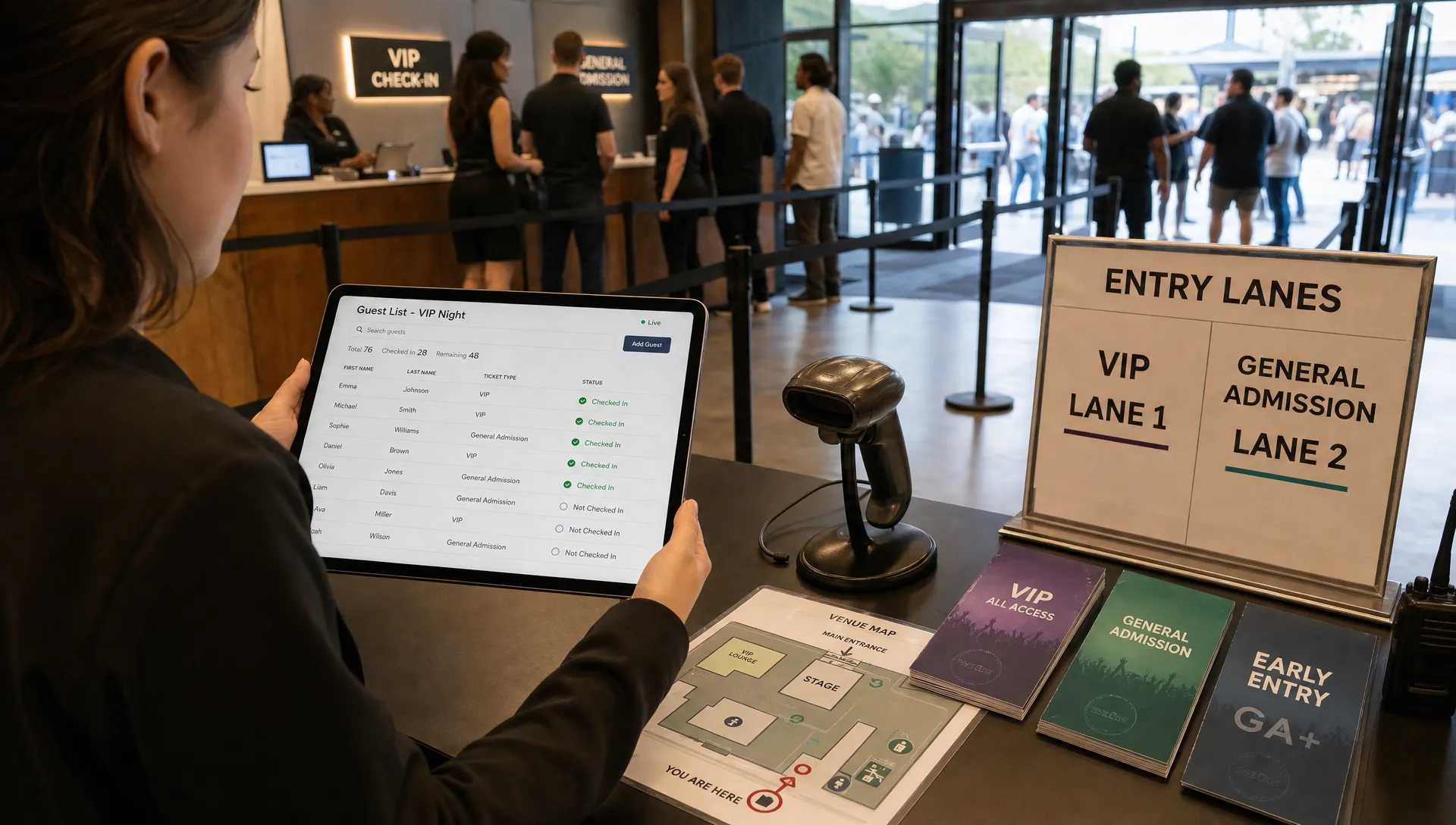
A digital guest list helps your team see who purchased, who is expected, and what ticket type they hold. It can reduce confusion at the door, especially when you have multiple tiers, complimentary guests, staff lists, press access, or late purchases coming in close to entry time.
Before choosing a platform, ask how easy it is for front-of-house staff to access guest information. Also consider how the system handles last-minute purchases, name changes, promo code buyers, and capacity tracking. The smoother this workflow is, the shorter your lines feel and the less pressure your team faces at peak arrival times.

Security and buyer confidence
A ticket selling site handles payments, personal information, and access to a real-world event. Security is not optional.
At a minimum, organizers should look for secure payment processing, HTTPS pages, reliable payment authentication, and clear dispute or refund workflows. Buyers should feel that payment is safe and that their confirmation will arrive quickly.
Security also includes operational reliability. If your ticket page goes down during a launch, if checkout fails during a promotion, or if attendees do not receive confirmations, the damage is immediate. Ask how stable the platform is during traffic spikes and whether the purchase flow is simple enough to avoid unnecessary failure points.
No buyer registration can also support privacy expectations by reducing unnecessary account creation. The buyer pays, receives the ticket, and moves on. For many events, that is exactly the experience people want.
The 2026 ticket selling site checklist
Use this table to compare platforms before you commit. The best choice is usually the one that performs well across buyer experience, organizer control, and financial clarity.
| What to evaluate | Why it matters | What to look for |
|---|---|---|
| Checkout speed | Reduces abandoned purchases | Mobile-friendly flow, minimal fields, no forced registration |
| Fee structure | Protects margins and trust | Clear pricing, predictable per-ticket costs, no surprise add-ons |
| Payout timing | Supports production cash flow | Instant or fast payouts, transparent payout rules |
| Ticket tiers | Enables better pricing strategy | Unlimited or flexible tiers, capacity controls, clean buyer display |
| Sales phases | Saves manual work | Automated start and end times for releases or price changes |
| Promo codes | Helps track campaigns | Smart codes, usage limits, partner-specific offers |
| Event page branding | Builds buyer confidence | Customizable pages that match the organizer and event |
| Guest list tools | Improves entry operations | Digital guest lists and real-time attendee visibility |
| Payment infrastructure | Reduces operational risk | Trusted payment processor and clear refund or dispute handling |
Red flags to avoid
Not every ticket selling site that looks modern is built for serious event operations. Some platforms are easy to start with but become limiting once sales increase or your event model becomes more complex.
Watch for these warning signs:
- Fees are difficult to calculate before tickets go live.
- Buyers must create an account before purchasing.
- Payout timing is vague or delayed without a clear reason.
- Ticket tiers are limited or hard to manage.
- Promo codes are too basic to support real campaigns.
- Event pages cannot be customized enough to match your brand.
- Sales data is not available in real time.
A platform does not need every advanced feature imaginable, but it should not block the core actions that drive ticket sales and event execution.
Where TixFlow fits
TixFlow is built for organizers who want a faster, cleaner way to sell tickets online without giving up control. It supports instant payouts, low fees, easy setup, no buyer registration, flat per-ticket fees, real-time sales control, customizable event pages, unlimited ticket tiers, automated sales phases, smart promo codes, digital guest lists, and Stripe Connect integration.
For organizers, that combination matters because it connects the buyer experience with the operational side of the event. Buyers get a simpler path to purchase. Teams get clearer control over pricing, sales phases, guest lists, and cash flow.
If you are evaluating a ticket selling site in 2026, the question is not only whether it can process a payment. The better question is whether it helps your event sell more confidently, operate more smoothly, and get paid on a timeline that works for your business.
Frequently Asked Questions
What is the most important feature in a ticket selling site in 2026? The most important feature is a low-friction checkout experience because it directly affects whether interested buyers complete their purchase. Fast payouts, transparent fees, and real-time control are also critical for organizers.
Should a ticket selling site require buyers to create an account? For most events, forced buyer registration adds unnecessary friction. A guest checkout or no-registration flow usually creates a faster experience and can help reduce abandoned purchases.
Why do payout timelines matter for event organizers? Payout timelines affect cash flow. Faster access to ticket revenue can help organizers pay vendors, fund marketing, manage production costs, and respond to demand before the event takes place.
Are flat per-ticket fees better than percentage fees? Flat per-ticket fees can make revenue easier to forecast because the cost per sale is predictable. The best model depends on your ticket prices and event structure, but fee clarity is essential either way.
How many ticket tiers should an event have? Use only as many tiers as your pricing strategy needs. Early bird, general admission, VIP, and group options can work well, but too many choices may confuse buyers. A good platform should support flexibility without making the checkout feel crowded.
Choose a platform that protects sales and cash flow
The best ticket selling site in 2026 should feel fast for attendees and calm for organizers. It should reduce friction, make pricing clear, support flexible sales strategies, and help your team stay in control from launch to entry.
If you want a modern platform built around instant payouts, low fees, no buyer registration, real-time control, and customizable event pages, explore TixFlow and see how it can support your next event.