
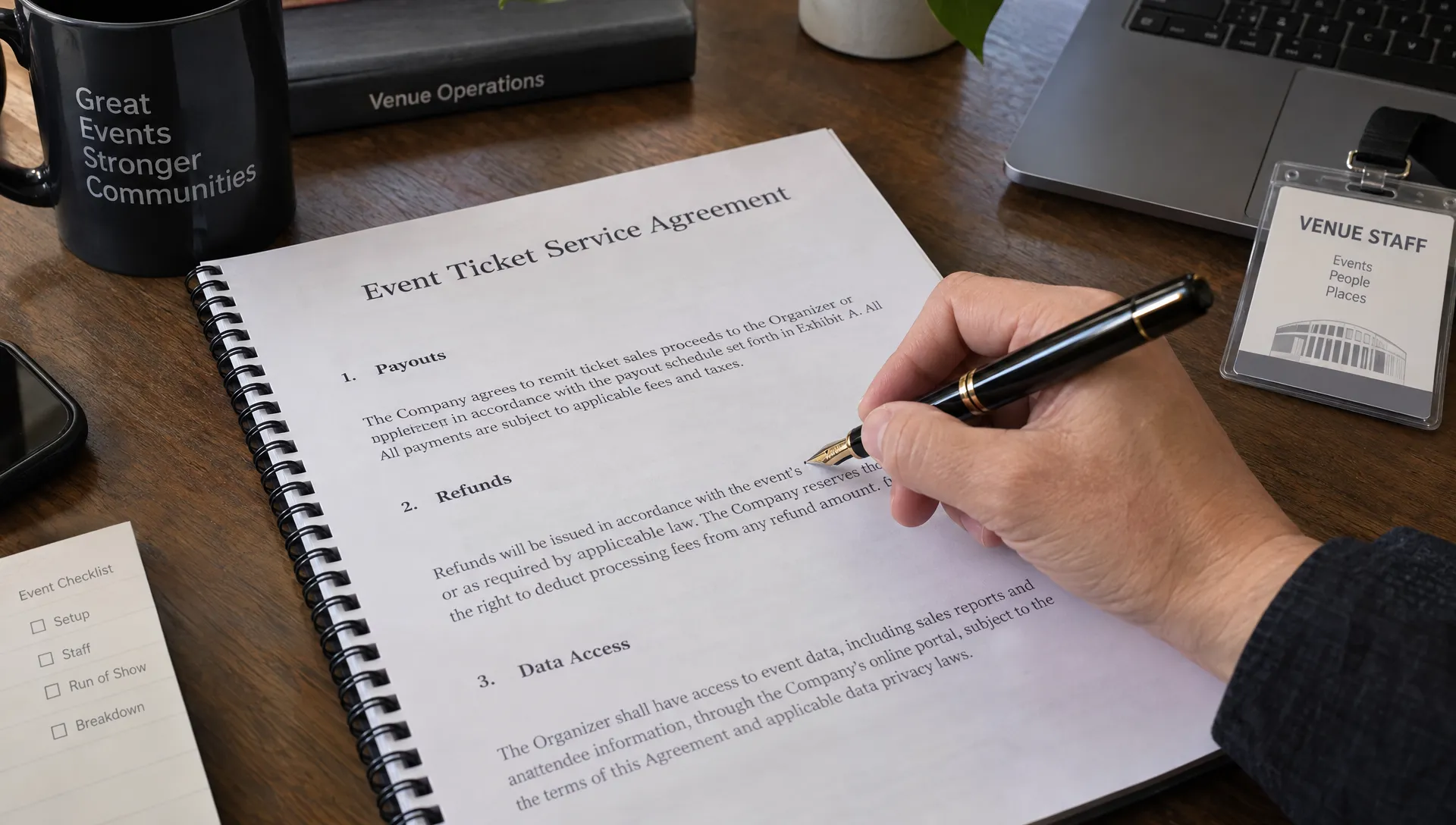
What to Include in an Event Ticket Service Agreement
An event ticket service agreement should explain more than how tickets get sold. It should establish who controls revenue, when money becomes available, what happens after a cancellation and how you recover your attendee records if the relationship ends. For organizers and music producers, those terms can affect whether ticket revenue arrives in time to pay a venue deposit or production invoice.
Use the checklist below to review a proposed agreement before sales open. It focuses on the organizer’s contract with the ticketing provider, not the separate terms attendees accept when purchasing. This is general planning guidance, not legal advice; have counsel review the final documents for your jurisdiction and event.
Identify the parties and the documents that govern
Start with the legal names of the organizer and provider, their business addresses and the people authorized to approve changes. A promoter’s trading name may differ from the company receiving ticket proceeds. Resolve that distinction before connecting a payment account.
Identify the seller, the merchant of record if different, the payment processor and the account holder entitled to settlement. These roles help determine who handles transaction records, disputes and financial obligations. A payment integration alone does not establish who carries each responsibility.
Your event ticket service agreement should also define its scope: one event, a recurring series or every event you produce during the term. Check for exclusivity, minimum sales commitments and restrictions on using other sales channels.
The signed contract may incorporate online terms, a fee schedule, a privacy policy and payment-processing conditions. Record the applicable versions and establish which document prevails if provisions conflict. Require clear notice of changes and specify whether material changes need your consent. Save copies rather than relying on links that may later display different terms.
Put fees and pricing responsibilities in writing
A headline fee is not a complete cost schedule. Ask the provider to identify platform charges, payment-processing fees, payout charges and any costs associated with refunds, disputes or termination. State whether charges apply to paid tickets, complimentary tickets or both.
The agreement should distinguish buyer-paid fees from organizer-paid fees and explain how each appears in reports. Our guide to what organizers should really pay in ticket service charges can help you evaluate those cost categories before negotiating.
For each event ticket service charge, specify the calculation basis, who pays and whether the charge is returned after a refund. Do not assume that refunding the ticket automatically reverses every associated fee.
Assign responsibility for price display and tax handling. For covered U.S. live-event ticket sales, the FTC’s Rule on Unfair or Deceptive Fees requires upfront total-price disclosure including mandatory fees, subject to specified exclusions. The contract should allocate implementation duties, but a private allocation does not remove obligations imposed by law.
Have an accountant confirm who calculates, collects and remits applicable taxes. Clarify how discounts, partial refunds and different ticket tiers affect the records you receive.
Define when ticket revenue becomes usable cash
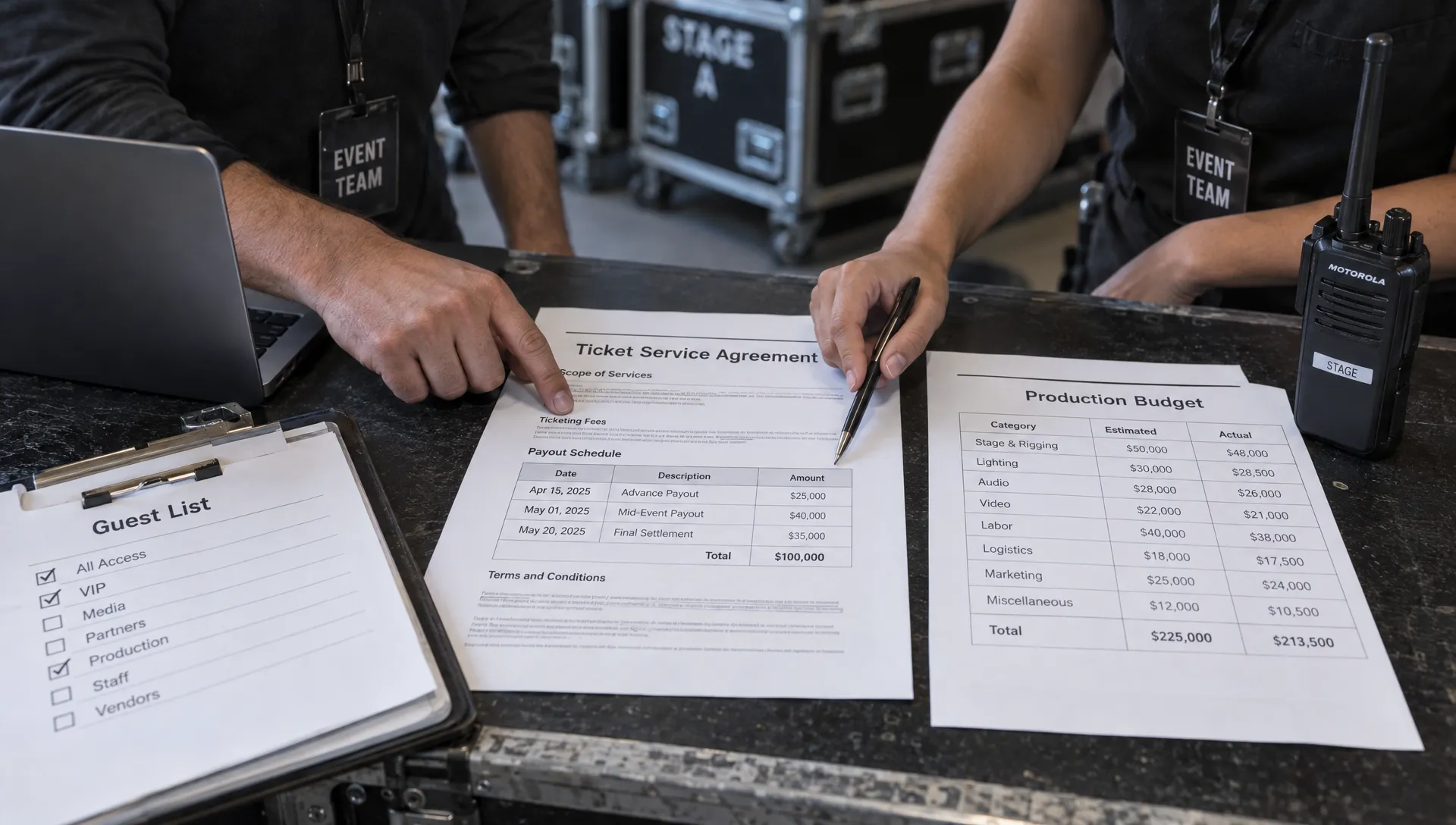
A payout promise is only useful when its conditions are clear. Distinguish payment authorization, settlement, payout initiation and arrival in your bank account. Those are separate milestones.
Require a written schedule that addresses ordinary transactions as well as holds and exceptions:
| Financial term | What the agreement should establish |
|---|---|
| Payout timing | The triggering event, processing window and expected bank-arrival timing |
| Eligibility | Verification requirements and conditions for accelerated or instant payouts |
| Reserves | Calculation method, permitted triggers and release conditions |
| Account deductions | Which fees, refunds or disputes can be deducted from proceeds |
| Reconciliation | Available transaction records and the process for challenging discrepancies |
| Final settlement | How remaining balances and later adjustments are handled after the event |
The event ticket service contract should explain who may impose a hold, what notice you receive and how you challenge it. Identify any separate processor terms governing holds; the platform may not control every restriction.
For a rolling reserve, request the percentage or calculation method, release schedule and treatment after termination. For a discretionary hold, seek objective triggers and a review process. Avoid building a production budget around funds whose release date remains undefined.
Keep advances and personal financing separate
Ask whether an early payment is settlement of completed sales or an advance that must be repaid. If it is financing, review the repayment formula, fees, security interests and any personal guarantee separately.
The same separation matters if you are independently considering mortgage or refinancing options from New Era Lending. Personal borrowing creates a different obligation from receiving ticket proceeds. Do not treat projected sales as guaranteed repayment funds or assume a fast-payout feature eliminates financing risk. Have an adviser review any proposal that puts personal assets behind an event shortfall.
Assign refunds, cancellations and dispute costs
The event ticket service agreement should distinguish an individual refund request from an event-wide cancellation. It should also address postponements, venue changes and other material changes, since each can create different operational and legal questions.
For each situation, identify who decides whether refunds are offered, who communicates with buyers and who initiates the transactions. State whether refunds cover the ticket price, mandatory fees and any optional purchases. Buyer-facing policies must remain consistent with applicable law; a contract cannot make every “no refunds” statement enforceable.
Explain where refund money comes from after proceeds have already been paid out. Can the provider debit a connected account, offset future sales or request a separate payment? What notice and authorization are required? An unrestricted right to collect money can create a serious cash-flow problem during a cancellation.
Chargebacks need their own process. Allocate responsibility for responding, supplying evidence and meeting processor deadlines. Specify dispute fees, who bears the final loss and how suspected provider errors are investigated.
A force majeure clause should address notification and operational consequences, not merely list disasters. Cancellation of the event does not automatically resolve who must fund refunds or pay outstanding charges.
Document event-day operations and support
Translate operational promises into defined responsibilities. Identify who configures ticket tiers, approves sales phases, manages promo codes and authorizes capacity changes. Establish which users may issue refunds or export attendee records.
Your event ticket service agreement should name the support channel available during sales and at the door. Distinguish a response commitment from a resolution commitment. “Support available” tells you little about what happens when a checkout failure occurs an hour before doors open.
If a service-level agreement applies, define the covered service, measurement method, exclusions and remedy. Understand whether a service credit is the only remedy and whether it addresses the likely impact of a failure.
Agree on a fallback plan for lost connectivity, scanning problems or unavailable guest lists. Specify who prepares backup records, how staff prevent duplicate admission and how changes are reconciled afterward. Do not assume offline access exists unless it is confirmed.
Clear communication ownership matters just as much. Establish who answers purchase questions and who handles event-specific requests. These customer service practices that reduce ticket support requests can help turn that division of work into a practical plan.
Protect attendee data and define access rights
Avoid relying on a broad statement that you “own the data.” Define which records you can access, the purposes for which each party may use them and what happens when the relationship ends. Contractual access rights do not override attendees’ privacy rights.
The event ticket service agreement should distinguish order records from payment credentials, marketing permissions and sensitive information. Payment details may remain with the processor rather than being available for export.
Specify whether the provider can market unrelated events to your buyers. Record who collects consent, how preferences are stored and who processes deletion or access requests where required. Operational emails and promotional messages should not be treated as interchangeable.
Security provisions should address access controls, incident notification, cooperation and relevant subcontractors. If a data-processing agreement is needed, incorporate it and identify the parties’ roles.
Define export fields, file formats and delivery timing. A useful handover may include ticket status, transaction references, refunds and consent records where applicable. Request a sample export before signing so you can assess whether it supports your actual operations.
Allocate liability, indemnities and insurance deliberately
Liability provisions determine which losses remain with your organization when something goes wrong. Review the cap, how it is calculated and whether it covers the period in which your largest sales occur. A cap linked to a small amount of fees may leave substantial exposure with you.
Check whether unpaid ticket proceeds, confidentiality breaches, fraud or other specified conduct receive different treatment. Counsel should assess the language and enforceability under the governing law rather than assuming every proposed exception is appropriate.
An event ticket service contract should separate responsibility for organizing a safe, lawful event from responsibility for operating the ticketing system. If you must indemnify the provider, examine which claims trigger that duty and whether it extends to matters outside your control.
Address defense procedures, notice, settlement approval and cooperation. One party should not be able to settle a claim in a way that creates new obligations for the other without an agreed process.
Record any insurance requirements, including evidence of coverage and renewal obligations. Insurance is not a substitute for a clear allocation of duties, and a certificate alone does not explain every exclusion or coverage limit.
Write the event ticket service exit terms before launch
Check the initial term, renewal method and deadline for preventing automatic renewal. Distinguish ending the agreement for convenience from terminating for breach, nonpayment or a security concern. Where appropriate, define notice and an opportunity to fix the problem.
Ending the contract should not leave active ticket holders without a workable admission process. Specify whether existing events continue, whether sales stop immediately and what assistance is available during a transition.
Address ticket validation before moving an active event. A spreadsheet export may preserve names but not transfer valid ticket credentials. Establish how the old and new systems will avoid duplicate entry or rejected tickets.
The agreement should also cover final settlement, outstanding refunds, later disputes and data retention. Set a deadline for requesting exports and identify any permitted transition charges. Clarify which obligations survive termination and for how long.
Finally, review governing law, the dispute forum and any arbitration requirements. Consider whether the cost and location of pursuing a claim would make an otherwise useful contractual right difficult to enforce.
Test the wording against realistic scenarios
Before signing, walk through a successful event, a cancellation after payouts and a system failure during entry. The exercise often reveals responsibilities that a feature list does not capture.
Ask how the event ticket service agreement handles a simple cash-flow test: tickets sell on Wednesday, but a supplier must be paid on Friday. Which clause establishes whether that money will be available? If nobody can identify it, the payout commitment needs clarification.
Replace vague language with specific terms for counsel to finalize. For example:
Instead of: “Payouts are processed promptly.”
Request language addressing: “Eligible proceeds will be submitted for payout within [defined period] after [defined trigger], subject to the verification requirements, reserves and exceptions listed in [specified schedule].”
Instead of: “Organizer data is available on request.”
Request language addressing: “The provider will supply [specified fields] in [specified format] within [defined period] of an authorized request, including during the agreed transition period.”
These are drafting prompts, not ready-to-sign clauses. The brackets should become concrete commitments, and related terms must be checked for contradictions. Keep the final agreement, incorporated policies and written clarifications together so your finance and event teams work from the same record.
Frequently asked questions
Is the organizer agreement the same as the ticket purchase terms? No. The organizer agreement governs the provider relationship. Ticket purchase terms govern the buyer’s purchase and admission conditions. Keep them consistent on refunds, event changes and communication responsibilities, while recognizing that applicable consumer law may impose additional requirements.
Does an event ticket service with instant payouts guarantee immediate bank access? Do not infer a guarantee from the feature name alone. Confirm eligibility, verification, payout initiation, bank timing and possible holds in the applicable terms. Ask which conditions the platform controls and which come from its payment processor.
Who pays refunds after ticket proceeds have been transferred? The agreement should answer this explicitly. It may provide for a reserve, an authorized account debit or another funding method. Confirm the treatment of fees and disputes too, and ensure the required refund process remains workable after a cancellation.
Can I negotiate a standard agreement? Ask. Some providers use fixed terms but may offer an order form, addendum or written clarification. Prioritize payout restrictions, financial liability, data access and continuity for active events. If a material risk cannot be changed, factor it into the provider decision rather than relying on an informal assurance.
Confirm the terms before opening sales
If you are evaluating TixFlow, use this checklist to confirm how its flat per-ticket fees, instant payouts and Stripe Connect integration apply to your event. Get payout conditions, refund responsibilities and transition arrangements in writing. The goal is a contract your finance team can budget against and your event team can follow when plans change.