

What Organizers Should Know About Ticket Buying Services
Choosing ticket buying services is about more than giving fans somewhere to pay. For organizers, the service also determines who controls inventory, when money becomes available and who handles a buyer whose ticket does not work at the door.
The most useful starting point is to separate the buyer’s purchase experience from your operating responsibilities. A recognizable marketplace, a low advertised fee or a buyer guarantee does not, by itself, tell you whether a service fits your event. You need to understand the entire transaction, from listing to settlement and entry.
Know who is selling the ticket
An official ticket seller, a resale marketplace and a purchasing broker serve different purposes. Confusing them can lead to conflicting prices, unclear support responsibilities and promises your team cannot fulfill.
| Sales model | What it does | What organizers should establish |
|---|---|---|
| Official primary seller | Issues tickets from inventory authorized by the organizer or venue | Who controls availability, pricing, ticket changes and refunds |
| Resale marketplace | Facilitates sales of tickets already purchased or allocated | Whether transfers are permitted and whether the marketplace is an authorized partner |
| Purchasing broker or concierge | Sources tickets for a buyer, sometimes through other sellers | Where the tickets originate, when delivery occurs and who handles problems |
A resale listing is not automatically fraudulent, but it is not automatically authorized either. Likewise, a service that helps someone obtain tickets is not necessarily the system that issued them.
When evaluating ticket buying services, identify the seller of record and the party responsible for delivering a valid admission credential. If those are different businesses, document how responsibility passes between them.
Make the official sales route easy to verify
Give attendees a clear route from your event website, artist announcement or venue page to the authorized checkout. Use consistent event names, dates and venue details across those channels.
If you appoint multiple official sellers, explain which ticket categories each can sell. A hospitality partner may have a legitimate package without being authorized to sell general admission, for example.
Your public information should also distinguish payment confirmation from ticket delivery. Tell buyers whether the ticket arrives immediately, appears later in an account or requires a subsequent transfer. Only promise delivery methods and timelines your provider actually supports.
This clarity matters when unofficial listings appear. Your team should be able to confirm whether a seller is authorized without declaring every unfamiliar listing a scam. Publish a support contact for verification and explain what information a buyer should provide, without asking them to post ticket barcodes publicly.
Compare ticket buying services by the complete transaction
Compare an equivalent purchase: the same event, ticket category, quantity, access rights and delivery method. A lower displayed ticket price is not necessarily a lower checkout total.
For US live-event ticket offers, the FTC’s Rule on Unfair or Deceptive Fees generally requires advertised prices to include mandatory fees upfront, subject to specified exclusions. Check how your provider implements the rule rather than assuming a fee breakdown alone is sufficient.
Consider this hypothetical, tax-exclusive order, with no refund or dispute:
| Transaction item | Amount |
|---|---|
| Two tickets at $40 each | $80.00 |
| Mandatory buyer service charge | $6.00 |
| Buyer checkout total | $86.00 |
| Service charge retained by provider | $6.00 |
| Processing cost charged to organizer | $2.50 |
| Organizer proceeds before other obligations | $77.50 |
These are illustrative amounts, not TixFlow pricing. The example shows why the buyer’s total and your net proceeds need separate calculations.
Request a sample settlement showing every deduction, including processing, refunds, disputes and any reserve. For a closer examination of fee allocation, use the framework in what organizers should really pay in ticket service charges.
Define cancellation, postponement and invalid-ticket rules
Buyer guarantees offered by ticket buying services should be evaluated against specific situations, not treated as a blanket promise of protection. A guarantee may describe reimbursement without explaining how quickly a buyer will receive help at the venue.
Ask the provider to walk through these cases in writing:
| Situation | Question to resolve before launch |
|---|---|
| Event cancellation | Who initiates refunds, which charges are returned and how refunds are funded |
| Postponement | Whether tickets remain valid and when buyers may request refunds |
| Material event change | What policy applies if the venue, lineup or access arrangements change |
| Invalid or undelivered ticket | Who investigates and whether the remedy is replacement, reimbursement or another response |
| Payment dispute | Who submits evidence and bears the resulting costs |
Published terms must also comply with applicable consumer law. Do not assume a “no refunds” statement overrides legal obligations or payment-network requirements.
Assign an owner for buyer communications. If the organizer announces a postponement while the seller’s checkout still shows the original date, support problems begin immediately.
Put these responsibilities into your provider contract. The checklist for what to include in an event ticket service agreement can help you turn verbal assurances into reviewable terms.
Check transfer rules before promising flexibility
Transferability is not the same as resale permission. A ticket may allow a buyer to send it to a friend while prohibiting commercial resale, or it may require the original purchaser to attend.
Before approving ticket buying services for distribution, confirm how their delivery and transfer processes match your admission rules. A marketplace cannot make a restricted ticket transferable merely by listing it.
Your ticket page should explain any named-ticket requirement, identification check, transfer deadline or age restriction that could affect entry. If a ticket requires a provider’s app, say so before payment. If it does not, avoid implying otherwise.
Ask what happens to the original credential after an authorized transfer. Does it become invalid, and can venue staff identify the current holder? Do not assume a forwarded PDF has the same controls as a transfer that invalidates the original ticket.
These details are especially important for festivals, VIP packages and events with multiple access zones. A valid ticket may still be the wrong credential for a particular entrance or benefit.
Separate payouts from money you can safely spend
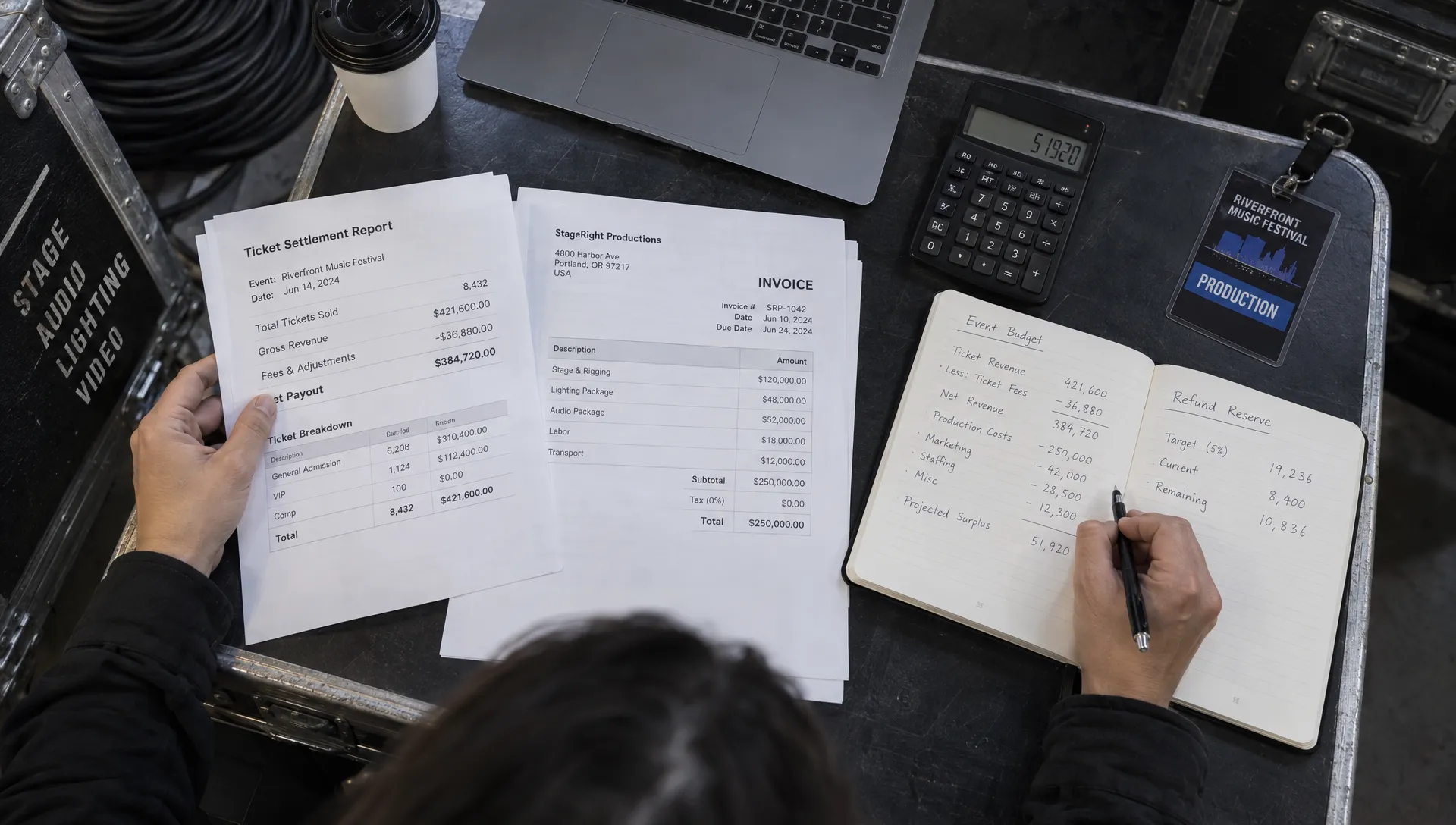
A payout reaching your bank account does not make the entire amount available for production spending. Some of it may need to cover taxes, refunds, artist settlements or other commitments.
For cash-flow planning, assess ticket buying services on both payout timing and the conditions that can change it. Ask about eligibility, verification, settlement schedules, reserves and the treatment of disputed transactions.
Build your event budget around expected bank receipts rather than gross dashboard sales. An early sales surge can look reassuring while leaving you exposed if deposits are due before funds become available.
Keep a refund buffer alongside the production budget
Maintain a separate allowance for potential refunds and disputes. Its size should reflect your event’s obligations and risk, not an arbitrary percentage copied from another organizer.
Run a postponement scenario before committing ticket income to nonrefundable expenses. Identify which payments could be recovered, which would remain due and how buyer refunds would be funded. Fast payouts help working capital, but they do not remove those liabilities.
Also distinguish platform charges from taxes and production expenses in your records. For Australian operations, Perfect Accounting & Tax Services provides bookkeeping and tax consultation. Ask a local adviser how GST, ticket receipts and refund adjustments should be recorded for your circumstances.
Reconcile orders, deductions and bank deposits
Give each event a consistent identifier in your sales reports, accounting records and supplier documentation. Reconcile completed orders against refunds, fees, adjustments and actual deposits.
Keep an explanation for differences rather than forcing the numbers to match. A payout may cover several sales days, while a refund may appear in a later settlement period.
For music producers, gross ticket revenue also needs to be distinguished from artist earnings. A $100 ticket does not reveal the performer’s share. Venue costs, promoter arrangements, taxes and the artist’s contract all affect the eventual settlement.
Test entry and escalation, not just checkout
A successful payment is only one part of a successful ticket purchase. Before launch, test how your team will handle a missing confirmation, an incorrect email address, a transfer and a disputed credential.
Ask which actions staff can perform themselves and which require provider support. Establish who can authorize a replacement or admission exception, with a record of the decision.
Also confirm what information door staff can access and what contingency exists if connectivity fails. Do not assume a digital guest list includes offline access, scanning or duplicate detection unless those capabilities are explicitly confirmed.
When reviewing ticket buying services, judge support by the route to a decision during your actual event hours. An inbox that responds the following business day is not equivalent to help during a Saturday-night entry problem.
Avoid distributing unrestricted attendee spreadsheets to every contractor. Give staff only the information needed for their role and set a process for handling exported guest lists after the event.
Use a short pre-launch acceptance test
Before opening public sales, run an end-to-end test using the provider’s supported test process. If a live transaction is necessary, confirm how its fees and refund will be handled.
Keep the acceptance checklist focused on observable outcomes:
- Purchase: A buyer can identify the correct ticket, understand the total price and complete checkout on a phone.
- Delivery: The confirmation explains how to retrieve the ticket and where to get help.
- Control: Staff can locate the order and follow the agreed correction or transfer process.
- Finance: The transaction can be traced through the sales report, deductions and settlement record.
- Entry: The event team knows how to verify admission and escalate an exception.
Record the results and assign unresolved issues to a named person. “The feature exists” is weaker evidence than “our team completed the task.”
This gives you a practical way to compare providers without turning the decision into a contest over the longest feature list.
Frequently asked questions
What are the best ticket buying services for organizers? The best fit depends on whether you need primary ticket issuance, authorized distribution or a resale arrangement. Compare control over inventory, total costs, payout conditions, buyer policies and event-day responsibilities before choosing.
Does a buyer guarantee mean a ticket is official? No. A guarantee describes a provider’s promised remedy under its terms. Official status depends on authorization from the organizer, venue or another party entitled to distribute the inventory.
How much does an artist make from a $100 ticket? There is no universal amount. Ticket revenue may fund taxes, venue costs, production and other obligations before an artist is paid under a guarantee, revenue share or another contractual arrangement.
Can instant payouts eliminate cash-flow risk? No. Earlier access to proceeds can help pay expenses, but organizers still need to account for refunds, disputes, taxes and contractual commitments.
Choose a platform around your operating responsibilities
For organizers managing primary sales, TixFlow offers instant payouts, flat per-ticket fees and checkout without buyer registration. Unlimited ticket tiers, automated sales phases and real-time sales control support different release strategies.
Evaluate those capabilities against your event’s requirements, then confirm the applicable terms before launch. A sound choice gives buyers a clear purchase path while leaving your team with a workable plan for the money, the tickets and the door.