
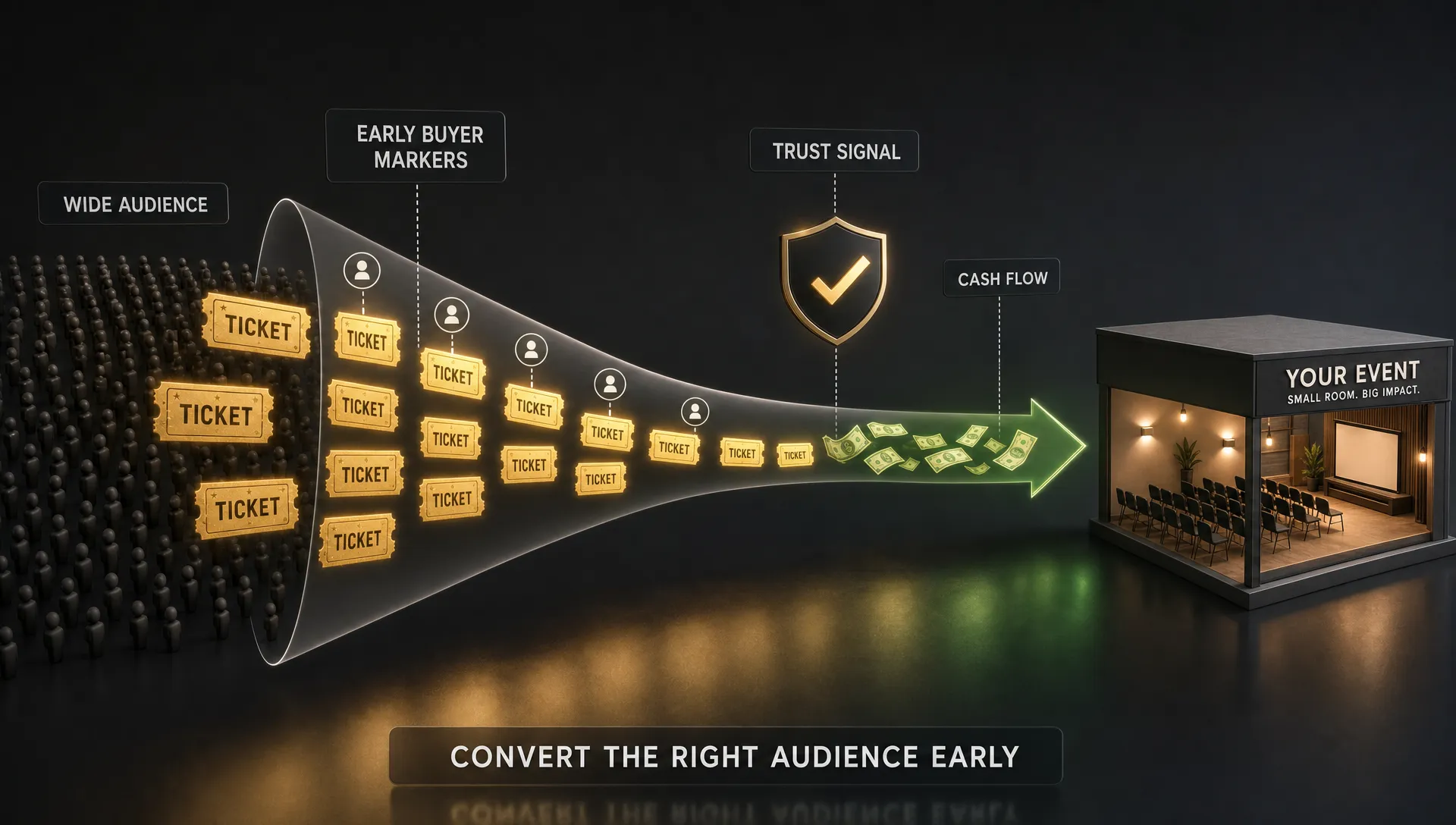
Ticket Selling Strategies for Events With Small Audiences
Small audiences are not a problem to solve. They are a different selling environment.
When you are trying to fill a 50-seat workshop, a 120-capacity listening room, a local producer showcase or a niche community meetup, the usual event advice can feel oversized. “Go viral” is not a plan. “Run more ads” can burn through the margin before the first guest walks in. For small events, the best ticket selling strategies are built around direct trust, clear value, low friction and careful cash flow.
The goal is not to reach everyone. It is to convert the right people early enough that the event feels real, financially safe and worth talking about.
Why small-audience ticket sales work differently
Large events can absorb waste. A festival might spend broadly on awareness because even a small conversion rate can move thousands of tickets. Small events cannot afford that luxury. If your capacity is 80 people, 12 extra buyers might be the difference between breaking even and losing money.
Small-audience selling depends on three things:
- Relevance: People need to understand quickly why this event is for them.
- Trust: Buyers often know the organizer, artist, venue or community behind the event.
- Timing: Early orders matter because they unlock confidence, cash flow and social proof.
That changes how you should approach marketing. Instead of trying to make the event look bigger than it is, make it feel more specific. A small room, a limited guest list or a niche theme can become the reason people buy, as long as the promise is clear.
Start with the audience you already have
For small events, your warm audience is usually more valuable than a cold ad campaign. This includes past attendees, email subscribers, artist followers, venue regulars, local community members, friends of performers and people who have already shown interest in similar events.
Before you announce publicly, map your audience into simple groups:
| Audience group | What they already know | Best selling angle |
|---|---|---|
| Past attendees | They trust the experience | “You already know the vibe, come back before it fills.” |
| Artist or speaker followers | They trust the person involved | “See them in a more intimate setting.” |
| Venue regulars | They trust the location | “A familiar space with a focused crowd.” |
| Community members | They trust the topic or mission | “This is built for people like us.” |
| New prospects | They may know nothing yet | “Here is exactly what you get and why it is worth your night.” |
This exercise keeps your messaging sharp. A music producer selling tickets to a small listening party should not speak to “music fans” in general. They should speak to people who care about unreleased tracks, artist access, local culture or being in the room before something spreads.
Set a realistic sales goal before you sell
A small event should not start with “sell as many as possible.” It should start with a minimum viable room.
Ask yourself how many paid attendees you need for the event to make sense. That number may be lower than capacity. For example, a 100-capacity show might need 55 paid tickets to cover fixed costs, 70 to feel healthy and 90 to feel like a strong win.
Once you know those thresholds, your strategy becomes easier. You can decide how many early tickets to release, when to push public promotion and whether a partner needs to help move a specific number of orders.
This is also where pricing and sales strategy meet. If you are still working through the numbers, the guide to ticket pricing strategies that help small events sell out is a useful companion because it focuses on perceived value, timing and capacity instead of just picking a low price.
Sell the first 20 percent personally
For small audiences, the first sales often come from personal outreach, not public posts. This does not mean begging people to attend. It means giving your most likely buyers a clear early invitation.
A simple message usually works better than a polished campaign:
“Hey, we are hosting a small producer night next month with limited capacity. I thought of you because you came to the last one and you know the sound we are building. Early tickets are open now before we post publicly.”
The message works because it is relevant, direct and tied to a real reason. It also creates a small sense of priority without fake pressure.
Use personal outreach for your most likely buyers first. If you have 80 seats, selling the first 15 to 20 privately can change the entire psychology of the event. It gives you early cash, reduces risk and makes the public announcement more credible.
Build a sales sequence, not a one-day announcement
Many small events underperform because the organizer announces once, posts a few reminders and hopes people remember. Most buyers do not act the first time they see an event. They need context, repetition and a reason to buy now.
A simple sequence is enough:
| Timing | Sales objective | Message focus |
|---|---|---|
| 6 to 8 weeks out | Secure warm buyers | Early access, limited room, clear value |
| 4 to 6 weeks out | Build public awareness | Event promise, artists, speakers, venue or experience |
| 2 to 4 weeks out | Convert undecided buyers | Social proof, ticket tier movement, practical details |
| Final week | Close remaining demand | Last availability, schedule, arrival info |
| Final 24 hours | Capture late buyers | Convenience, urgency, final call |
The exact timeline depends on your event type. A niche workshop may need more lead time because people plan around calendars. A local club night may sell heavily in the final week. The point is to avoid treating ticket sales as one announcement.
If your event uses multiple ticket tiers or sales phases, automate what you can so the campaign does not depend on manual updates. TixFlow supports unlimited ticket tiers and automated sales phases, which can help small teams create structure without managing every switch by hand.
Make the event promise specific
Small-audience events sell best when the promise is concrete. Buyers should know what will happen, who it is for and why the format matters.
Weak promise: “Come vibe with us at a special event.”
Stronger promise: “A 70-person listening session for local producers, DJs and vocalists, with unreleased tracks, live feedback and time to connect after the set.”
The stronger version tells buyers what they are entering. It also gives them language to share with friends. That matters because small events often grow through peer recommendation.
Your event page should answer the questions people ask before buying:
- Who is this for?
- What happens during the event?
- What is included in the ticket?
- Why is capacity limited?
- When should I arrive?
- Can I come alone?
If someone has to message you for basic details, the ticket page is leaking sales. The fix is not longer copy. It is clearer copy.
Use scarcity honestly
Scarcity works for small events because capacity is genuinely limited. You do not need to manufacture urgency. You only need to show buyers the real constraints.
For example, “Only 80 seats” is stronger than “Hurry before it is too late” because it explains the reason to act. “Early ticket tier ends Friday” is stronger than a vague discount because it gives buyers a deadline they can understand.
The best scarcity is tied to something operationally true:
- Limited room capacity
- Early-bird tier ending
- Reserved seating limit
- Guest list cutoff
- Workshop material deadline
- Food or drink headcount
Avoid overusing urgency. If every post says “last chance” for three weeks, people stop trusting you. Use scarcity when it reflects a real change in availability, price or access.
Turn partners into distribution, not just logos
Partners can be powerful for small events, but only if they help sell. A sponsor, artist, speaker, venue or community partner should not simply appear on the flyer. They need a role in distribution.
Give each partner a simple task. That might be sending one email, posting three times, sharing a private link with their audience or offering a small promo code to their community. Keep the ask specific and easy to complete.
Smart promo codes can be useful here because they let you create targeted offers without discounting the entire event. For example, a venue partner might get a limited code for its regulars, while an artist gets a code for their fan group. The code can feel personal and it also helps you see which channels are producing real orders.
The key is to avoid vague collaboration. “Please promote the event” is easy to ignore. “Can you send this link to your list on Thursday morning with this short copy?” is much easier to act on.
Reduce checkout friction as much as possible
Small events lose sales when the buying process asks too much. If someone clicks from Instagram, a text message or an artist newsletter, they are often acting in a short window of attention. A slow checkout, forced account creation or confusing fee display can break the sale.
Checkout friction is not just a design issue. It affects revenue. The Baymard Institute has documented cart abandonment across ecommerce for years, with checkout complexity and extra costs among the recurring problems buyers report. Event tickets are not identical to retail carts, but the buyer behavior is familiar: when the process feels annoying or unclear, people leave.
For small events, make buying feel immediate. Use a ticketing flow that does not require buyer registration, shows the ticket options clearly and works well on mobile. TixFlow is built around no buyer registration, customizable checkout and flat per-ticket fees, which helps organizers remove common points of hesitation before the order is complete.
For a deeper look at turning interest into paid orders, the article on event selling tactics that convert buyer intent pairs well with this strategy because it focuses on the steps between curiosity and checkout.
Protect cash flow from the start
Small events often operate with tight cash flow. Venue deposits, artist guarantees, production costs, staff, insurance and promotion may need to be paid before the event happens. Waiting weeks to access ticket revenue can make an otherwise healthy event feel risky.
That is why ticket selling strategies for small audiences should be tied to cash timing. Early sales are not only a marketing signal. They are working capital.
A practical cash flow plan might look like this:
| Sales milestone | What it tells you | Operational decision |
|---|---|---|
| First 10 percent sold | Warm audience is responding | Continue direct outreach |
| Break-even number reached | Core risk is reduced | Confirm final production spend |
| 70 percent sold | Demand is strong | Push social proof and final tier |
| 90 percent sold | Capacity is nearly gone | Prepare guest list and door plan |
This is where instant payouts can matter. With TixFlow, organizers can access instant payouts, which can help event teams manage expenses while tickets are still selling. That does not replace planning, but it can reduce the pressure created by delayed cash access.
If margins are tight, be careful with discounts. A small discount across a small room may feel harmless, but it can erase the money you needed for staffing or production. Use targeted promos instead of public blanket discounts and keep each offer tied to a reason.
Make social proof visible, even before the room is full
Small events do not always have big numbers to show, but they often have better proof: real people, recognizable names and community relevance.
Social proof can come from:
- A short quote from a past attendee
- A photo from a previous edition
- A lineup announcement from a trusted artist or speaker
- A post from the venue
- A partner sharing why they are involved
- A visible update when an early tier sells out
Do not wait until you are nearly sold out to show momentum. If the first ticket tier moves, say so. If a respected local DJ is attending, share it if they are comfortable with that. If a workshop has only a few participant spots, explain why the small size makes the experience better.
The strongest social proof for a small event is not “everyone is going.” It is “the right people are going.”
Keep the door experience part of the sales strategy
Selling tickets does not end at checkout. The guest experience at arrival affects repeat sales, word of mouth and future trust.
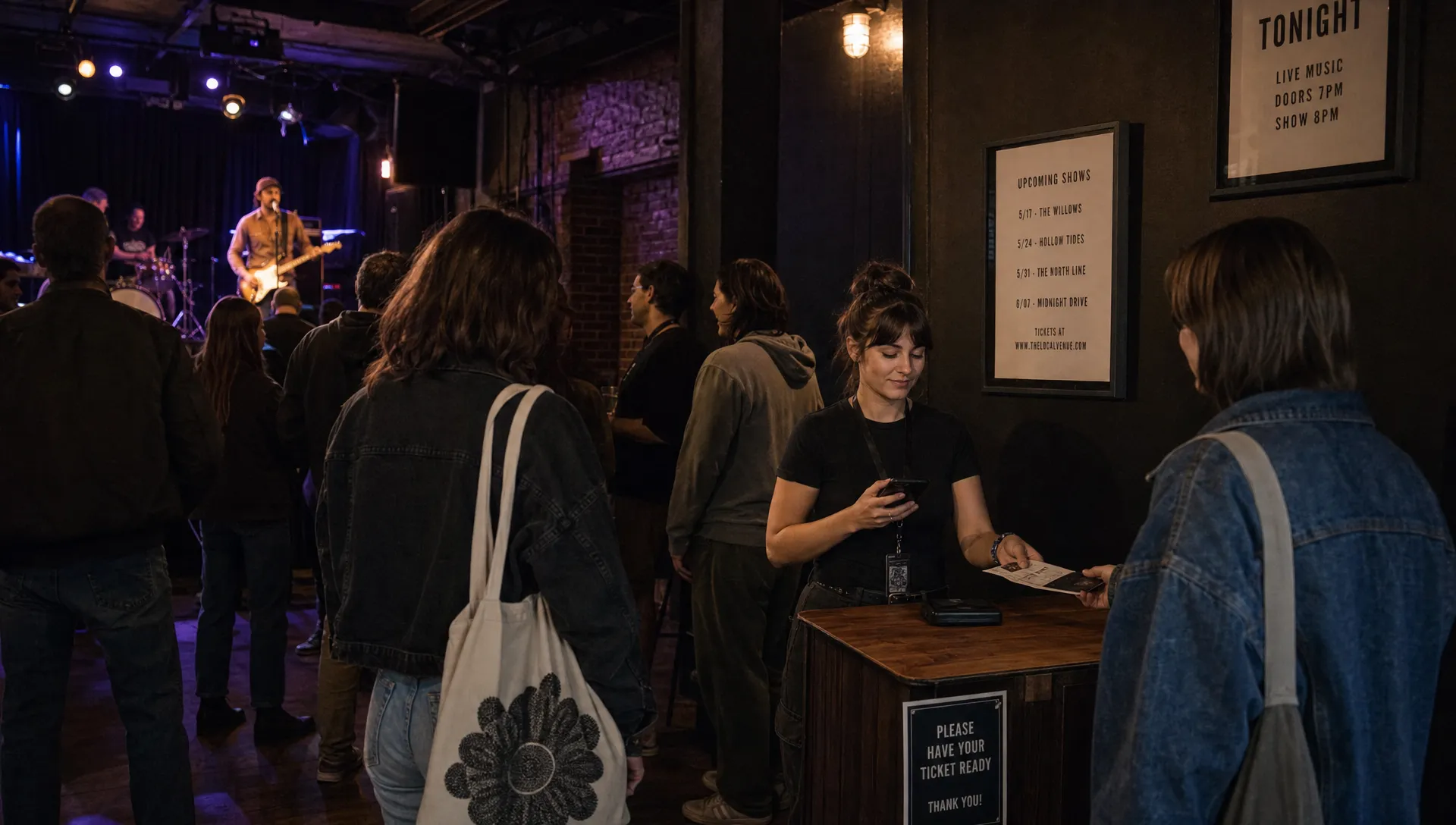
For small events, the door should feel smooth and organized. A messy check-in line can make the event feel less professional, even if the programming is excellent. Digital guest lists help because your team can verify attendees faster and reduce confusion around names, ticket tiers or comped guests.
This matters most if you run recurring events. A buyer who has an easy purchase and arrival experience is more likely to buy earlier next time. Over multiple editions, that trust can become your strongest sales channel.
Review what happened after every event
After the event, do a short sales review before moving on. Small audiences give you useful signals because every channel is easier to trace.
Look at questions like:
- Which audience group bought first?
- Which partner actually drove orders?
- When did sales slow down?
- Did buyers wait for discounts?
- Did any ticket tier create confusion?
- How many people bought in the final 48 hours?
- Did the checkout process create support messages?
This review helps you build a repeatable playbook. If 40 percent of sales came from direct messages, plan that outreach earlier next time. If a partner code moved only two tickets, change the partner ask. If most buyers waited until the final week, adjust your communication rhythm instead of panicking too early.
Small events improve quickly when you treat each one as data, not just a one-off push.
A simple small-audience ticket selling plan
If you want a practical structure, use this plan for your next event:
- Define your minimum viable room: Know the number of paid tickets needed to cover costs and the number that makes the event feel successful.
- Invite the warmest buyers first: Use direct messages, email and private links before the public announcement.
- Launch with a clear event promise: Make the page specific enough that buyers understand the audience, format and value.
- Use real scarcity: Tie urgency to capacity, tier deadlines or operational cutoffs.
- Give partners a measurable role: Use specific links, promo codes or agreed posting dates.
- Remove checkout friction: Keep the purchase flow fast, mobile-friendly and free of unnecessary account creation.
- Watch cash flow as sales come in: Connect sales milestones to spending decisions so you do not overcommit too early.
- Review and repeat: Use each event to sharpen the next one.
This plan is not flashy, but it is realistic. For small audiences, consistency beats noise.
Frequently Asked Questions
What are the best ticket selling strategies for small events? The best strategies are direct outreach to warm buyers, a clear event promise, honest scarcity, partner distribution, simple ticket tiers and a low-friction checkout. Small events usually perform better when organizers focus on conversion quality instead of broad reach.
How early should I start selling tickets for a small event? It depends on the event type, but many small events benefit from opening sales 4 to 8 weeks ahead. Workshops, seated experiences and professional events may need more lead time, while local music nights may see more activity closer to the date.
Should I use discounts to sell more tickets? Use discounts carefully. For small-capacity events, broad discounts can damage margins quickly. Targeted promo codes for partners, past attendees or early buyers are usually safer than public price cuts.
How do I sell tickets if I do not have a large following? Start with borrowed trust. Work through artists, speakers, venues, community groups and past attendees who already have relevant audiences. A small but trusted channel often sells more tickets than a large but cold audience.
Why is checkout speed important for small events? Every potential buyer matters when capacity is limited. If checkout is slow, confusing or requires account creation, some buyers will leave before completing the order. A fast mobile-friendly checkout helps capture interest while it is fresh.
Sell smarter to the audience you actually have
Small events do not need a massive marketing machine. They need a ticketing setup that supports direct selling, controlled pricing, fast checkout and healthy cash flow.
TixFlow helps organizers sell tickets with instant payouts, flat per-ticket fees, no buyer registration, customizable event pages, unlimited ticket tiers, smart promo codes, automated sales phases and digital guest lists. If you are building events for focused communities, intimate rooms or niche audiences, use a platform designed to keep sales simple from the first order to the door.