
No Ticket Fees Sounds Great, But Is It Worth It?
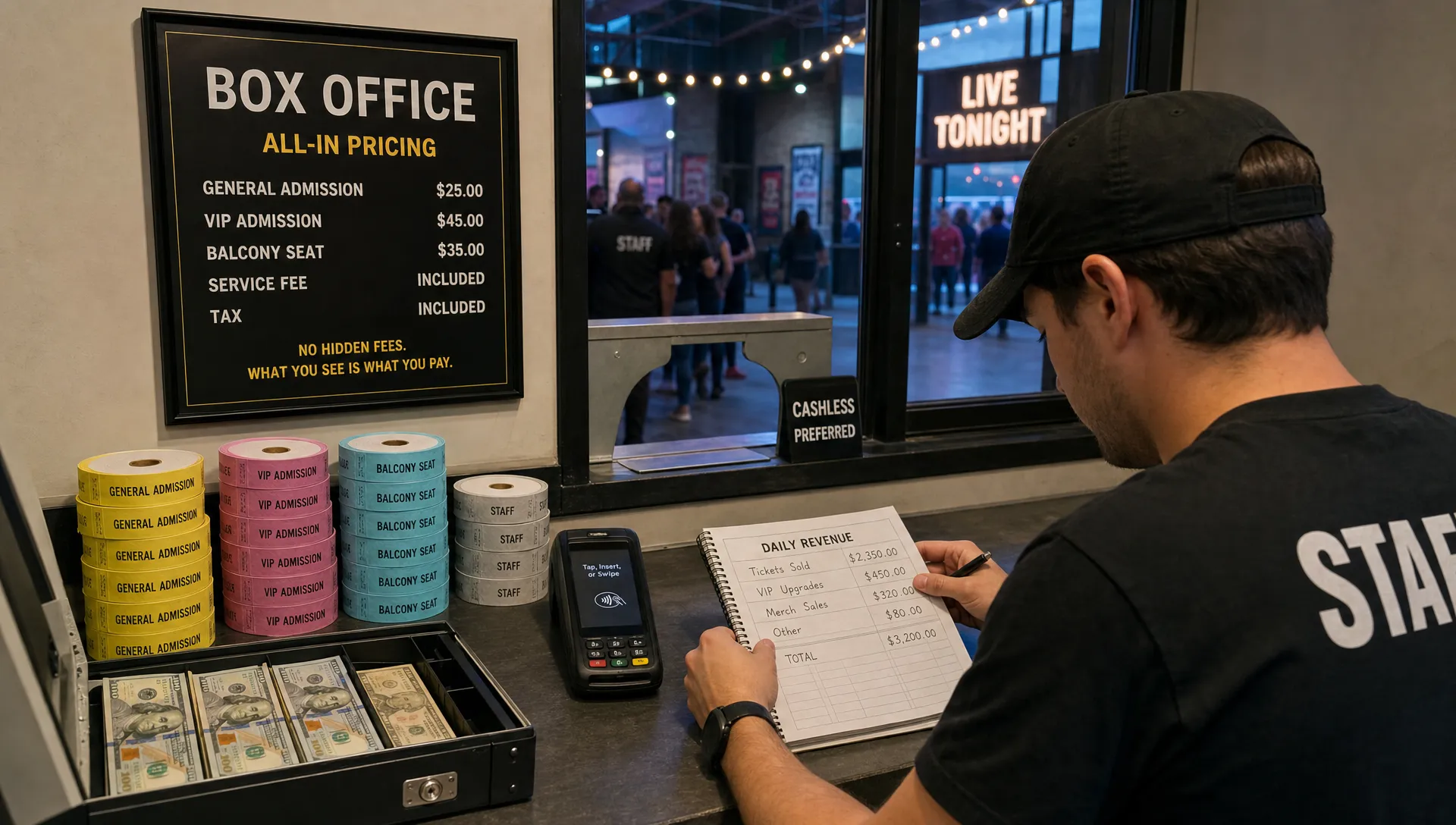
No ticket fees is one of the most attractive promises in event ticketing. It sounds cleaner for attendees, easier to market, and more generous than adding a service charge at checkout.
But for organizers, music producers, venue teams, and anyone managing event cash flow, the real question is not whether no ticket fees sounds good. It is whether the model protects your margin, accelerates sales, and keeps money moving when you need it.
The short answer: no ticket fees can be worth it in the right context, but only if you understand where the cost goes. Ticketing is never costless. Payment processing, fraud prevention, checkout infrastructure, support, refunds, and door operations still need to be paid for. A no-fee promise usually means the fee is absorbed, bundled, subsidized, or shifted somewhere else.
What no ticket fees really means
When a ticketing platform advertises no ticket fees, it can mean several different things. The attendee may not see an extra line item at checkout, but that does not automatically mean the organizer is paying nothing.
Most no-fee ticketing models fall into one of these categories:
- Organizer absorbs the cost: The buyer pays the advertised ticket price, and the organizer covers platform or processing costs from gross revenue.
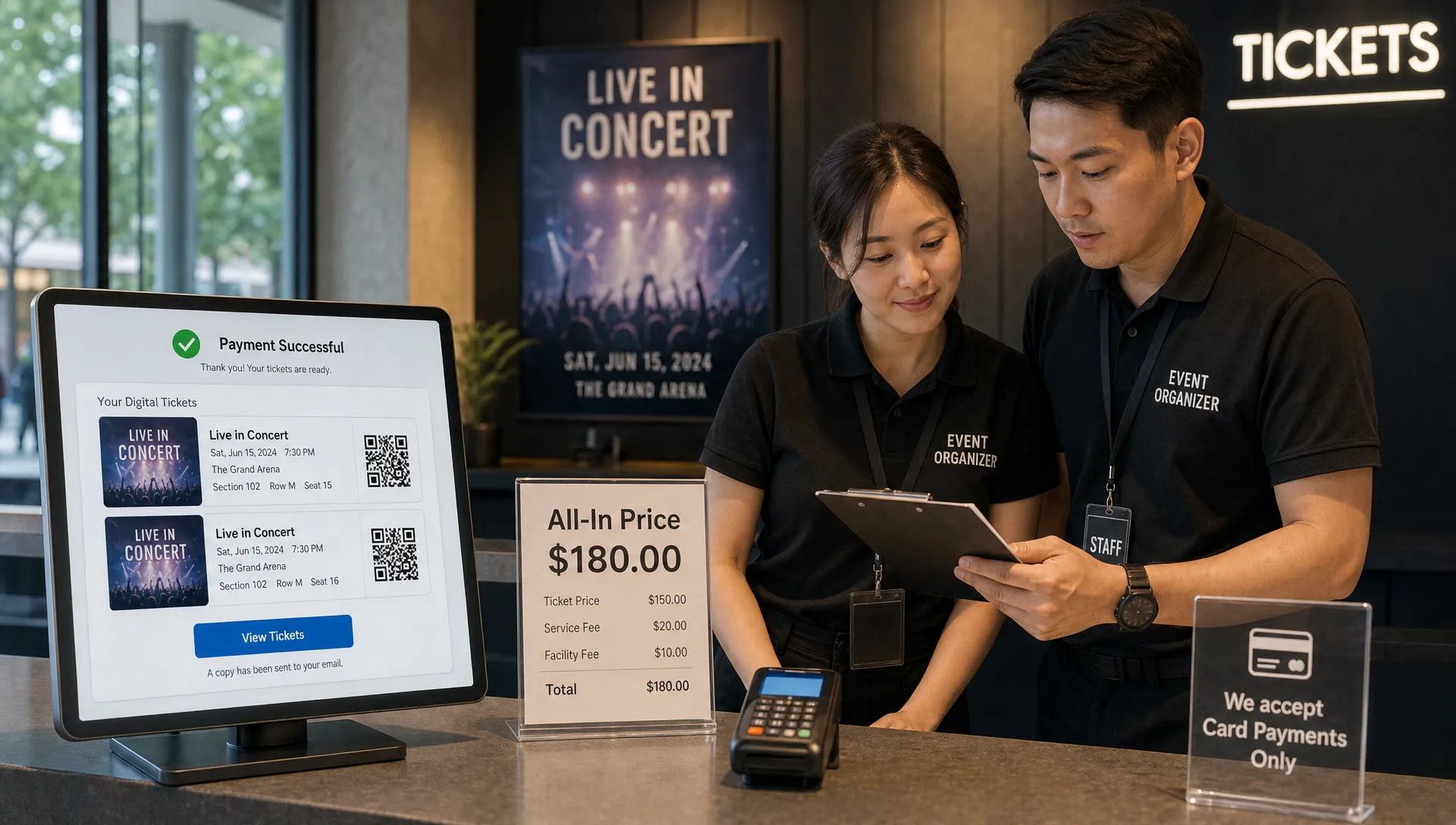
- Fees are built into the ticket price: The ticket is priced higher so the buyer sees one clean all-in price instead of a separate service fee.
- Fees are covered by another revenue source: Sponsors, donations, memberships, or venue budgets offset the cost of ticketing.
- The platform is free only for certain events: Some tools may waive fees for free tickets, small events, or limited use cases, then charge for paid events or advanced functionality.
For attendees, these differences may feel invisible. For organizers, they can change the entire financial picture.
If you are producing a low-margin show, running paid ads, fronting venue deposits, or paying artists before the event, a few dollars per ticket can decide whether the event is profitable. That is why no ticket fees should be evaluated as a pricing strategy, not just a marketing slogan.
Why attendees respond well to no ticket fees
Fee-free messaging works because buyers dislike surprises. If someone clicks on a $35 ticket and sees $43 at checkout, the final price can feel like a bait and switch, even if the fees are standard in the industry.
A clear all-in price can help reduce hesitation. It gives attendees confidence that the price they saw on the event page is the price they will actually pay. For high-volume events, concerts, nightlife, workshops, community events, and fan-driven launches, that trust can improve conversion.
The benefit is especially strong when checkout is already fast. A clean price, no unnecessary account creation, and instant ticket delivery can make the purchase feel effortless. If you want to explore that buyer experience more deeply, TixFlow’s guide to how online tickets improve checkout and entry breaks down why purchase friction affects both sales and door operations.
No ticket fees can also simplify promotion. A social post saying $25 tickets available now is more powerful when buyers do not have to mentally add a service charge. The same applies to flyers, artist announcements, early-bird campaigns, and influencer posts. Simpler pricing is easier to repeat and easier to trust.
The hidden tradeoffs organizers need to watch
The danger is assuming that no visible buyer fee equals better economics. It may boost conversion, but it can also reduce your net revenue if you absorb the cost without adjusting your pricing or sales strategy.
Here is the practical difference between common fee models:
| Pricing model | What the attendee sees | Organizer impact | Best fit |
|---|---|---|---|
| Buyer-paid fees | Ticket price plus fee at checkout | Organizer keeps more of the base ticket price | Events where buyers tolerate added fees and margin matters most |
| Organizer-absorbed fees | One clean ticket price with no added fee | Organizer revenue per ticket is lower | Events where reducing checkout friction is more valuable than per-ticket margin |
| All-in pricing | A single higher ticket price that includes costs | Organizer protects margin while staying transparent | Events with price-sensitive buyers who dislike surprise fees |
| Sponsored or subsidized ticketing | Free or low-cost tickets for attendees | Costs are covered outside ticket revenue | Community events, brand activations, nonprofit events, invite-only launches |
No model is automatically best. The right choice depends on your ticket price, audience sensitivity, cost structure, sales volume, and how soon you need access to funds.
For example, if your audience is extremely fee-sensitive, absorbing a small fee may increase completed purchases enough to pay for itself. But if your event has tight margins and high production costs, absorbing fees can quietly turn a healthy-looking sellout into a weak return.
When no ticket fees is worth it
No ticket fees tends to make the most sense when the buyer experience is central to your growth strategy. If your goal is to remove every possible reason not to buy, a clean price can be a strong lever.
It is often worth considering when you are launching a new event brand. Early trust matters, and surprise checkout fees can make first-time buyers question whether the event is professional. A transparent all-in price helps you look organized from the first interaction.
It can also work well for fan communities and local scenes. Music producers, promoters, and independent venues often depend on repeat attendance. If fans feel like ticketing is fair, they are more likely to come back, share the event, and buy earlier next time.
No ticket fees may also be the right move when you can offset the cost elsewhere. Sponsors, bar sales, VIP upgrades, merchandise, donations, or memberships can make the ticket itself a lower-friction entry point. In that case, the ticket is not your only profit center. It is the gateway to the full event experience.
Finally, fee-free pricing is useful when your marketing promise depends on simplicity. If you are advertising $10 community tickets, $20 early-bird access, or a limited $50 VIP drop, extra checkout fees can weaken the message.
When no ticket fees is not worth it
No ticket fees becomes risky when it hides costs instead of helping you control them. If you absorb ticketing costs without changing your pricing, forecasting, or sales phases, you may lose revenue on every order while thinking you are improving the customer experience.
It is also risky when the platform uses no fees as a tradeoff for slower payouts, limited controls, or poor checkout performance. For organizers, cash flow is not a back-office detail. It affects deposits, artist payments, staffing, production rentals, marketing spend, and contingency planning.
A fee-free model can also backfire if it encourages low-intent registrations. This is especially common with free or heavily subsidized tickets. If people reserve a spot because there is no cost and no friction, your RSVP numbers may look strong while actual attendance remains uncertain.
Another warning sign is lack of pricing flexibility. If a platform offers no buyer fees but makes it hard to run early-bird pricing, release new tiers, automate sales phases, or use targeted promo codes, you may lose more revenue through weak pricing control than you save in fees.
Calculate net revenue before choosing the model
The most useful way to evaluate no ticket fees is to compare net revenue, not advertised price.
A simple formula looks like this:
Net ticket revenue = ticket price collected - ticketing costs - payment processing costs - refunds - discounts - taxes or required charges
For a hypothetical example, imagine you want the buyer to pay around $30 for a general admission ticket.
| Scenario | Buyer sees | Organizer fee approach | Revenue effect |
|---|---|---|---|
| Separate buyer fee | $30 plus added fee | Buyer pays the ticketing cost | Higher organizer revenue per base ticket, but possible checkout drop-off |
| Organizer absorbs fee | $30 total | Organizer pays the ticketing cost | Better price clarity, but lower net revenue per ticket |
| All-in price | $32 total | Cost is built into the ticket | Transparent checkout while protecting more margin |
The all-in price is often the overlooked middle ground. It avoids the psychology of surprise fees while still acknowledging that ticketing has real costs.
This matters because the best pricing decision is rarely emotional. It is operational. If a no-fee model increases conversion by 10 percent but reduces net revenue by 12 percent, it may not help. If it increases early sales, reduces abandoned checkouts, and gives you faster cash to reinvest into promotion, it may be worth it.
Ask better questions than is it free?
Before choosing a no-ticket-fee model, ask questions that reveal the real cost and control behind the promise.
Start with payout timing. If the platform holds your money until after the event, no buyer fee may not matter much. You still need to finance the event upfront. Faster payouts can be more valuable than a small difference in fee structure, especially for independent producers and lean teams.
Next, look at checkout friction. Does the buyer need to create an account? Are there unnecessary steps? Is the final price clear before payment? A no-fee checkout that still feels slow or confusing will not solve the real conversion problem.
Then evaluate pricing control. Can you create unlimited ticket tiers? Can you schedule automated sales phases? Can you run smart promo codes? Can you adjust availability in real time? These tools often do more for revenue than simply removing a visible fee.
You should also listen to your audience before changing your pricing model. Search DMs, comments, support emails, and community discussions for phrases like fees are too high, checkout took too long, or I thought it was cheaper. If your team already uses community monitoring or lead discovery workflows, Redditor AI can help surface relevant audience conversations that may reveal how buyers actually talk about ticket costs.
For a broader platform evaluation framework, see TixFlow’s guide on how to compare event ticketing platforms in 2026. The strongest choice is usually the one that balances buyer trust, organizer control, and reliable cash flow.
The better goal: transparent fees, low friction, and strong cash flow
Instead of chasing no ticket fees at all costs, organizers should aim for transparent ticketing economics. Buyers should understand what they are paying. Organizers should understand what they are keeping.
This is where a flat, predictable fee structure can be more useful than a vague promise of free ticketing. If you know your per-ticket cost in advance, you can decide whether to pass it on, absorb it, or build it into the ticket price.
TixFlow is designed around that kind of control. Organizers can use flat per-ticket fees, instant payouts, no buyer registration, real-time sales control, customizable event pages, unlimited ticket tiers, automated sales phases, smart promo codes, digital guest lists, and Stripe Connect integration. That combination is especially useful for teams that care about both checkout conversion and cash flow.
The point is not that every event should advertise no ticket fees. The point is that every event should avoid confusing fees, slow money movement, and rigid pricing.
A practical decision framework
Use this framework before deciding whether to remove buyer-facing fees from your event.
| Question | If yes | If no |
|---|---|---|
| Are buyers highly sensitive to surprise fees? | Consider all-in pricing or absorbing fees | Buyer-paid fees may be acceptable |
| Can you protect margin after absorbing costs? | No ticket fees may be viable | Reprice tickets or keep fees separate |
| Do you need cash before the event? | Prioritize payout speed | Fee model may be less urgent |
| Do you have sponsors or secondary revenue? | Lower-friction ticketing can support growth | Ticket margin becomes more important |
| Can your platform support tiers and sales phases? | Use pricing strategy to offset costs | Removing fees may limit revenue upside |
| Is attendance more important than ticket revenue? | Free or fee-free ticketing may work | Optimize for net revenue instead |
A good rule of thumb: if no ticket fees improves the attendee experience while preserving your event economics, it is worth testing. If it only makes the checkout page look cleaner while weakening your margin or delaying your funds, it is not worth it.
Frequently Asked Questions
Does no ticket fees mean ticketing is actually free? Not usually. It often means the attendee does not see a separate service fee. The cost may be absorbed by the organizer, built into the ticket price, subsidized by sponsors, or limited to certain event types.
Is it better to absorb ticket fees or pass them to buyers? It depends on your audience and margins. Absorbing fees can reduce checkout friction, but passing fees to buyers can protect revenue. Many organizers use all-in pricing as a middle ground.
Can no ticket fees increase ticket sales? It can, especially when buyers dislike surprise charges. However, higher conversion only helps if your net revenue and cash flow still support the event.
What is the biggest risk of no-fee ticketing? The biggest risk is margin erosion. If you absorb costs without adjusting price, volume, sponsorship, or secondary revenue, you may sell more tickets while earning less.
Should free events use no-fee ticketing? Often, yes, but free ticketing still needs a strategy. You should consider no-show risk, guest list management, capacity limits, and whether attendees have enough commitment to actually show up.
Sell tickets with clarity, control, and faster cash flow
No ticket fees can be a smart move, but only when it supports the bigger goal: profitable, low-friction event sales.
If you want transparent pricing, instant payouts, flexible ticket tiers, real-time sales control, and a checkout experience built to reduce friction, explore TixFlow. The right ticketing setup should help attendees buy faster and help organizers keep control of their revenue from the first sale onward.