

How to Spot Promo Code Abuse on a Discount Tickets Website
A sudden surge in redemptions on a discount tickets website can mean your promotion worked. It can also mean a private code reached a coupon forum, a buyer found a loophole or automated requests are testing possible codes. The sales total alone will not tell you which happened.
For event organizers and music producers, the goal is to protect ticket revenue without turning legitimate attendees away. Start with the promotion’s rules, compare suspicious activity with normal buying patterns and verify the affected orders before changing access or canceling tickets.
Separate promo code abuse from a successful campaign
An unusual redemption pattern is a reason to investigate, not proof of abuse. A group booking, a shared household or a popular artist announcement can produce activity that looks suspicious in isolation.
Define the difference between three situations:
- Expected use: Buyers redeem an offer within its published eligibility, quantity and timing rules.
- Promotion leakage: A code reaches people outside the intended audience, but the checkout still accepts it under the configured rules.
- Rule circumvention: Someone bypasses an eligibility requirement, redemption limit or other enforced restriction.
A public code with no stated restrictions is not automatically being abused because it spreads widely. If the commercial intention was “one ticket per invited attendee” but neither the terms nor the checkout reflected that, the immediate problem is campaign design.
Before labeling activity on a discount tickets website as abuse, write down what the offer actually permits. Include eligible ticket tiers, redemption dates, the maximum discounted quantity and whether the code can be shared. Preserve the version of the terms buyers saw, rather than rewriting them after the campaign takes off.
Warning signs worth reviewing
Look for combinations of signals. One shared IP address is weak evidence because venue Wi-Fi, workplaces and mobile networks can put unrelated buyers behind the same address.
| Signal | Possible explanation | What to check next |
|---|---|---|
| Redemptions suddenly accelerate | A legitimate campaign spike or a leaked code | Campaign timing, referral sources and paid orders |
| Many orders use small variations of an email address | Repeat buying or attempts to bypass a limit | Order quantities and other legitimately available identifiers |
| Repeated invalid-code attempts precede a successful redemption | Typing mistakes or automated code guessing | Attempt frequency, code variations and successful orders |
| A partner code appears outside its expected channel | Sharing, attribution loss or unauthorized distribution | Partner activity and the offer’s sharing rules |
| An order receives an unexpected combined discount | Intended stacking or a configuration defect | The pricing rules and actual amount charged |
| Discounted purchases exceed a stated allowance | Group buying or limit circumvention | Whether the allowance applies per order, person or ticket |
The strongest warning signs on a discount tickets website connect abnormal behavior to a specific rule violation. “Thirty orders arrived quickly” is less useful than “thirty completed orders exceeded the campaign’s total redemption cap.”
The OWASP Automated Threats to Web Applications project describes token cracking, which includes automated guessing of values such as voucher or coupon codes. Repeated failed attempts matter even when they have not yet produced a completed ticket purchase.
How to investigate a discount tickets website
Reconcile attempts, orders and ticket quantities
Start by separating code-entry attempts from completed transactions. A failed checkout, an abandoned cart and a refunded order should not be counted as three successful redemptions.
Record discounted ticket quantities as well as order counts. One order containing eight discounted tickets has a different financial impact from one order containing a single ticket. Check whether any redemption allowance is consumed when a ticket is reserved or only after payment, if your platform exposes that behavior.
For completed orders, compare the code applied, eligible ticket tier, expected discount and amount actually charged. Use a test purchase or test environment to reproduce unexpected pricing rather than relying on a checkout screenshot alone.
An investigation of a discount tickets website should distinguish incorrect pricing from suspicious buyer behavior. If an ineligible ticket tier consistently accepts a code, fix the configuration or implementation first. You do not need to prove malicious intent to close a pricing defect.
Ask your ticketing provider which records are available. Do not assume that code-entry logs, device identifiers or payment-level signals exist simply because the platform has sales reporting.
Compare redemptions with the campaign source
Check when the code was distributed and what happened immediately afterward. An email send, promoter post or artist announcement may explain a sharp increase in purchases.
Compare the suspicious period with earlier activity for the same event and similar campaigns. Avoid declaring abuse because a fixed number of orders arrived in a minute: that threshold means very different things for a small club night and a large festival.
The most useful source review for a discount tickets website connects a redemption spike to an identifiable distribution event. Ask partners whether they posted the code publicly, forwarded it to another list or changed their campaign timing.
If you need a stronger attribution process, establish how to connect ticket orders to their marketing source before the next promotion launches.
Missing referral data is not proof of abuse. Privacy settings, copied links and app-to-browser transitions can obscure a legitimate buyer’s source. Treat attribution as supporting context, not an eligibility decision by itself.
Validate eligibility without demanding unnecessary data
Check the rule most directly connected to the suspected violation. For an invitation-only offer, that may be the invitation record. For a quantity-limited promotion, it may be the total discounted tickets purchased under the relevant identity.
Use payment or device signals only when they are legitimately available and permitted for this purpose. Never collect or copy full card numbers into an investigation spreadsheet. Multiple attendees can also share a payment method, so payment overlap does not establish wrongdoing on its own.
Identity checks on a discount tickets website should be proportionate to the offer. Requiring every buyer to create an account can add friction without reliably preventing someone from creating multiple accounts.
Group related orders into a review cohort and document the reason for grouping them. Distinguish “possibly connected” from “confirmed to breach the limit.” If the evidence remains ambiguous, contact the buyer neutrally to clarify the booking rather than accusing them of fraud.
Preserve a small, useful evidence record
Keep enough information to explain your decision: the order reference, relevant timestamps, promotion terms, pricing calculation and reason for review. Add the action taken, the person responsible and any buyer communication.
Record what was observed separately from what was inferred. “Six orders redeemed the code within two minutes” is an observation. “One person placed all six orders” needs additional evidence.
A review file for a discount tickets website should support both an operational decision and a later explanation to the buyer. Restrict access, set an appropriate retention period and avoid exporting unrelated personal data.
For teams that also manage formal compliance reviews, AuditReady’s centralized audit evidence and incident records can help organize ownership, supporting documents and remediation alongside other controls. Documentation supports accountability, but it does not replace verifying the underlying ticket orders.
Keep detailed personal information out of general team chats. Share a case reference and the decision needed, with supporting records available only to authorized reviewers.
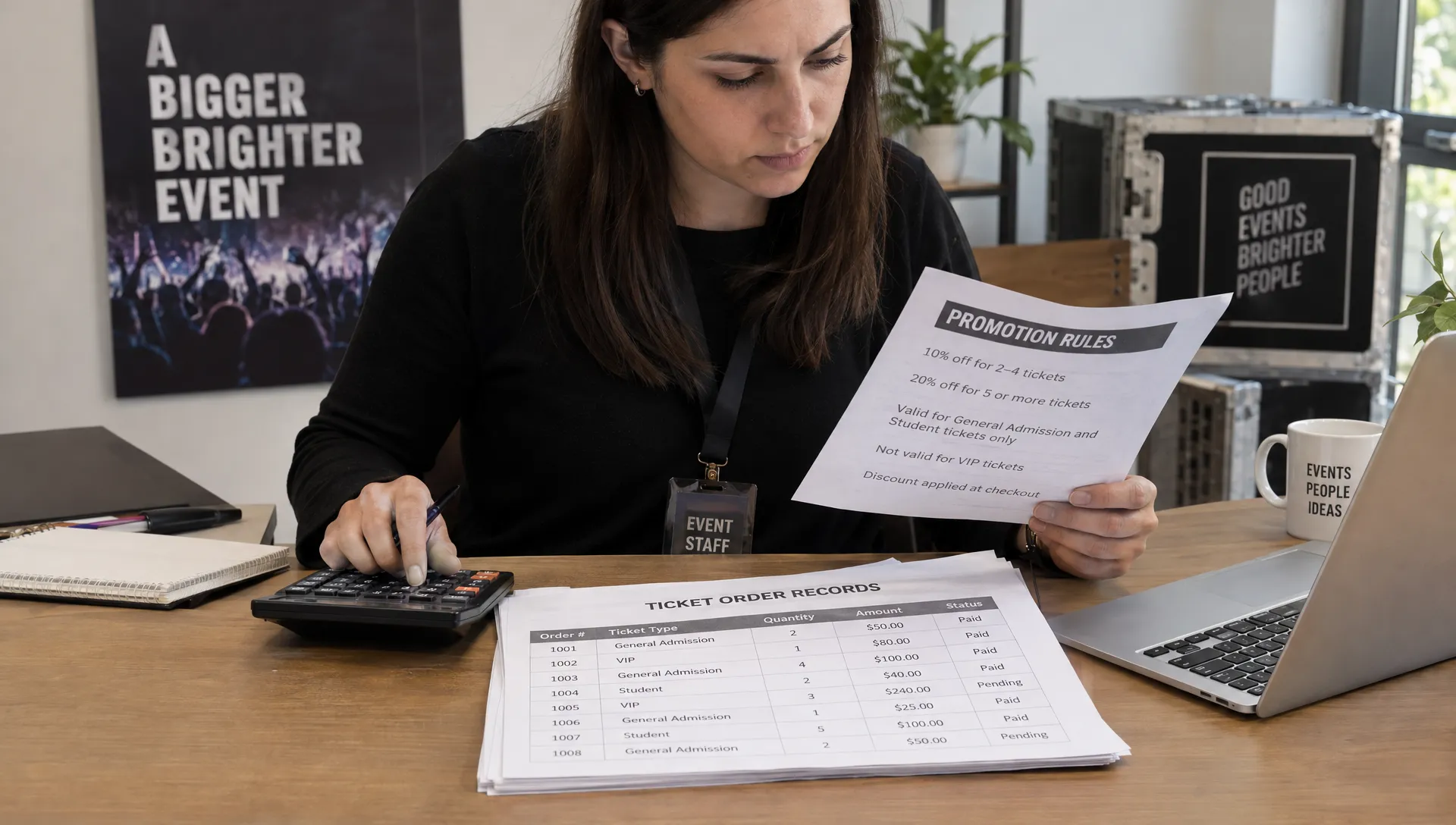
Calculate the exposure before changing the promotion
Measure the discount granted, then determine how much falls outside the intended rules. These are not the same number.
Suppose a $50 ticket receives a 20% discount. The discount is $10 per ticket, so 300 completed discounted ticket sales represent $3,000 in discounts. If review confirms that only 80 tickets breached the offer’s eligibility rules, the confirmed out-of-policy discount is $800.
These figures are hypothetical and measure the price reduction only. They do not establish net revenue loss: some attendees might not have purchased at full price. Transaction fees, refunds and other costs require separate treatment.
Financial reporting for a discount tickets website should separate confirmed violations, unresolved cases and legitimate redemptions. Otherwise, a healthy campaign can look like a fraud incident simply because it delivered substantial discounts.
Also consider remaining exposure. How many discounted tickets can still be sold, and could those sales consume inventory intended for full-price buyers? Available cash is not the same as settled profit, especially if refunds or payment disputes remain possible.
Contain the problem without punishing valid buyers
Match the response to the evidence. A leaked partner code may need replacement, while a pricing defect may require disabling the affected promotion until checkout calculations are corrected.
Preserve the existing settings and evidence before making changes. Notify the campaign owner so scheduled emails or partner posts do not keep distributing a disabled code. Where possible, act on the specific promotion rather than shutting down all ticket sales.
Containment on a discount tickets website should protect future transactions without automatically invalidating legitimate completed purchases. Review the applicable terms and refund obligations before canceling orders, and do not attempt to charge buyers the difference retroactively without a valid basis and authorization.
If automated guessing is suspected, involve the provider or technical team. Rate limits, monitoring and additional checks can help, but the team should evaluate accessibility and false positives before applying broad blocks.
Give affected buyers a clear explanation and a route to resolve mistakes. “We’re reviewing whether this booking meets the promotion’s ticket limit” is more useful than a generic fraud accusation. Keep ticket validity and entry status clear while the review is underway.
Make the next promotion easier to monitor
Design the offer around a measurable business objective, such as filling a slow sales period or rewarding a specific partner’s audience. Our guide to discount ticket prices for a slow sales week covers that commercial planning; abuse prevention adds limits and review procedures around the offer.
Before launch, confirm eligible tiers, campaign dates, sharing rules and discounted ticket allowances. Test expired codes, ineligible tiers and combinations with other offers. Check that pricing and eligibility are enforced by the backend, not just displayed in the browser.
A discount tickets website is easier to supervise when each campaign has an owner, a defined exposure limit and a documented response to unexpected activity. Where supported, separate codes by partner or audience so one compromised promotion can be changed without disrupting every channel.
If the platform cannot enforce a required restriction, redesign the offer or confirm another reliable control before advertising it. A rule written in campaign copy is not a substitute for checkout enforcement.
After the campaign, compare legitimate discounted sales with exceptions and buyer complaints. Use the findings to improve the next offer rather than retaining unnecessary buyer data indefinitely.
Frequently asked questions
Is a leaked promo code automatically fraud? No. A leak may undermine your targeting, but fraud or abuse requires more than wider distribution. Check the published terms, configured restrictions and evidence of circumvention before classifying purchases.
Can I identify repeat buyers by IP address? Not reliably. Shared networks can connect unrelated attendees, while one buyer can use several networks. IP information, where lawfully available, is a supporting signal rather than proof of identity.
What should I monitor first on a discount tickets website? Start with completed discounted ticket quantities, the amount charged, redemption timing and compliance with the offer’s rules. Add technical signals only when they are available and necessary for the investigation.
Should I require registration to prevent repeated redemptions? Not automatically. Registration can add checkout friction and still allow multiple accounts. Choose eligibility checks that match the offer, and verify which restrictions your provider can actually enforce.
Keep promotions manageable with TixFlow
TixFlow offers smart promo codes, unlimited ticket tiers and real-time sales control, alongside checkout without buyer registration. Use those capabilities as part of a documented promotion process, not as a substitute for reviewing exceptions.
Before launching a restricted offer, confirm that its required limits and reporting are supported. Clear terms, tested pricing and a named campaign owner give your team a practical starting point for protecting revenue while keeping checkout straightforward.