

How to Record the Sale of Tickets for Event Bookkeeping
Recording the sale of tickets correctly means separating what buyers paid, what your payment provider deducted and what your event has actually earned. A bank payout alone cannot tell you all three.
For an organizer using accrual accounting, advance ticket payments generally start as a liability, not immediate revenue. You recognize admission revenue when you deliver the event. Fees, sales taxes and refunds need their own entries so your books explain both your cash balance and your event’s financial result.
The examples below assume you organize and deliver the event yourself, rather than sell admissions as an agent for another promoter.
Choose your accounting basis first
Under accrual accounting, receiving payment and earning revenue are separate events. If someone buys a December concert ticket in October, you ordinarily record the October payment as deferred ticket revenue. Once the concert happens and you fulfill the admission obligation, you move that amount into revenue.
Under cash-basis accounting, income generally follows receipt rather than event delivery. However, the relevant receipt date is not necessarily the date a payout reaches your bank. Payment-agent arrangements and constructive-receipt rules can matter.
The IRS guidance on accounting methods explains the distinction for federal tax purposes. Tax rules for advance payments can differ from financial-reporting rules, so confirm your treatment with an accountant rather than assuming your bookkeeping entries determine your tax return.
Use one consistent method for your books. Do not recognize some advance payments immediately and defer others simply because their payouts arrived in different months.
How should you record the sale of tickets?
Start with accounts that keep customer payments separate from earned income and settlement deductions. You can use event codes or tracking categories instead of creating a new general-ledger account for every show.
| Account | What it tracks |
|---|---|
| Payment clearing | Customer payments and deductions awaiting settlement |
| Bank | Money received in or paid from your business bank account |
| Deferred ticket revenue | Advance payments for admission you have not yet provided |
| Ticket revenue | Admission income earned by delivering the event |
| Sales tax payable | Tax collected that must be remitted to the relevant authority |
| Ticketing and processing expense | Fees your business incurs on ticket transactions |
| Refunds and allowances | Reductions to previously recognized revenue, where applicable |
A payment clearing account is useful because one payout may combine many orders, fees, refunds and adjustments. It provides a bridge between transaction records and your bank statement.
Keep event identifiers alongside these accounts. Otherwise, a business running several concerts or conferences may reconcile its bank correctly while still assigning revenue to the wrong event.
Work through a balanced presale example
Suppose the sale of tickets for one event consists of 100 admissions at $50 each. For this illustration only, assume you must collect 8% sales tax and your provider deducts $162 in combined transaction fees.
These are hypothetical amounts, not TixFlow pricing or a statement that event admissions are taxable everywhere.
The customer payments total $5,400: $5,000 for admission plus $400 in tax. The provider sends $5,238 to your bank after deducting fees.
Record payment, fees and settlement separately
| Transaction | Debit | Credit |
|---|---|---|
| Customers pay before the event | Payment clearing: $5,400 | Deferred ticket revenue: $5,000; Sales tax payable: $400 |
| Provider deducts fees | Ticketing and processing expense: $162 | Payment clearing: $162 |
| Provider sends the payout | Bank: $5,238 | Payment clearing: $5,238 |
Each row balances. After these transactions, the clearing account returns to zero, assuming there are no other unsettled payments or adjustments.
Your bank holds $5,238, but that does not mean you have earned $5,238. The books still show an obligation to provide $5,000 of admission services and a separate $400 tax liability.
This example assumes you bear the fees. If the platform charges buyers its own separately contracted fee, that amount is not automatically your revenue or your expense. Follow the contractual arrangement and settlement detail.
Recognize revenue when you deliver the event
For this single-event example, the sale of tickets becomes earned admission revenue when the event takes place and you fulfill your obligation to attendees.
Record a $5,000 debit to deferred ticket revenue and a $5,000 credit to ticket revenue. This moves the balance from the balance sheet to the income statement without moving cash again.
When you remit the assumed sales tax, debit sales tax payable and credit bank for $400. Tax collected on behalf of an authority is not admission revenue.
Packages containing several events, merchandise or separately promised services may require allocation and different recognition dates. A no-show at an event you delivered also differs from a canceled event you never provided.
Reconcile orders to payouts, not just bank deposits
A reliable reconciliation starts with transaction records and ends at the bank. For each settlement, calculate:
Gross customer payments − refunds − fees − chargeback deductions − newly withheld reserves + released reserves ± other adjustments = payout.
Use the provider’s actual classifications. A withheld reserve generally remains an asset if you retain a right to receive it; it is not automatically an expense.
Reconcile the sale of tickets by matching order IDs and transaction dates to settlement references, then match each settlement to the bank deposit. Investigate differences instead of forcing them into a miscellaneous expense account.
Timing differences are normal. Orders captured on the last day of a month may settle the following month, leaving a valid clearing balance at period-end. Keep a schedule explaining what remains outstanding and when it subsequently clears.
This distinction also matters for budgeting. As the guide to building predictable cash flow for ticketed events discusses, cash availability affects operating decisions. Bookkeeping adds another constraint: available cash may still be needed for refunds, taxes or undelivered events.
Handle refunds, cancellations and chargebacks correctly
Refunds before the event
If you refund an advance payment, ordinarily reduce deferred revenue rather than revenue you have not recognized.
Using the earlier assumptions, refunding two $50 tickets plus $8 in associated tax produces this entry: debit deferred ticket revenue $100, debit sales tax payable $8 and credit bank or payment clearing $108.
That example assumes the tax remains payable and the refund qualifies for the corresponding reduction. If you already remitted it, your jurisdiction’s credit or recovery process may require different bookkeeping.
Refunds change the sale of tickets recorded for the event, but fee reversals must follow what actually happens. Do not reverse processing expenses unless the provider returns those fees.
Refunds after recognition or event cancellation
A refund issued after you recognized admission revenue will generally reduce revenue or enter a refunds-and-allowances account, depending on your policy and circumstances.
For a canceled event, identify outstanding customer obligations, establish the appropriate refund liability and reconcile amounts paid back. Do not recognize admission revenue merely because the scheduled date passed.
Chargebacks and disputes
Track disputed transactions separately from voluntary refunds. Record the cash or clearing deduction, any dispute fee and the outcome of the case without counting the same customer payment twice.
Whether a disputed amount belongs in a receivable, a loss account or a revenue adjustment depends on the facts and your accounting policy. Keep the original order, dispute evidence and final resolution together.
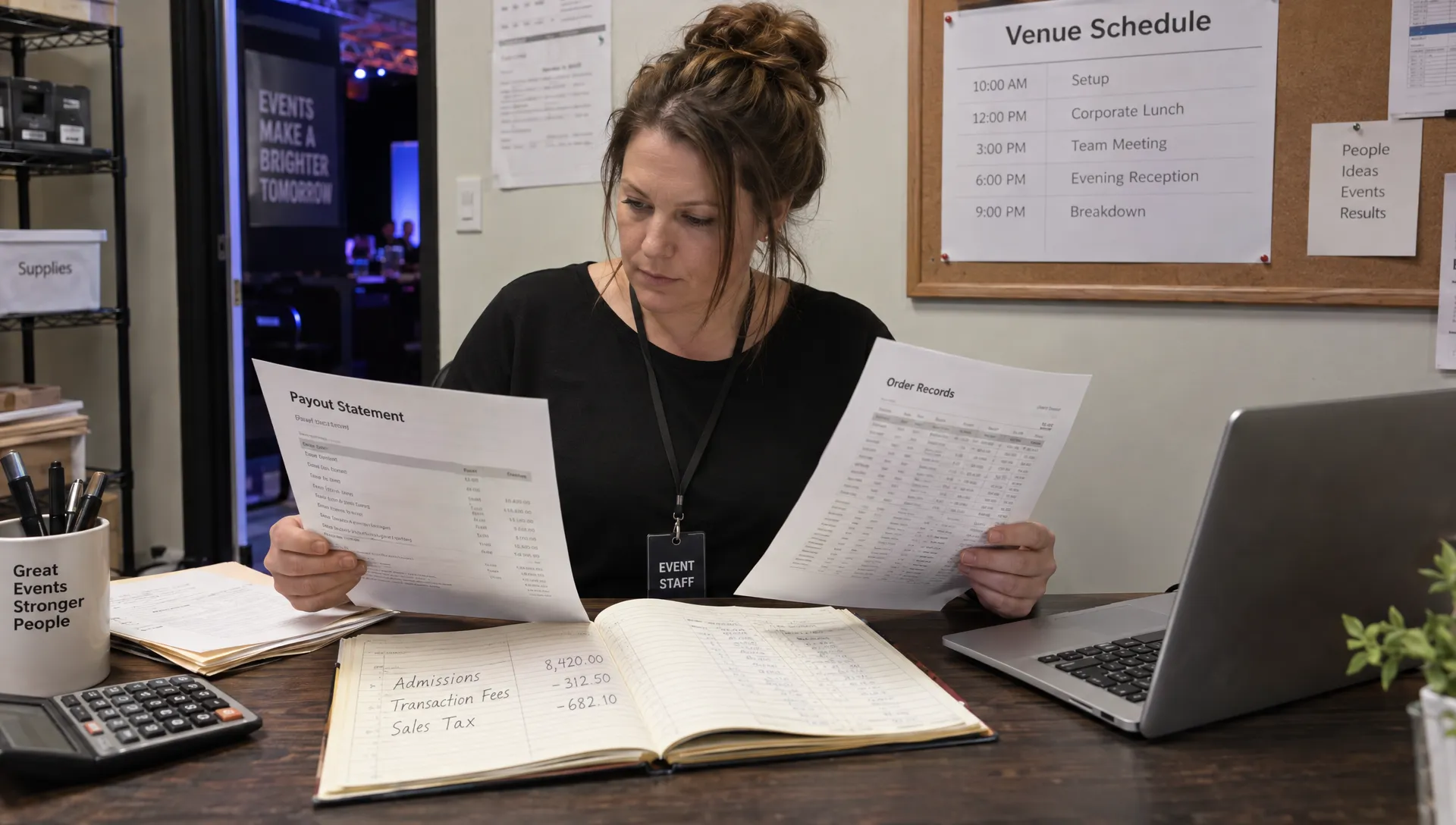
Keep event costs separate from ticket receipts
Venue hire, artist payments, production, security and promotion belong in their appropriate expense or prepaid accounts. They should not disappear into a single “net ticket income” entry.
For example, if you promote a B2B conference through Naano’s LinkedIn creator marketplace, keep the campaign agreement and invoice separate from ticket settlements. Recognize the promotional cost when the contracted work is delivered, subject to your accounting policy, rather than deducting it invisibly from ticket receipts.
The sale of tickets should remain traceable to customer transactions even when your marketing reports attribute those purchases to a campaign. Attribution explains where demand came from; it does not replace accounting evidence.
Likewise, distinguish an advance paid to a venue from an expense already incurred. Under accrual accounting, paying a deposit does not necessarily mean the entire amount belongs on that month’s income statement.
Assign costs to the same event identifiers used for admissions. This lets you measure event profitability without confusing the timing of supplier payments with the timing of expense recognition.
Close each month and each event
At month-end, review both completed events and future events with advance bookings. A business can report a profitable completed show while holding substantial deferred revenue for another show next quarter.
Your close should cover these checks:
- Match settled payouts to bank deposits and explain outstanding clearing balances.
- Reconcile deferred revenue by event to undelivered admission obligations.
- Verify refunds, disputes, fees and reserves against supporting records.
- Reconcile tax liabilities to applicable filings and remittances.
- Review completed events for revenue recognition and unpaid supplier costs.
Also compare admissions activity with financial activity. Complimentary tickets affect attendance but do not create paid ticket revenue. Discounts reduce the amount charged; they are not cash expenses merely because a promo code was used. Failed payments should not be treated as collected cash.
When reviewing the sale of tickets, distinguish orders, paid admissions and attendees. One order can contain several tickets, while one attendee may hold a complimentary admission. The guide to using ticket statistics to improve event sales provides useful context for interpreting operational metrics alongside your ledger.
Check information returns without using them as your ledger
If you receive Form 1099-K, reconcile it to your payment records. The IRS explanation of Form 1099-K notes that its gross payment amount is not adjusted for items such as fees, refunds and discounts.
Consequently, the reported amount will not necessarily equal bank deposits, financial-statement revenue or taxable profit. Keep a reconciliation covering the relevant differences, including timing and amounts collected for others where applicable. Do not replace your transaction-level bookkeeping with the form’s total.
Frequently asked questions
Is the sale of tickets always revenue immediately? No. For accrual books, payment for a future event generally creates deferred revenue until you provide admission. Cash-basis treatment and tax rules can differ. Bundles, agency arrangements and other contractual obligations may also change the appropriate treatment.
Should I record the net payout as ticket revenue? Generally not when you are the principal organizer. Separate your admission amount, taxes collected and fees you incur. Recording only the bank deposit can understate both revenue and expenses while hiding liabilities. Agency arrangements require a separate principal-versus-agent assessment.
What if my event takes place next year? Under accrual accounting, advance admission payments generally remain deferred revenue at year-end if you have not delivered the event. The corresponding cash is still an asset, but it is not automatically current-year admission revenue. Confirm the tax treatment separately.
Do instant payouts change revenue recognition? No. Faster access to money changes cash availability, not when you satisfy your obligations to attendees. You still need to distinguish settlement dates, event dates and refund obligations.
Can I use a spreadsheet instead of accounting software? For a small operation, a controlled spreadsheet can support transaction reconciliation and event schedules. It should retain order references, adjustments and payout matches, with a clear audit trail. As volume grows, use a system that supports consistent entries and reliable review.
Make your next event easier to reconcile
Before opening the sale of tickets, decide how you will identify the event, record advance receipts and match transactions to payouts. Document who reviews refunds and who approves the event’s final close.
TixFlow offers flat per-ticket fees, instant payouts and Stripe Connect integration. Pair those operational features with a consistent bookkeeping process so faster collections do not become unexplained deposits or prematurely recognized revenue.