

How to Evaluate Ticket Event Sites for Local Venue Partnerships
Choosing ticket event sites for a local venue partnership means evaluating more than ticket prices and checkout design. The platform becomes part of a shared operating agreement: who receives the money, who controls capacity, who handles refunds and what happens when the partnership ends.
For a promoter booking a neighborhood club or a producer building a recurring concert series, those details can determine whether a successful show also produces usable cash. Evaluate the venue arrangement first, then test whether the ticketing platform can support it.
Define the partnership before reviewing platforms
Start with a one-page operating brief that both the organizer and venue approve. A platform demonstration is much more useful when you already know which responsibilities it needs to support.
Record the event capacity, ticket tiers, expected sales channels and responsibility for door operations. Then specify which business sells the tickets, which account receives payments and who can authorize a cancellation or refund.
The commercial arrangement matters just as much. A room rental with a fixed fee creates different requirements from a co-promoted show where the venue receives a share of ticket revenue. An ongoing residency also needs repeatable reporting, not a settlement process rebuilt from scratch every month.
Treat platform requirements as consequences of the deal, not substitutes for agreeing on the deal. If the partners disagree about who controls proceeds, software will not resolve that disagreement.
Build a scorecard for ticket event sites
Use a weighted scorecard to compare evidence rather than presentation quality. The weights below are a suggested starting point for a local partnership, not an industry benchmark.
| Evaluation area | Suggested weight | Evidence to request |
|---|---|---|
| Cash availability | 25% | Payout conditions, account requirements and an example payment timeline |
| Shared inventory and operations | 25% | Demonstration of allocations, capacity changes and guest-list handling |
| Commercial terms | 20% | Written fees, refund responsibilities, exclusivity and exit terms |
| Buyer experience | 15% | Mobile purchase test showing the final price and confirmation |
| Data access and permissions | 15% | Sample exports, account access rules and marketing consent handling |
Score each area from zero to four: zero means unsuitable, one means unverified, two means partially suitable, three means it works in testing and four means testing is backed by clear written terms. Multiply each weight by the score divided by four to calculate a total out of 100.
Keep hard requirements outside the scoring system. A strong overall result cannot compensate for a contractual conflict or an inventory setup that risks overselling.
For broader software criteria, use this framework alongside a comparison of event ticketing platforms, while keeping partnership responsibilities central to your decision.
Follow the money from purchase to venue settlement
When comparing ticket event sites, distinguish sales recorded, funds available for payout and money received in the bank. Those are separate milestones.
Ask the provider to trace a hypothetical purchase through each stage. Identify the payment account holder, any verification requirements, payout eligibility, possible holds and expected bank receipt timing. Then compare that timeline with venue deposits, artist guarantees and production invoices.
A payout feature is useful only if its conditions match your actual deadlines. Ask whether faster payouts depend on account history, location, payment method or other eligibility rules. Confirm any additional cost in writing.
Also establish who funds refunds after proceeds have been distributed. If the venue has already received its share, the organizer should not discover after a cancellation that it must cover every refund without a recovery process.
Test the settlement formula with actual arithmetic
Consider this illustrative arrangement, using assumed figures rather than any provider’s pricing:
| Settlement item | Amount |
|---|---|
| 200 tickets sold at $25 | $5,000 |
| Refunds | -$250 |
| Organizer-absorbed ticketing and payment fees | -$200 |
| Revenue remaining before the venue share | $4,550 |
| Venue share, 20% of that remaining revenue | -$910 |
| Organizer balance before other expenses and taxes | $3,640 |
The contract must define the calculation base. Twenty percent of gross ticket sales would be $1,000, not $910. Neither formula is automatically correct; the signed agreement determines which applies.
Ask shortlisted ticket event sites to show how their reports support that calculation. If you need a spreadsheet to finish the settlement, identify who prepares it and who approves it.
Finally, separate profitability from liquidity. If $2,500 in deposits is due before the event but only $1,000 has reached your bank, the immediate funding gap is $1,500, regardless of the eventual organizer balance.
Protect shared capacity and front-door operations
A venue may sell walk-up tickets, maintain a house guest list and hold places for accessibility needs or production. Your platform evaluation must account for those allocations before public sales begin.
Use a concrete demonstration. Suppose the event has an approved sellable capacity of 180 after operational holds. Allocate 150 tickets online, 20 to the door and 10 to complimentary guests. Ask the provider to show how those allocations remain within the same overall limit.
When evaluating ticket event sites, test what happens when a manager releases a hold, changes a ticket tier or records a door sale. Do not assume separate sales channels automatically share live inventory.
If the venue requires its own ticketing channel, first examine the operational risks of selling tickets on multiple sites. Agree on a single capacity owner and a reconciliation process before launching.
Door staff also need a workable fallback. Ask what happens if connectivity drops, an attendee arrives without their confirmation or two people present the same ticket. Request a demonstration of supported procedures rather than accepting a general claim that check-in is easy.
Put data access and marketing permissions in writing
An organizer may need attendee information to deliver event updates, while the venue wants to promote its next show. Those purposes should not be treated as interchangeable.
Clarify which organization can access purchase records, which fields it receives and what permissions apply to future marketing. Access to an attendee list does not automatically authorize either partner to add everyone to a promotional mailing list. Applicable law and the consent collected still matter.
Compare how ticket event sites support the agreed arrangement. Request a sample export and check whether it contains the information needed for settlement, customer service and any documented consent records. Ask what each partner can retain after the event or after account access ends.
Account permissions deserve their own test. Can venue staff perform their work without receiving unnecessary financial or attendee information? If granular permissions are unavailable, establish an alternative workflow and decide whether the extra administration is acceptable.
The partnership agreement should also identify who responds to attendee requests and who communicates a cancellation. Buyers should not have to determine which partner is responsible.
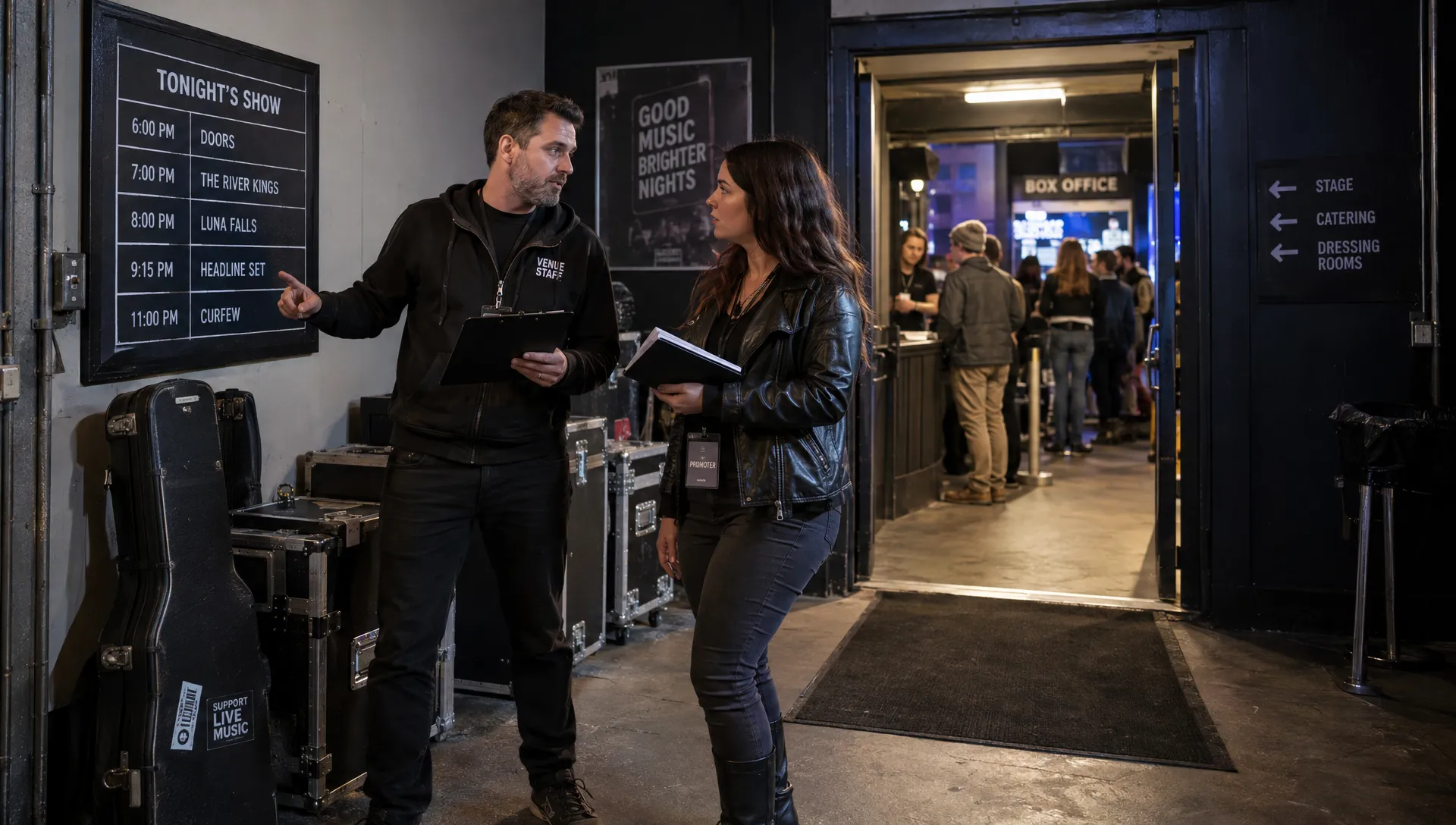
Run a pilot that covers the whole event lifecycle
A polished demonstration cannot show how your two teams will work together. Before committing an entire season, run a limited pilot with a representative event, ideally using the same staff who will manage future shows.
Test the complete journey: event setup, a mobile purchase, confirmation delivery, an inventory adjustment, guest-list preparation and settlement reporting. Where a live refund test would create costs, agree on a controlled test or request a provider-led demonstration.
The most useful pilot for ticket event sites includes exceptions, not just successful purchases. Check how the team handles a misspelled attendee name, a requested refund, a sold-out tier and a last-minute schedule change. Use only the actions the provider actually supports.
Record results in a shared worksheet:
- Buyer journey: Whether the full price, event details and confirmation were clear during the purchase test.
- Operations: Whether staff completed inventory changes and guest-list tasks without unresolved discrepancies.
- Finance: Whether payout timing and the settlement report matched the documented expectations.
- Support: Whether a realistic question received an actionable answer through the support route you would use on event day.
Assign an owner and a resolution date to every failure. Repeat critical tests after changes, rather than treating a promised fix as a passed test.
Evaluate the venue’s existing commitments and your exit route
A preferred platform may still be unsuitable if the venue has an exclusive ticketing agreement. Ask about existing commitments before signing a ticketing contract or announcing where tickets will be sold.
Confirm whether exclusivity covers every event, only certain rooms or only shows promoted by the venue. Also check restrictions on customer fees, branding, box-office sales and the placement of purchase links. Get approval from someone authorized to interpret the venue’s agreement.
Your own exit terms matter too. If you move to another room or end the partnership, establish what happens to events already on sale, remaining balances, refund obligations and access to historical records.
Avoid switching a live event without a migration plan. Previously issued tickets, attendee communications and remaining inventory all need clear ownership.
For organizers recruiting new venue partners, the evaluation meeting is itself worth improving. Explain what the venue should bring, such as its capacity plan and settlement requirements, then offer a straightforward scheduling path. This guidance on helping qualified visitors book a meeting is useful for making partnership inquiries easier to qualify and hand off without an unnecessarily long form.
Where TixFlow fits in the evaluation
TixFlow is worth including when your comparison of ticket event sites emphasizes cash flow, straightforward purchasing and flexible sales setup. Its stated features include instant payouts, flat per-ticket fees, no buyer registration and Stripe Connect integration.
For recurring venue events, unlimited ticket tiers, automated sales phases and smart promo codes can support different on-sale arrangements. Customizable event pages, real-time sales control and digital guest lists are also relevant to the pilot described above.
Evaluate those capabilities against your agreement rather than assuming they resolve every partnership requirement. For example, a flat per-ticket fee does not by itself establish the complete payment-processing cost or refund treatment. Likewise, a digital guest list does not establish support for every check-in or offline scenario.
Ask TixFlow to confirm current fees, payout eligibility and timing, account permissions, reporting and any required fund-distribution workflow. Only count a requirement as satisfied when you have the evidence needed for your event.
Frequently asked questions
Can an organizer use a different platform from the venue’s preferred provider? Possibly, but first check the venue’s contractual commitments and obtain approval. If both platforms remain involved, agree on inventory allocations, reporting and who can stop sales.
Which ticket event sites are best for a revenue-sharing partnership? Prioritize platforms that support your required payout schedule, inventory controls and reporting. The best fit is the one that lets both parties verify the agreed settlement without leaving critical responsibilities unclear.
Does instant payout mean all ticket revenue is immediately spendable? Do not assume so. Confirm eligibility, verification, available balances, possible holds, transfer costs and bank receipt timing. Build the event budget around confirmed access to funds rather than a feature label.
Should the venue receive the full attendee list? Only if that access is appropriate for its role and consistent with the applicable terms, permissions and legal requirements. Define operational access separately from permission to send future marketing.
Make the decision with both partners present
Bring the venue manager and organizer together to approve the scorecard, settlement example and pilot results. Resolve any hard failures before committing additional dates.
If TixFlow matches your shortlist, explore its ticketing platform and use your partnership brief to guide the conversation. A useful evaluation ends with documented responsibilities and tested workflows, not just a favorable demo.