
How Service Fees for Tickets Affect Your Event Revenue
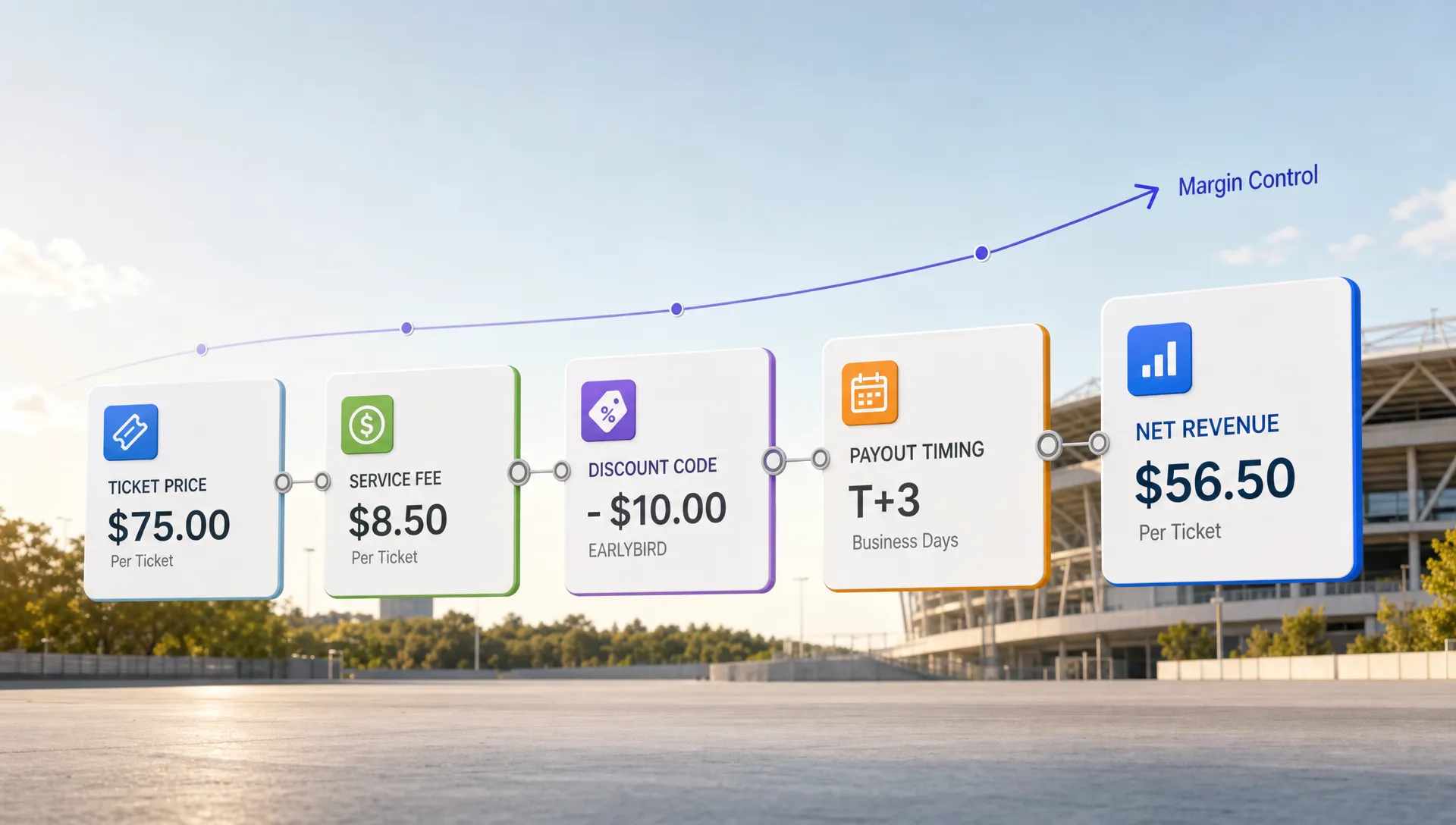
Service fees for tickets can look like a small checkout detail, but they influence almost every part of your event economics: what attendees pay, what you keep, how many people complete checkout, and how much cash you have before doors open.
For organizers, the real question is not simply whether ticket fees are high or low. It is whether the fee structure supports your revenue model. A $2 fee can be harmless on one event and painful on another, depending on ticket price, buyer sensitivity, payout timing, discounts, and the way you present the final price.
If you want healthier margins, you need to understand how ticket service fees move through the full revenue chain.
What service fees for tickets usually cover
A ticket service fee is typically the charge added by a ticketing provider, platform, or organizer to cover the cost of selling and managing tickets. It may help pay for the checkout system, digital ticket delivery, payment infrastructure, fraud prevention, event page hosting, guest list tools, reporting, and support.
That is different from a pure payment processing cost, which is tied to card networks, wallets, and payment providers. In practice, attendees often see both as one extra charge at checkout, while organizers experience them as a direct margin decision.
The exact structure depends on the platform. Some providers use percentage-based fees, some use fixed per-ticket fees, and others combine both. The difference matters because a fee model that looks small on a $25 general admission ticket can become much more expensive on a $150 VIP ticket.
If you are comparing platform charges in detail, this guide to what organizers should really pay for a ticket service charge is a useful companion. Here, we will focus specifically on how those fees affect total event revenue.
Gross sales are not the same as usable revenue
Many event teams plan around gross sales. If you sell 500 tickets at $40, the top-line number looks simple: $20,000. But that is not the amount available for venue rental, artist guarantees, production, security, marketing, insurance, staff, and profit.
Your usable revenue is closer to this formula:
Ticket revenue collected minus platform fees, payment costs, refunds, taxes where applicable, discounts, and event expenses.
Even small service fees can change the outcome when margins are tight. Consider a hypothetical event with 500 tickets sold at a $40 face value.
| Fee approach | Attendee pays | Gross face-value sales | Fee impact | Organizer revenue before event costs |
|---|---|---|---|---|
| Organizer absorbs $2 per ticket | $40 | $20,000 | $1,000 | $19,000 |
| Buyer pays $2 per ticket separately | $42 | $20,000 | Passed to buyer | $20,000 before other costs |
| Organizer absorbs 6% fee | $40 | $20,000 | $1,200 | $18,800 |
| Fee included in a $42 all-in price | $42 | $21,000 | $1,000 | $20,000 before other costs |
These numbers are simplified, but they show the core issue. If your event expenses are $16,000, then absorbing $1,000 in ticket fees reduces profit from $4,000 to $3,000. That is a 25% drop in profit, even though the fee was only $2 per ticket.
This is why service fees for tickets should be modeled before launch, not discovered after sales start.
Service fees affect buyer behavior, not just accounting
Fees do not only reduce organizer revenue. They can also influence whether attendees complete their purchase.
A buyer who sees a $40 ticket on your event page and then a $48 total at checkout may feel misled, even if the fees are standard in the industry. That reaction can lower trust and increase abandonment, especially for price-sensitive events such as local shows, student events, club nights, workshops, and community gatherings.
The more competitive your event category is, the more this matters. If buyers have several similar options on the same weekend, a surprise checkout increase can push them away. Transparent pricing helps reduce that friction.
There are three common ways organizers handle this:
| Fee presentation | How it works | Revenue upside | Risk |
|---|---|---|---|
| Add fees at checkout | Ticket price appears lower at first | Easier to market a lower face value | Buyers may dislike the final total |
| Absorb fees | Buyer sees a cleaner price | Lower friction and simpler messaging | Organizer margin shrinks |
| Use all-in pricing | Fees are built into the advertised price | More transparent and easier to forecast | Sticker price may look higher upfront |
There is no universal best option. A premium conference may be able to show all-in pricing with little resistance. A nightlife event may prefer a lower visible ticket price, as long as checkout stays reasonable. A nonprofit fundraiser may choose to absorb fees to keep the donor experience simple.
The right choice depends on your audience, your ticket price, and your margin target.
Fee structure changes how your revenue scales
Fixed fees and percentage fees behave differently as ticket prices rise.
With a fixed per-ticket fee, the cost per sale is predictable. If the fee is the same on a $25 ticket and a $100 ticket, your effective fee percentage decreases as ticket price increases. That can make VIP tiers, late-bird pricing, and premium packages easier to forecast.
With a percentage-based fee, the platform takes more as the ticket price increases. This may feel fair on low-cost tickets, but it can become expensive for higher-priced experiences, multi-day passes, and bundled packages.
Here is a simple comparison using hypothetical numbers:
| Ticket price | $2 fixed fee as % of price | 6% percentage fee |
|---|---|---|
| $25 | 8% | $1.50 |
| $50 | 4% | $3.00 |
| $100 | 2% | $6.00 |
| $200 | 1% | $12.00 |
For a low-priced event, a small percentage fee may be cheaper than a fixed fee. For a high-priced event, a flat per-ticket fee may protect more revenue. This is one reason organizers should not compare ticketing platforms only by the headline fee. You need to compare the fee against your actual pricing model.
Cash flow timing can be as important as fee size
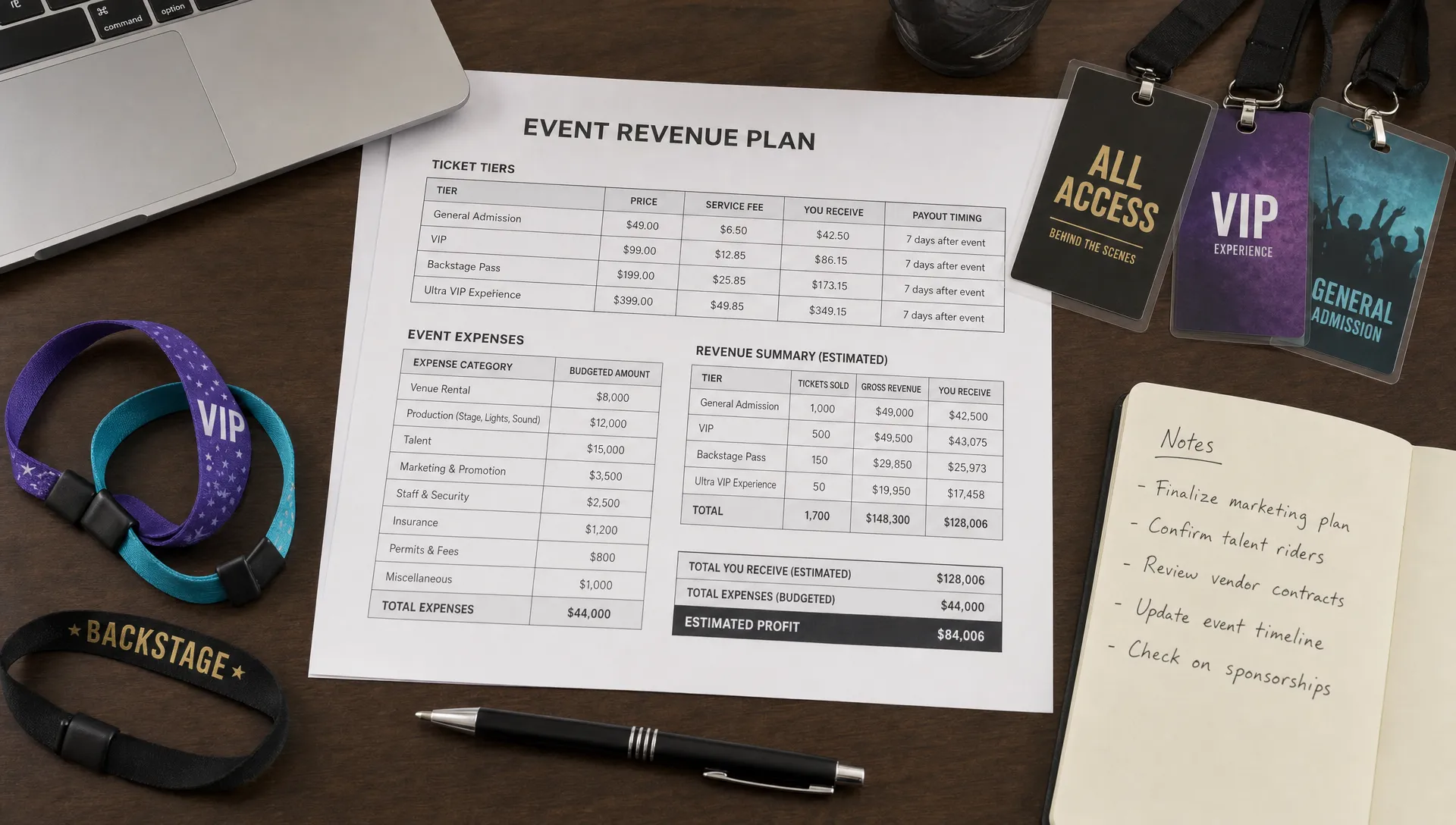
A platform with lower fees is not always better if payouts are slow. Event organizers often need cash before the event happens: deposits, marketing spend, artist advances, equipment rental, hospitality, staffing, and production schedules rarely wait until after the show.
If ticket revenue is held for too long, you may have to cover event costs from savings, credit, or sponsor money. That can limit your ability to promote aggressively during the most important sales window.
Fast access to funds gives organizers more flexibility. You can reinvest early sales into ads, upgrade production, confirm vendors sooner, or reduce personal financial exposure. This is especially important for independent promoters, music producers, pop-up organizers, and small teams running multiple events close together.
That is why fee analysis should include payout timing. A platform that combines predictable fees with faster payouts can be more valuable than a platform that looks cheaper but delays your usable cash.
Discounts and promo codes can multiply fee pressure
Promo codes are useful, but they can quietly amplify the effect of ticket service fees.
Suppose your ticket is $40 and you offer a 20% discount. The buyer pays $32. If you also absorb a $2 service fee, your net before event costs is $30. That is not a 20% revenue reduction. It is a 25% reduction from the original $40 face value.
This gets risky when discounts are used casually. A few influencer codes, partner codes, early access offers, and last-minute promotions can make the average ticket price much lower than expected.
Before launching promo codes, decide what each code is meant to do. A code for sponsors may be worth the margin loss. A code for loyal fans may help fill the room early. A public discount with no clear purpose can train buyers to wait and reduce revenue from people who would have paid full price.
For a broader planning framework, review these event ticket pricing strategies before setting discount rules, tier jumps, or late-sale pricing.
Build fees into your ticket strategy before sales open
The strongest event pricing plans start with net revenue, not face value. Instead of asking what ticket price sounds attractive, start by asking what you need to keep after fees and variable costs.
A practical pre-launch process looks like this:
- Calculate your break-even point: Add fixed costs such as venue, production, guarantees, insurance, staffing, and marketing.
- Estimate variable costs per attendee: Include wristbands, check-in labor, drink tokens, merch bundles, seating, catering, or any item that increases with attendance.
- Model ticket fees by tier: Compare early bird, general admission, VIP, group tickets, and door pricing after platform and payment costs.
- Decide who pays the fee: Choose whether to absorb it, pass it on, or include it in all-in pricing.
- Stress-test lower sales volume: Check what happens if you sell 60%, 75%, or 90% of capacity.
Do not forget non-ticket costs tied to the attendee experience. If your event includes shipped merch, sponsor kits, or VIP gift boxes, even custom cardboard packaging belongs in the same cost model as ticketing fees because it affects the true margin per order.
This kind of planning helps you avoid a common problem: selling a healthy number of tickets but realizing too late that the net revenue is too weak.
When service fees can actually support revenue
It is tempting to see every fee as a loss. But the cheapest checkout is not always the most profitable checkout.
A good ticketing system can reduce operational friction, improve buyer confidence, and give your team better control over sales. If a platform helps buyers complete purchases faster, lets you adjust tiers in real time, supports clear promo code rules, and simplifies guest list management, the fee may pay for itself through higher completion rates and fewer manual tasks.
The key is value per fee. You should be able to answer these questions clearly:
- Does the fee structure make revenue predictable?
- Does the checkout reduce buyer friction?
- Can you control sales phases without manual work?
- Can you access funds when you need them?
- Does the system save staff time before and during the event?
If the answer is yes, the fee is not just a cost. It is part of your revenue infrastructure.
How TixFlow helps organizers keep revenue under control
TixFlow is built for organizers who want a faster, cleaner, and more predictable ticketing workflow. Its flat per-ticket fees help make revenue planning easier, while instant payouts support cash flow when event costs are due before show day.
The platform also removes buyer registration from checkout, which can reduce unnecessary friction for attendees. For organizers, features such as real-time sales control, customizable event pages, unlimited ticket tiers, automated sales phases, smart promo codes, digital guest lists, and Stripe Connect integration help connect pricing strategy with day-to-day operations.
That matters because revenue is not protected by pricing alone. It is protected by the entire path from event page to checkout to payout to door management.
If you are planning an event where margins, speed, and cash flow matter, TixFlow gives you the tools to sell tickets without turning fees into a guessing game.
Frequently Asked Questions
Are service fees for tickets always bad for attendees? Not necessarily. Attendees usually dislike surprise fees, but they are often more accepting when the total price is clear and the checkout experience is fast. Transparency matters more than whether a fee exists.
Should organizers absorb ticket service fees? Absorbing fees can create a cleaner buyer experience, but it reduces your margin. It works best when your ticket price already includes enough room to cover fees or when buyer trust is more important than maximizing per-ticket net revenue.
Is all-in pricing better than adding fees at checkout? All-in pricing can improve trust because buyers see the real total earlier. The tradeoff is that the advertised price may look higher than competing events that show fees later. Test based on your audience and event type.
How do service fees affect small events differently? Small events usually have less margin for error. A few hundred dollars in absorbed fees can remove a large share of profit, especially when venue, production, and marketing costs are fixed.
What is the best way to protect event revenue from fees? Start with your required net revenue, model fees across every ticket tier, avoid uncontrolled discounts, and choose a ticketing platform with predictable costs and payout timing that supports your cash flow.
Turn ticket fees into a revenue decision, not a surprise
Service fees for tickets affect more than the checkout total. They shape buyer trust, conversion, pricing flexibility, profit margin, and pre-event cash flow.
The organizers who handle fees best do not wait until after launch. They model net revenue in advance, choose a fee presentation strategy that fits their audience, and use ticketing tools that make sales easier to control.
With predictable pricing, instant payouts, flexible ticket tiers, smart promo codes, and a friction-light checkout, TixFlow helps event teams protect revenue from the first sale to the final scan at the door.