

Choosing the Best Site to Sell Tickets for a Workshop Event
Searching for the “best site to sell tickets for event” can lead you to concert marketplaces, resale sites and registration tools that solve very different problems. For a workshop, your priority is simpler: sell the right number of places, collect enough money to prepare and give participants clear instructions before they arrive.
For a single-date workshop, prioritize controlled capacity, transparent total fees, suitable payout timing and a short mobile checkout. If you need recurring cohorts, lesson content or attendance tracking across several weeks, compare course-management tools as well.
Start with the workshop you need to run
A 24-person ceramics class has different requirements from an online production masterclass or a corporate training session. Before comparing platforms, write down your teaching capacity, minimum viable attendance, purchasing deadlines and registration requirements.
Capacity should reflect the tightest constraint. A room might hold 40 people, but if you have 12 workstations and participants need individual equipment, you may only have 12 sellable places. Include assistants, accessibility requirements and safe movement around the room when planning the setup.
Also distinguish selling admission to your own workshop from reselling a ticket you already purchased. Organizer platforms create and manage your event inventory. Resale marketplaces handle existing tickets and may impose restrictions that make them unsuitable for launching a class.
What “best site to sell tickets for event” means for workshops
The right category of platform depends on what participants are buying. Start with the operational requirement, then assess individual providers.
| Workshop format | Platform category to evaluate | What to verify before choosing |
|---|---|---|
| One-off, in-person class | Event ticketing platform | Capacity controls, ticket types, payouts and guest lists |
| Multiweek course | Course or class-management system | Enrollment across sessions, attendance records and participant communications |
| Workshop with assigned workstations | Ticketing or booking system with allocation tools | Whether buyers can select a specific seat or station |
| Live online workshop | Event registration platform or webinar registration tool | Access delivery, joining instructions and handling of multiple attendees |
| Private team workshop | Booking or invoicing workflow | Group purchasing, invoice requirements and named attendee collection |
A feature-rich system is not automatically better. You should not need a course portal to sell a two-hour candle-making class. Conversely, a simple ticket page may leave you doing substantial manual work for an eight-week program.
If several categories appear suitable, use this comparison of ticketing options for independent organizers to build a shortlist. Then test each candidate against your actual workshop rather than a generic feature checklist.
Protect capacity across every ticket tier
Early-bird, standard and bring-a-friend tickets can help fill a workshop, but they introduce inventory risks. The best site to sell tickets for an event should make it clear how each purchase affects your remaining teaching capacity.
For a 24-place workshop, an early-bird allocation of eight places should leave no more than 16 places available elsewhere. If a platform supports shared event capacity, verify how ticket tiers draw from it. If it does not, make sure the individual allocations cannot exceed your total.
Pay particular attention to group offers. A two-person ticket must reserve two participant places, not simply count as one order. Likewise, a materials upgrade should not consume an additional seat unless it actually includes another admission.
Test inventory behavior before publishing. Place sample orders across different tiers and check the remaining availability. Confirm what happens after a cancellation, refund or ticket change rather than assuming the place automatically returns to sale.
Selling through several websites can create another source of overselling. Unless capacity is reliably synchronized, one checkout is easier to control. Our guide to selling tickets on multiple sites explains the trade-offs if you are considering additional channels.
Calculate your margin per participant
A low advertised fee is only useful if the whole transaction remains economical. Compare platform charges, payment processing, optional services and any costs associated with refunds or payouts. Establish which fees you absorb and what the participant sees at checkout.
For a workshop, the best site to sell tickets for an event should support a workable margin after materials and teaching costs, not just offer an attractive headline rate.
Consider this hypothetical budget, not a quote from any provider:
| Budget item | Example amount |
|---|---|
| Ticket price | $95 |
| Materials per paid participant | $20 |
| Assumed combined transaction cost per ticket | $5 |
| Contribution toward fixed costs per participant | $70 |
| Fixed venue and instructor costs | $900 |
| Workshop capacity | 24 participants |
The contribution is $95 minus $20 minus $5, or $70. Dividing $900 by $70 gives a break-even requirement of 13 paid participants, rounded up. At 24 paid places, the example leaves $780 after the listed expenses, before taxes and any additional costs.
This calculation assumes materials are purchased only for paid attendees. If you must buy 24 nonreturnable kits in advance, treat that committed purchase differently when assessing cancellation risk.
Run the same calculation for discount codes and early-bird prices. A promotion that fills the room can still leave too little money to pay the instructor.
Match payouts to purchasing deadlines
Profitability and available cash are separate questions. You might have enough bookings to cover the workshop while the proceeds remain unavailable for a venue deposit or materials order.
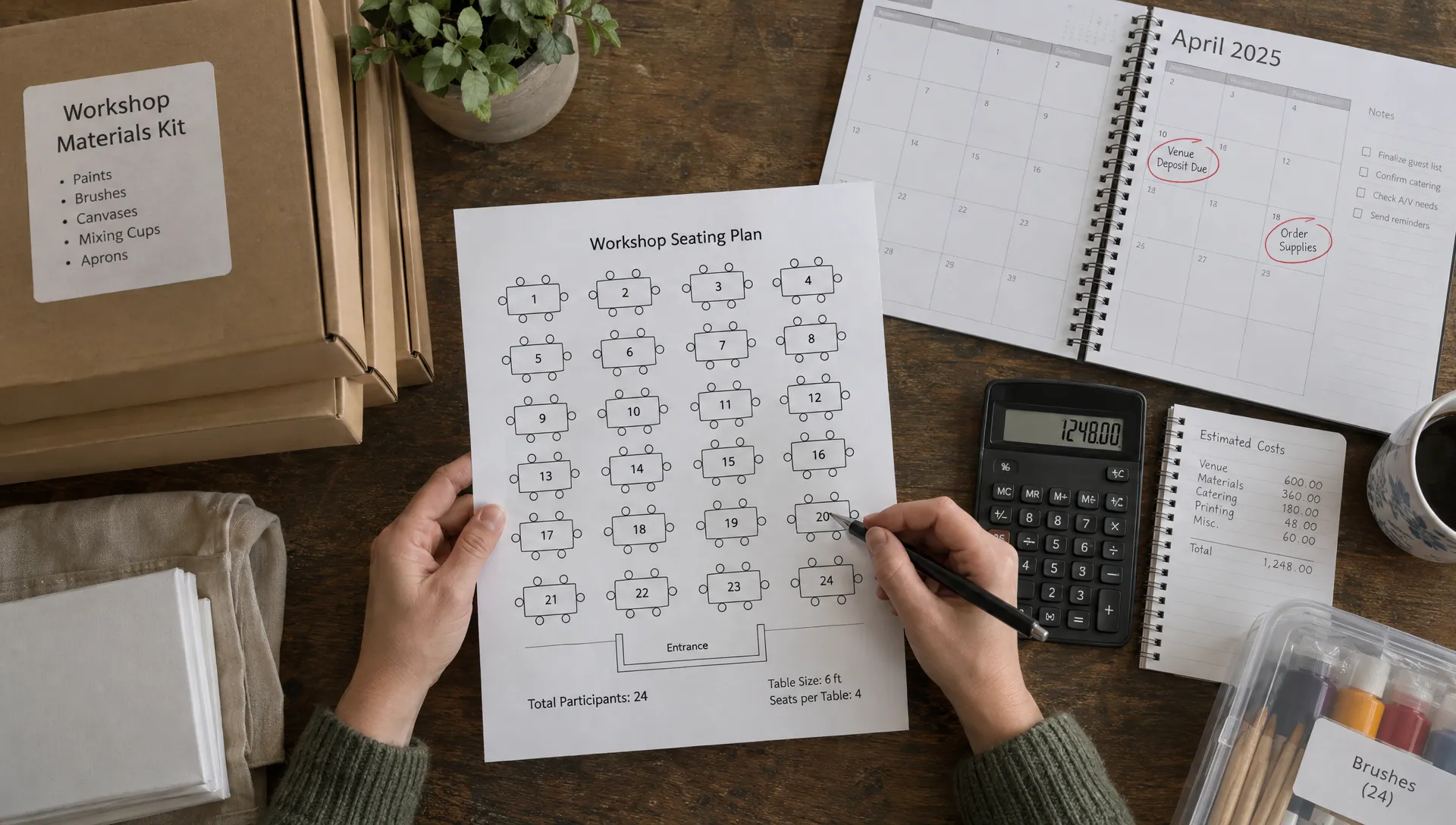
Suppose $600 of your venue cost is due two weeks before the class and 24 materials kits cost another $480. You need access to $1,080 before the event, even if the workshop is profitable on paper.
The best site to sell tickets for an event should therefore fit your purchasing calendar. Ask when proceeds become eligible for payout, when a payout can be initiated and when the money should reach your bank. Those are not necessarily the same moment.
Payment processors can apply settlement periods, initial payout delays or other restrictions. Stripe’s payout documentation explains how payout schedules and settlement timing differ, which matters when evaluating platforms connected to Stripe.
Before committing, confirm whether account verification, reserves, payout charges or refund obligations could affect access to funds. Avoid planning essential spending around an unverified promise of immediate availability.
Keep a separate refund buffer, too. Receiving funds early does not remove the obligation to return money when your published policy or applicable law requires it.
Test checkout and participant instructions on a phone
Many workshop customers arrive from a social post, instructor newsletter or community message. Their first purchase attempt may happen on a phone between other tasks. Test that experience yourself.
The best site to sell tickets for an event should let participants understand the offer and complete payment without unnecessary steps. Requiring a new account can add friction, but removing registration should not mean removing essential order details.
Make the event page answer practical questions before checkout:
- Who is it for? State the experience level, prerequisites and any age restrictions.
- What is included? Explain materials, equipment use, take-home items and refreshments where applicable.
- What should participants bring? Specify clothing, laptops, software or protective equipment as relevant.
- What happens if plans change? State cancellation, substitution and organizer-cancellation terms clearly.
Keep required questions limited to information you genuinely need. If dietary, accessibility or equipment information must be collected separately, explain that process and handle sensitive details appropriately.
Check the distinction between buyer and attendee. Someone purchasing four places may not be attending. Verify whether you can identify each participant and communicate preparation instructions without relying entirely on the purchaser to forward them.
Where TixFlow fits a workshop launch
TixFlow is worth evaluating for a standalone workshop when your priorities are straightforward ticket sales, pricing flexibility and control over sales activity.
Its stated features include no buyer registration, flat per-ticket fees, customizable event pages and unlimited ticket tiers. Automated sales phases can support a planned move from early-bird to standard pricing, while smart promo codes provide another way to structure offers. Digital guest lists support checking who is expected at the workshop.
For organizers comparing the best site to sell tickets for an event, TixFlow also offers instant payouts and Stripe Connect integration. Confirm the conditions that apply to your account, including eligibility, settlement timing and any relevant charges, before matching payouts to supplier deadlines.
The workshop-specific checks still matter. Unlimited ticket tiers do not, by themselves, confirm shared capacity across tiers. Digital guest lists do not establish that a platform supports assigned workstations, multi-session attendance or specialized registration forms. Ask about those capabilities if your class depends on them.
If you need a standard admission flow with different price phases, TixFlow belongs on your shortlist. If your operation depends on recurring enrollment or allocated equipment stations, verify those requirements before deciding whether a ticketing platform alone is sufficient.
Set a minimum-enrollment decision date
A workshop can require a go-or-cancel decision before ticket sales naturally slow down. Set that date around your nonrefundable commitments, not simply the morning of the event.
In the example budget, 13 paid participants cover the listed costs. You might need to confirm the venue before reaching that number, so decide in advance how much financial exposure you can accept. Check the actual cancellation terms for the room, instructor and suppliers.
Record your capacity limit, minimum enrollment, final materials-order date and refund procedure in one operating plan. A clear plan makes the best site to sell tickets for an event useful in practice: sales information becomes a basis for decisions rather than just a running total.
Before launch, complete a test purchase and check the confirmation, guest-list entry and refund workflow. If a process requires manual work, assign an owner so it does not get missed on event day.
Frequently asked questions
Should I use a resale site to sell tickets to my own workshop? Usually not. You need an organizer platform that creates admission inventory, processes new registrations and gives you access to attendee information. Resale sites primarily handle tickets that have already been issued.
Can early-bird and standard tickets share the same capacity? Some platforms support shared capacity, but you should verify the specific setup. If each tier has its own allocation, make sure the combined total cannot exceed your workshop limit.
Should materials be included in the ticket price? Include mandatory materials in the price or disclose the required charge prominently before purchase. Optional upgrades can be separate, provided participants understand what the base ticket includes. Check applicable pricing disclosure requirements.
Do I need reserved seating for a workshop? Not necessarily. General admission can work when all places are equivalent. If participants must select a pottery wheel, computer station or accessible workspace, verify allocation capabilities or establish a clear manual assignment process.
Can I rely on ticket revenue to buy supplies? Only after confirming when funds will actually be available. Account verification, settlement periods and payout conditions can affect timing. Keep enough flexibility to cover essential purchases and potential refunds.
Choose around your next workshop
The best site to sell tickets for an event is the one that fits your capacity, margin and preparation schedule without complicating registration. Start with those requirements, then test the buying and administration workflows.
Explore TixFlow’s ticketing platform against your workshop plan, paying particular attention to ticket allocations, checkout, total costs and payout conditions before opening sales.