
How Ticket Purchasing Websites Impact Event Sales
Event organizers often think of ticket purchasing websites as simple infrastructure: publish an event, collect payments, send tickets. In practice, they are one of the strongest sales levers you control.
Every ad, email, social post, sponsor mention, and word-of-mouth referral eventually sends a buyer to the same place. If that purchase path feels fast, trustworthy, and easy, more people complete the transaction. If it feels slow, unclear, or expensive at the last step, interested visitors hesitate, abandon, or decide to come back later.
That is why the impact of ticket purchasing websites goes far beyond payment processing. The right platform can improve conversion rates, protect margins, increase urgency, simplify operations, and help organizers make better decisions while sales are still happening.
The ticketing page is where interest becomes revenue
Most event marketing creates intent. A strong lineup, a compelling speaker, a limited-capacity venue, or a well-timed announcement can get people interested. But interest is not revenue until someone buys.
The ticket purchasing website is the bridge between those two moments. It has to answer a buyer’s practical questions quickly: What is included? How much does it cost? Can I trust this page? How long will checkout take? Will I get my ticket instantly? Are there extra fees?
For organizers, that means the ticketing experience should be treated as part of the sales strategy, not as an administrative afterthought. A good event page reduces doubt. A good checkout reduces delay. A good pricing setup gives buyers a reason to act now.
Small improvements matter because event sales are time-sensitive. Unlike ecommerce products that can be sold all year, most events have a hard deadline. When a visitor abandons checkout two days before the event, there may not be enough time to win them back.
Checkout friction directly lowers completed purchases
The most obvious way ticket purchasing websites impact event sales is checkout friction. Every extra step gives the buyer another chance to pause.
Common friction points include mandatory account creation, too many form fields, unclear totals, slow mobile pages, confusing ticket tiers, and payment screens that do not feel secure. None of these problems usually feel dramatic in isolation. Together, they can turn a warm buyer into a lost sale.
Guest checkout is especially important for events. Many buyers are making a one-time purchase. They may not want another account, password, or profile just to attend a concert, class, pop-up, workshop, fundraiser, or conference. If the buyer is on mobile, standing in line, responding to a friend’s message, or buying after seeing an Instagram story, the tolerance for friction is even lower.
That is why organizers should pay close attention to whether their ticketing system supports a fast purchase flow without forcing registration. TixFlow’s guide on why forcing sign-up can hurt ticket sales explains this conversion problem in more depth.
A low-friction checkout does not mean collecting no information at all. It means collecting only what is necessary to complete the purchase, issue the ticket, and run the event smoothly. For many events, that can be as simple as name, email, ticket selection, and payment.
Trust determines whether buyers feel safe paying
Ticket buyers are not just evaluating your event. They are also evaluating the page that asks for their money.
Trust signals can have a major impact on event sales, especially for new organizers, independent venues, pop-up experiences, and first-time conferences. If a buyer lands on a page that looks generic, outdated, inconsistent with your brand, or unclear about policies, they may wonder whether the event is legitimate.
A trustworthy ticket purchasing website should make key details easy to find. The event name, date, time, venue, ticket types, refund policy, organizer identity, and checkout total should be clear before payment. Buyers should not need to search through multiple tabs or guess what happens after purchase.
Brand consistency also matters. If someone clicks from your website, newsletter, or social profile and lands on a checkout page that feels completely disconnected, trust can drop. This is one reason customizable event pages are more than a design feature. They help keep the buyer inside a familiar experience.
Security expectations are also higher in 2026. Buyers are used to smooth payment experiences, instant confirmations, and mobile-friendly checkout. A ticketing website that looks behind the times can quietly make buyers less confident, even if the event itself is excellent.
Pricing flexibility shapes urgency and order value
Ticket purchasing websites also impact sales through pricing structure. A flat general admission ticket can work for simple events, but many organizers need more flexibility to match different buyer motivations.
Early-bird tickets reward fast action. VIP tiers increase average order value for buyers who want a premium experience. Group tickets encourage friends or teams to buy together. Limited releases create urgency. Last-minute pricing can help protect margins when demand is strong.
The platform matters because these strategies are hard to manage manually. If an organizer has to constantly edit prices, close old tiers, open new tiers, and track promo codes in spreadsheets, mistakes become more likely. Automated sales phases, unlimited ticket tiers, and smart promo codes make pricing strategy easier to execute.
Urgency should be real, not manipulative. If capacity is limited, if early pricing ends on a specific date, or if a certain ticket tier includes a genuine benefit, the ticketing page should communicate that clearly. Buyers are more likely to act when they understand both the value and the deadline.
The result is not just more sales. It is better-timed sales. When more people buy earlier, organizers get clearer demand signals, stronger cash flow, and more confidence when making production, staffing, and marketing decisions.
Real-time control helps organizers adjust while sales are live
Events rarely sell in a perfectly predictable line. Sales may spike after a speaker announcement, slow during a holiday weekend, jump after a partner email, or stall when ticket prices change.
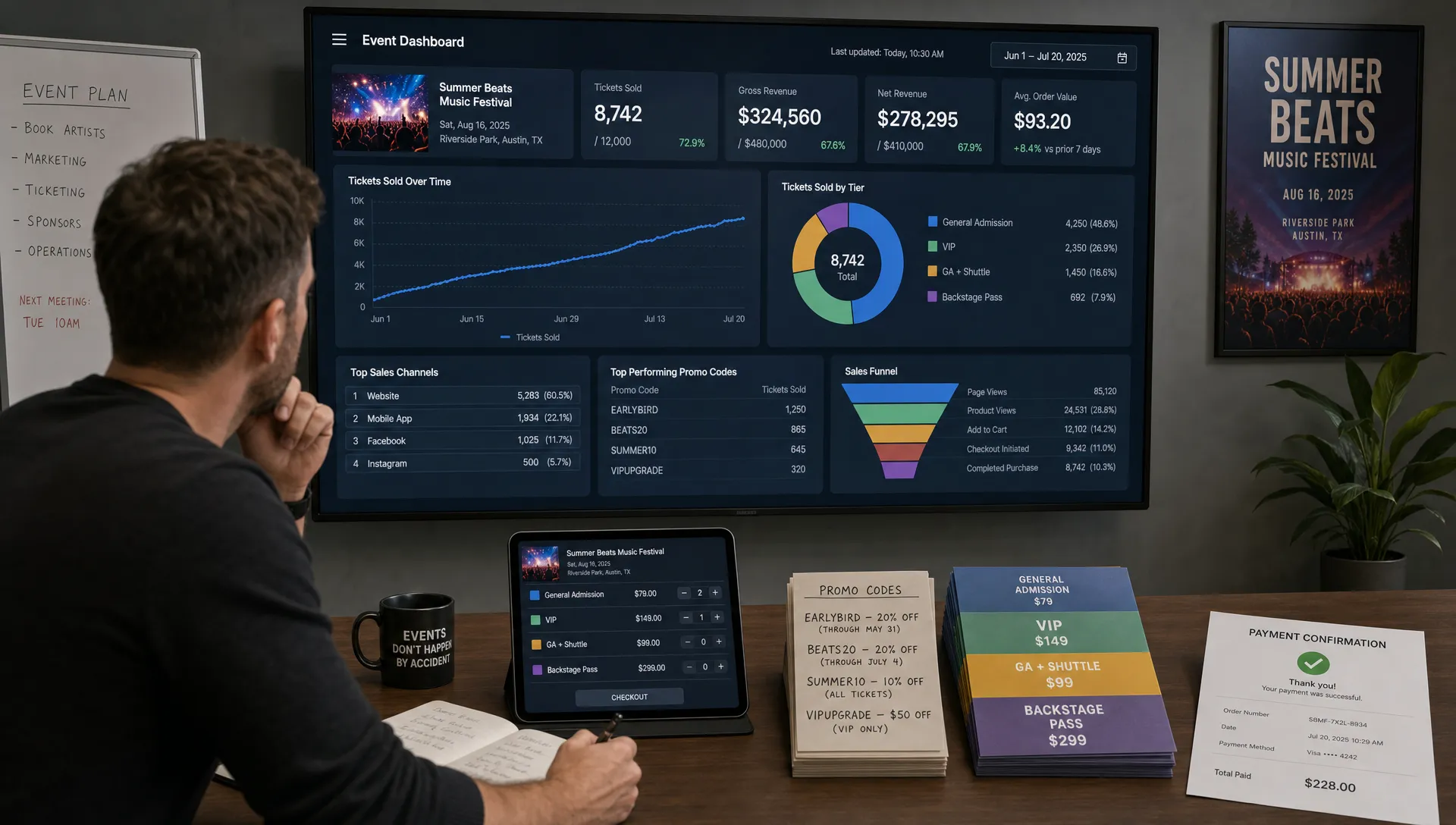
A ticket purchasing website with real-time control helps organizers respond while there is still time. If a tier sells faster than expected, you may need to open the next tier. If a promo code is underperforming, you may need to change the campaign. If a sponsor pushes a large audience, you need confidence that inventory and checkout can handle it.
Without real-time visibility, organizers often rely on delayed reports or manual exports. That slows decision-making and can hide problems until the window to fix them has passed.
| Sales lever | How the ticketing website affects it | Why it matters |
|---|---|---|
| Checkout conversion | Reduces steps, avoids forced registration, and supports fast payment | More interested visitors become buyers |
| Buyer trust | Shows clear event details, secure checkout, and consistent branding | Fewer buyers hesitate before paying |
| Pricing strategy | Supports tiers, phases, limited releases, and promo codes | Organizers can create urgency and protect margins |
| Marketing ROI | Tracks campaign demand and code performance | Ad spend and partner campaigns become easier to evaluate |
| Cash flow | Controls fees and payout timing | Organizers can fund event costs sooner |
| Entry operations | Connects digital tickets to guest lists and check-in | A smoother event day improves attendee satisfaction |
Fees and payout timing affect real revenue
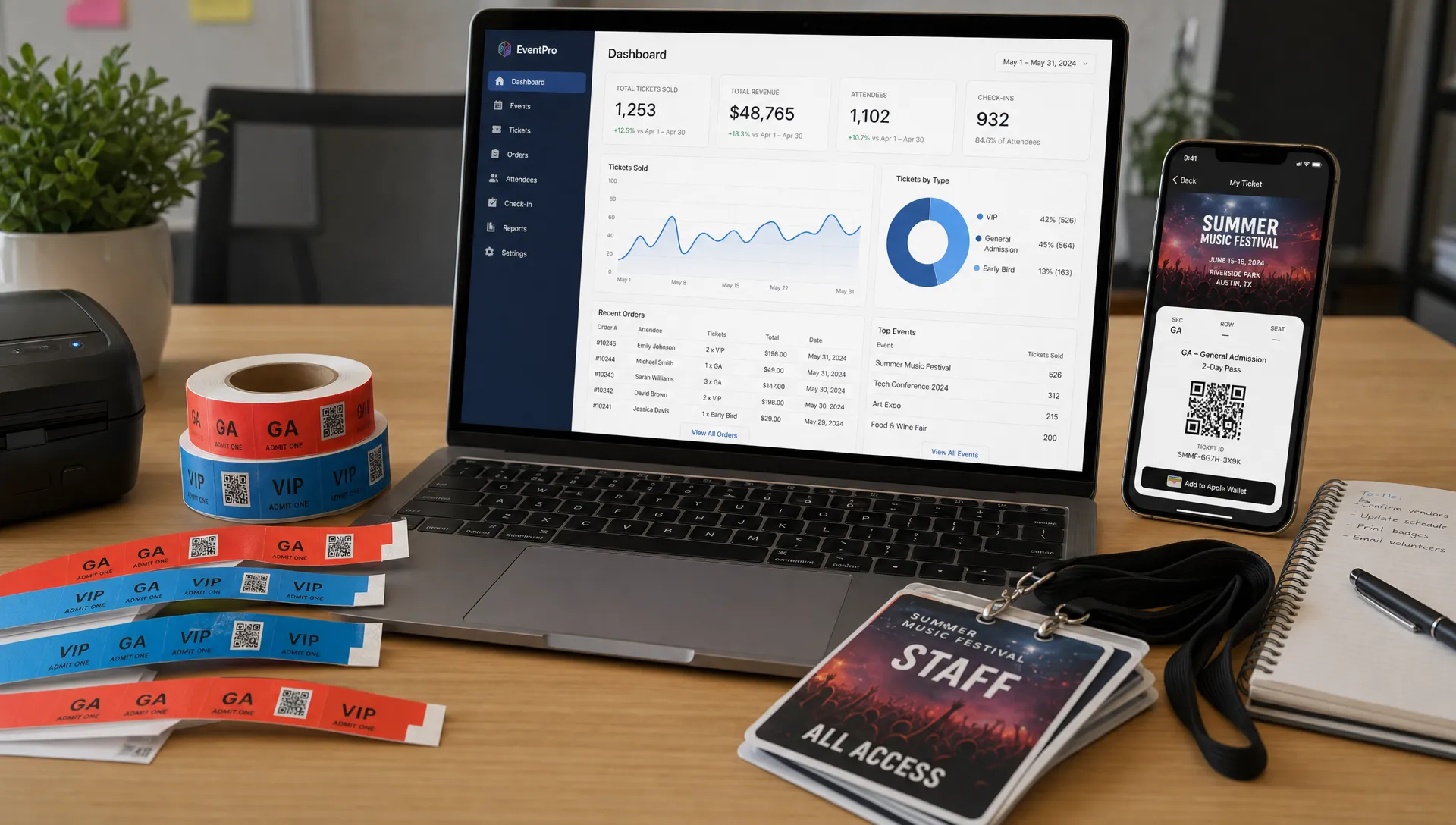
Gross ticket sales can look strong while net revenue tells a different story. Fees, payout delays, refunds, chargebacks, and absorbed costs all influence how much money the organizer can actually use.
This is where ticket purchasing websites can have a direct impact on profitability. If fees are unclear, buyers may abandon checkout when the final total appears. If organizers absorb too much of the fee structure, the event may sell well but still underperform financially. If payouts take too long, organizers may have to cover deposits, production costs, staffing, and vendor payments from other cash reserves.
Flat per-ticket fees can make revenue easier to forecast because organizers understand the cost per sale in advance. Instant payouts can also reduce operational pressure, especially for small and mid-sized events that need cash flow before event day.
The key is to evaluate ticketing costs as part of the full event model, not just as a software expense. A platform with a lower headline fee is not always better if it creates more abandonment, limits pricing options, or delays access to funds. For a deeper revenue perspective, see TixFlow’s article on how ticket fees change event revenue.
The ticketing experience changes marketing performance
Marketing teams often focus on traffic: more clicks, more impressions, more email opens, more social engagement. But ticket sales depend on what happens after the click.
If your checkout converts poorly, every marketing channel becomes more expensive. Paid ads need more budget to produce the same number of buyers. Influencer campaigns look weaker than they really are. Sponsor promotions underperform. Email campaigns generate interest but not enough completed orders.
A strong ticket purchasing website improves the return on all of those efforts because it captures more of the demand you already created. This is especially important for events with multiple acquisition channels, such as paid social, email lists, partners, affiliates, ambassadors, sponsors, and community groups.
For conferences, trade events, and agency-led workshops, organizers may also pair ticketing with outbound support from B2B customer acquisition partners such as DirectB2BLeads to keep the sales pipeline full. In that case, the ticketing page needs to support the sales motion by making registration clear, professional, and fast once a qualified prospect is ready to buy.
Promo codes can also connect marketing to revenue. A smart promo code setup helps organizers see which partners, communities, or campaigns are driving actual ticket purchases rather than just awareness. That makes it easier to double down on what works before the sales window closes.
Post-purchase experience influences attendance and repeat sales
The impact of a ticket purchasing website does not stop when payment is complete. The post-purchase experience shapes how confident attendees feel before the event and how smoothly they enter on event day.
Buyers expect immediate confirmation, clear ticket delivery, and easy access to their tickets from a phone. If they have to dig through emails, create an account, download an unfamiliar app, or contact support to find their ticket, the experience becomes stressful before the event even begins.
For organizers, the post-purchase flow affects support volume and check-in speed. Digital guest lists, accurate attendee records, and easy ticket validation help teams move people through the door faster. That matters because entry is part of the attendee experience. A slow or disorganized check-in can make a great event feel poorly run.
A smooth post-purchase process also supports future sales. Attendees who had an easy buying and entry experience are more likely to trust the organizer next time. That trust compounds across recurring events, seasonal programs, tours, workshops, and community gatherings.
What organizers should look for in ticket purchasing websites
Not every organizer needs a complex enterprise ticketing stack. But every organizer should expect the fundamentals that protect sales and reduce operational stress.
The most important features are the ones that remove friction for buyers and give control back to the event team. When comparing platforms, look past the surface-level event page and test the full buyer journey from discovery to checkout to confirmation.
Useful capabilities include:
- Fast mobile checkout with no unnecessary steps
- No mandatory buyer registration for simple purchases
- Transparent fee handling and predictable per-ticket costs
- Flexible ticket tiers for early-bird, general, VIP, group, and limited-capacity offers
- Automated sales phases that open and close ticket types on schedule
- Smart promo codes for partners, campaigns, and special audiences
- Customizable event pages that match the organizer’s brand
- Real-time sales control for active inventory and pricing decisions
- Digital guest lists that simplify check-in and attendee management
- Reliable payment infrastructure, including Stripe Connect integration when needed
TixFlow is built around these organizer priorities, including instant payouts, low fees, no buyer registration, flexible pricing, real-time sales control, customizable checkout, and digital guest lists. The goal is simple: reduce friction for attendees while making event operations easier for the team behind the event.
How to measure whether your ticketing website is helping sales
The best way to evaluate a ticket purchasing website is to measure its effect on the sales funnel. Do not rely only on total revenue, since revenue can rise or fall for reasons unrelated to the platform, such as lineup strength, seasonality, audience size, or marketing budget.
Instead, track the points where the website has the most influence. Start with the number of event page visitors, checkout starts, completed purchases, average order value, promo code usage, refund requests, support messages, and check-in performance.
| Metric | What it reveals | What to improve if it is weak |
|---|---|---|
| Event page conversion rate | Whether visitors understand the offer and feel ready to buy | Page clarity, ticket descriptions, trust signals, and pricing layout |
| Checkout completion rate | Whether buyers are dropping during payment | Guest checkout, form length, payment options, and fee transparency |
| Average order value | Whether pricing tiers and group options are working | Tier structure, bundles, VIP offers, and group incentives |
| Promo code revenue | Which campaigns create actual buyers | Partner strategy, code naming, campaign timing, and audience targeting |
| Support requests per order | Whether buyers are confused before or after purchase | Confirmation emails, ticket delivery, event details, and refund information |
| Check-in time | Whether ticket delivery and guest lists work on event day | Digital tickets, staff workflows, scanning process, and list accuracy |
These numbers help organizers separate marketing problems from ticketing problems. If traffic is low, the issue may be promotion. If traffic is strong but checkout completion is weak, the ticket purchasing website may be costing sales.
Frequently Asked Questions
What are ticket purchasing websites? Ticket purchasing websites are platforms or event pages where attendees select tickets, pay online, and receive confirmation or digital tickets. For organizers, they also manage pricing, inventory, attendee data, payouts, and entry workflows.
How do ticket purchasing websites increase event sales? They increase sales by reducing checkout friction, building buyer trust, supporting better pricing strategies, tracking campaigns, and helping organizers adjust sales settings in real time.
Does guest checkout really matter for event ticketing? Yes. Many event buyers are making a quick or one-time purchase. Requiring account creation can interrupt that momentum and reduce completed sales, especially on mobile.
Which ticketing features matter most for small events? Small events usually benefit most from simple setup, clear fees, flexible ticket tiers, promo codes, guest checkout, fast payouts, customizable pages, and easy digital guest lists.
How do ticketing fees affect event revenue? Ticketing fees affect both buyer behavior and organizer margins. Surprise fees can reduce checkout completion, while absorbed fees can lower net revenue. Predictable fees make pricing and profit planning easier.
When should an organizer switch ticketing platforms? Consider switching if buyers complain about checkout, sales reports are delayed, payouts are slow, fees are hard to predict, ticket tiers are difficult to manage, or your team spends too much time fixing manual ticketing issues.
Make the buying path as strong as the event itself
Your event can have the right audience, the right offer, and the right marketing, but the ticket purchasing website still determines how easily interest becomes revenue.
A better ticketing experience helps buyers act faster, helps organizers protect margins, and gives event teams more control before, during, and after the sale. If you want a modern platform built for fast checkout, instant payouts, low fees, flexible pricing, and real-time event control, explore TixFlow.